
Chapter 1
Hands of fate destiny unfolding
The school bell rang, but Silus barely heard it.
Hindembar High buzzed with the usual after-school chaos—students cheering, running to their parents, laughing too loudly, filled with the energy of youth. Teachers stood near the gates, giving gentle goodbyes to their students, reminding them to stay safe, do their homework, and get some rest.
Silus Mikana heard none of it.
The 15 year old stepped out of the building, barely acknowledging the crowd, peeling off his stiff school shirt, revealing his streetwear underneath. He shoved the uniform deep into his bag, letting out a breath that carried the weight of everything unspoken.
The moment his feet hit the pavement, the world narrowed.
People moved around him, passerbyers happily engaged in their lives, unaware—or perhaps, intentionally ignorant—of the sorrow in his stride.
He knew it was coming.
The usual judgmental comments whispered in passing:
"Hey, kid, lighten up—life ain't that bad."
"Geez, stop looking so miserable—people got it worse, you know!"
Silus didn't react.
What was there to say?
No one cared about the truth behind his sadness. No one wanted to understand—they just wanted to feel better about themselves by dismissing it.
His shoulders tightened.
And the memories came.
The news reports. The blurred footage of the collapsing Krane—the scaffolding that had taken everything, crushing the lives of innocents, including the only people that mattered to him.
And then, the face of Mr. Nathaniel Hoddinger—the business tycoon responsible for overseeing that project, standing before cameras at a press conference.
Silus could still hear his voice, crisp and carefully rehearsed, weaving an illusion of corporate remorse:
"We deeply mourn the victims of this tragic accident. We are committed to supporting the affected families with full compensation and assistance—no one will be forgotten."
Lies.
None of it came.
The families who lost everything were given promises on paper, empty words wrapped in legal jargon, with claims buried under bureaucracy so deep they were never meant to be processed.
Silus had seen the grieving families struggle, begging for the support they were assured they would receive—only to be met with ignored phone calls, delayed responses, and rejection letters full of corporate nonsense.
And him?
He had nothing.
A child who had lost his entire world, left to wander through life like a phantom, unnoticed, unimportant to the system that had wronged him.
His fists clenched.
His walk quickened, shoes hitting the pavement harder, pushing through the fog of his memories, forcing himself forward, despite the overwhelming despair clawing at his chest.
By the time he reached the cemetery, night had fallen.
The world was quieter here. The air was cool, the faint scent of damp stone and earth lingering.
His parents’ names were etched into the tombstone, still clear despite time’s attempt to wear them down.
He stared at them.
His eyes burned.
But he didn’t cry.
He couldn’t cry anymore.
The cemetery was quiet.
But Silus’s mind was anything but.
He stood before the cold stone markers of Harmon and Arlia Mikana, the names of his parents etched deep in the weathered slabs, surrounded by dirt, damp grass, and the hollow absence that had defined his life since that day.
His fists clenched, his jaw tightened, his breath shaky—but he spoke anyway.
Because who else would listen?
“You planned that day for me.”
His voice was sharp, bitter.
“You were supposed to spend time with your son—you wanted to take me out for once, not be stuck working—JUST ONE DAY.”
His nails dug into his palms as he exhaled sharply, trying to rein in the frustration festering inside him.
“And what happened? What happened? They DROPPED the scaffolding. They didn’t check their equipment. They didn’t CARE. And now you’re both gone—because of incompetence. Because of greedy, lazy, careless people who couldn’t even do their damn jobs right.”
The wind stirred.
Silus barely noticed.
His emotions had nowhere else to go.
The world hadn’t given him an outlet. It hadn’t given him justice. It had only given him empty words, false promises, bureaucratic nonsense wrapped in pretty paper meant to silence grief rather than fix what was broken.
Hoddinger stood up there and lied to everyone. He promised help—he promised ‘compensation’—but do you know what happened?”
His laughter was hollow, sharp, bitter.
“Nothing. NOTHING! He sat there and let families drown in the mess HIS company made, let them suffer, let them beg for help they would never get! And what did anyone do?”
His voice rose.
“NOTHING! Not a DAMN THING! People lost their parents, their siblings, their loved ones—and Hoddinger just kept moving forward like it was some PR hiccup!”
His vision blurred, though whether it was from rage or sorrow, he didn’t know anymore.
His fingers touched the stone, tracing the names as if they could still feel him.
“I hate them. I hate this city. I hate this LIFE. I hate that everyone else just… keeps moving on like it didn’t happen.”
Silence.
Heavy.
Unforgiving.
He let out a long breath, shaking his head.
“I don’t know if you can hear me,” he murmured, voice raw now, anger fading into exhaustion. “But I miss you. Every damn day, I miss you.”
And still, he spoke—because even if the world had stopped listening, they never would.
He eventually fell silent Instead, he let the silence consume him, let the wind carry the weight of his emotions—because he didn’t know how to let them go otherwise.
And then—
The presence.
Someone was there.
Watching.
Waiting.
standing among the graves, was a man in a suit—still, composed, his hands resting idly in his pockets, as if he belonged to the very shadows around him.
The man stood among the graves, unmoving, watching.
A cigarette hung loosely from his lips, ember faintly glowing in the dim light, the smoke curling up toward the sky in slow, lazy tendrils. He didn’t blink. He barely breathed. He simply observed—studying the boy before him with the kind of sharp calculation reserved for experiments rather than people.
Silus was venting now—grief, rage, pure, unfiltered bitterness spilling into the night, his words drenched in anger so deep it threatened to drown him.
Good.
That’s what the man needed to see.
He exhaled slowly, dragging the cigarette from his mouth, flicking the ash aside with a casual precision.
This one—this boy fit the criteria well.
He’d been shattered in all the ways that mattered. The kind of loss that wasn’t clean, that didn’t come with a sense of closure or relief—only rage and resentment, an unresolved scream trapped in his chest, clawing for a purpose it would never find.
And this—this was exactly why Silus was the perfect recipient.
Because he wouldn’t break further.
He was already broken.
This was not about kindness. Not about salvation.
This was about a burden, one that needed a host with enough rage to keep it alive. Someone angry enough to accept it without questioning, someone who wouldn’t crumble under the weight.
The man took another slow drag, studying the way Silus clenched his fists, the way he let his grief spill without shame, without hesitation.
Yes. This boy would do just fine. The man had been watching Silus long before tonight.
Long before the boy ever set foot in the cemetery.
It had started years ago—when tragedy struck, when the scaffolding stole everything from him. That was the moment Silus became interesting.
But grief was not enough.
Grief alone did nothing. It could fade, soften over time, become something hollow and survivable. But rage—rage was sustainable. Resentment had weight. Bitterness had endurance.
And so, the man ensured Silus would never heal properly.
He watched, waited, nudged.
His presence had always lingered, unseen, an invisible shadow at the edge of Silus’s life. He wove himself into the fabric of the boy’s misery, nudging encounters, twisting circumstances, ensuring each day carved the pain deeper.
The whispers in passing—“Hey, kid, lighten up—life ain’t that bad.”
The rejection letters—bureaucratic walls blocking compensation, delaying hope, suffocating any chance for closure.
The suffocating presence of Hoddinger’s lies, replayed endlessly in the media, reminding Silus again and again—justice would never come.
Each moment hardened the boy.
Each injustice sharpened his edges, sculpting him into the perfect vessel.
He was not ready before.
But now—now, the bitterness had rooted itself too deeply to be pulled out. His anger had become second nature, his resentment woven into his soul.
Finally, Silus was ripe for what came next.
The man took a slow drag from his cigarette, exhaling the smoke with calm satisfaction, watching the boy vent to the graves, his voice raw, his frustration uncontainable.
Yes. This one would do just fine.
The gravestones stood fresh and uncaring, as Silus continued to stare at them. His fingers tightened around his father’s old, worn-out watch, gripping it like it was the last tangible piece of them he had left.
And yet, time had betrayed them.
They were gone.
And the world had moved on.
The McGullen Corporation had paid lip service to their deaths—an accident, they had said, something tragic and regrettable. Compensation had been offered to silence the noise, but Silus knew the truth.
This wasn’t an accident.
It was greed, corruption, negligence—a company cutting corners, knowing the risks, but choosing profits over people. His parents had just been casualties of a system that didn’t care.
Silus squeezed his eyes shut, trembling.
“They should pay for this,” he whispered to himself.
And then—
"They won’t."
The voice, smooth and amused, came from behind him.
Silus jerked his head up, startled.
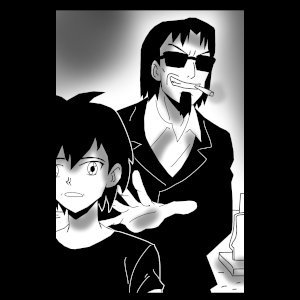
A man stood just outside the dim glow of a nearby streetlamp—black suit, polished shoes, a cigarette burning lazily between his lips. His slick hair fell just past his ears, framing his face like a shadow. Sunglasses obscured his gaze, but his grin—his wicked, knowing grin—was unmistakable.
"It’s a darn shame,” the man mused, taking a slow drag. “Good people, taken away, because of someone else’s carelessness. And what happens next? Nothing.” He exhaled smoke into the air. "Life moves on. The rich stay rich. And you?" He tilted his head, eyes glinting behind the lenses.
"You just get to watch."
Silus swallowed, pushing himself unsteadily to his feet.
“…Who are you?” he asked, voice rough from grief.
The man took a step forward, his presence almost suffocating. “My name?” He tapped the cigarette lightly, letting the ashes fall. “Not important but if it matters you can call me the Entity. What is important is what I can offer you.”
Silus tensed, frowning. “I don’t want anything from you.”
The man chuckled, shaking his head. “No, see—that’s where you’re wrong.” His hand gestured toward the graves, then settled back at his side. "I can see inside you, boy. I can see your pain. But more than that—"
He leaned slightly forward, voice dropping into a murmur.
"I can see the fire burning underneath it."
Silus’ breath hitched, suddenly aware of just how close this stranger was—how his words pierced straight through his defenses.
"You don’t just want justice," the man continued. "You want vengeance."
Silus shook his head, stepping backward. “No—I just—”
"You want them all dead, don’t you?"
The words cut deep—too deep.
Silus clenched his jaw, the overwhelming weight of his emotions threatening to consume him.
"I—No, that’s not—"
"You think it every day," the man interrupted smoothly. "You picture it—how it would feel, how it would end, how they would finally suffer. You want them to pay, and you know nothing will ever be enough unless they’re gone." The man smirks before continuing his push. "I can give it to you boy the power to make them all pay you want it don’t you look at yourself of course you do.”
Silus’ hands trembled.
It was true.
But hearing it said out loud—that was different.
The man reached forward, placing a hand on Silus’ wrist.

The moment their skin touched, his eyes flared red.
A sickening crimson glow spread between them, creeping up Silus’ arm like poison, sinking into his veins, his bones, his mind.
Pain exploded through Silus' body.
He gasped, his pulse hammering, trying to rip his arm free.
"No—stop!"
The man’s smile widened.
"Oh, but this is what you wanted," he whispered. "Don’t fight it, boy. Accept it. Embrace it."
Silus' body shook violently, his mind twisting, bending. His vision blurred, his breath hitched—
And then, in an instant—
The pain shattered into power.
His breath steadied.
His lips curled upward.
His tears were gone.
Silus looked up—his eyes now glowing red, mirroring the man’s.
A grin spread across his face.
And then—
"Hey!"
The sharp voice came from behind them.
The graveyard caretaker, an old man dressed in a dusty coat, approached with a scowl. "What the hell do you two think you’re doing?"
Silus turned.
He felt power now.
Real power.
His smile darkened.
"You’re annoying," he muttered, lifting a hand toward the caretaker.
"Please die."
The old man stopped, blinking once.
Then, without hesitation, he walked toward his shovel, standing it firmly into the dirt.
Silus watched, unmoving, as the caretaker climbed onto it, balancing himself—before suddenly launching his head downward.
His neck landed clean against the shovel blade, slicing deep—
And in the blink of an eye, his head tumbled to the ground, rolling across the soil.
Silus stared.
Then, a short, breathless laugh escaped his lips.
The man in the suit exhaled smoke, smiling even wider.
"See?" He chuckled. "Feels good, doesn’t it?"








Comments (0)
See all