
One time I particularly remember, it was only Lukas and me hanging out on the top balcony of his house. He had this old radio set up in his attic, and some nights when the conditions were right, he could tune in to the BBC to hear the latest music. That night it was humid and balmy, the feeling of summer on its way.
The sky was a muted cobalt blue from the sun setting later, and crickets sang in the garden below. The music emanating from the open attic door behind us was soft and pleasant. A Bunny Berigan tune, I think.
Lukas lit a cigarette, and its orange glow brightened every time he took a drag. Otherwise, its light was dim, like the faint stars I gazed up at.
 “I know the sound quality is terrible,” Lukas said, “but I’m glad I got it to work here. It still reminds me of being back in Hamburg.”
I nodded. “You truly miss it, don’t you?”
“Yeah, especially the rain.”
I chuckled, and Lukas turned to me with a lopsided grin.
“Of all the things you could possibly miss, you pick the rain?”
“I know it’s silly—but there’s something special about it.” He flicked ash over the balcony as he lowered his gaze down to the garden. “Most people get tired of it, or downright hate it, in a place where it rains so much—but not me.”
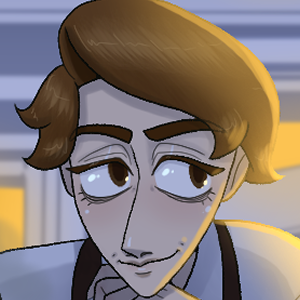
I smiled, finally understanding why Lukas carried his umbrella around like a little boy with a teddy bear. He became quiet for a moment, a pensive look in his brown eyes as he continued to stare down into the garden.
“I…I miss my mother too, of course,” he finally said.
My smile faded, and I frowned. It was the first time Lukas had mentioned much about his family, especially his mother. Anything else I’d heard from rumors at school, or the few things Leah had told me.
“What happened to her,” I began hesitantly, “if you don’t mind me asking?”
He sighed, flicking off more ash. The cigarette was nearly gone at this point, but he still took another drag off it. “She’s the kind of person with strong opinions,” he said, the smoke leaving his mouth, “the kind that got her arrested.”
“Ah…I see…”
“Now you know where I get it from.” He laughed dejectedly and stomped out the cigarette butt with his foot. There it was again, him deflecting with sarcasm. But then Lukas surprised me by continuing in earnest with what he said next. “I made a promise to her the very night the police came that no matter what, I’d stay true to what I believe in. It isn’t easy, but I’m still trying my best.”
This was him being truly vulnerable—not just being philosophical about frogs boiling in pots. He could talk about that sort of stuff in his sleep, but this was his real self at the base layer: the scared boy who longed for his mother.
Most people didn’t open up like this, especially boys who were trying to seem grown up. And despite Lukas’s tendency to wax poetic about his musings, I could tell he was no different in this regard. Him sharing this wasn’t something he’d do with merely anyone. I realized then he must’ve seen me as a good friend.
He turned to me, giving me an odd look. I must’ve been frowning in thought, as I tended to do.
“I bet you really wonder if everything you’ve heard about me at school is true,” he said.
I hadn’t been thinking about that at all, but it must have been an insecurity always in the back of his mind. I stared at him curiously. “Well, I already know your mother is Jewish and your father’s in the SS, but are you actually a Communist?”
Lukas burst up laughing. “I guess anything left of far right these days is Communism! Though, I’m not surprised that’s what Anton and Arnold think. They have rocks for brains, after all. No,” he said emphatically. “I may be on the liberal side, but I’m not a Communist. My mother is, though.”
I cleared my throat for what I was about to ask next. “If your mother is a Communist…then how did she—how did you—your—?”
 “How’d my parents ever stomach each other enough to produce a child?” Lukas finished—correctly—for me. “Good question. I guess right after the war, people were too happy it was over to think about their politics being diametrically opposed. My mother left her Orthodox family in Kraków to become an artist here in Germany—which is to say she worked in a café to pay rent and did her art on the side.
“She was young and naïve when she met my father, and I guess gaining the attention of a handsome war veteran made her feel special. I’m sure being with a Gentile like him was also her way of getting back at her parents for forcing their religion on her. She preferred Judaism that wasn’t as conservative as theirs, and drew the line by refusing to accept the guy the marriage broker had chosen for her. Once she left Poland, she never looked back. She was going to be an independent young woman—which was an exciting, new thing then.
“Of course, she gave into my father’s charms, believing his empty promises about how he loved her and how he would marry her. Imagine her surprise when she found out he was already married.”
I was bewildered by this. “Already married?”
“Yes. His wife was on her deathbed then—tuberculosis—so I guess he felt that justified his actions. My mother didn’t agree, and she wanted nothing more to do with him after that. For better or worse, though, you have to reap the seeds you sow, I suppose.” Lukas indicated himself, smirking sardonically. He then continued the story with his mother’s resolution to raise him herself without any involvement from his father. It was a financially precarious situation in the end, so she eventually gave up on her independence for a time.
“When my mother told him about her situation,” Lukas said, “My father surprised her by saying he would support us—on the condition she come back to him. He had become a widower by then, so my mother grudgingly agreed. She didn’t have much of a choice, and he knew it.”
“Why would your father do that?” I asked. “Wouldn’t it have been easier for him to refuse to acknowledge you? If he’s in the SS, that means he hates Jews, doesn’t it?”
“He wasn’t that far gone politically yet,” Lukas said. “Just an average chauvinist Arschloch. And he never had any children with his wife, so I was the only extension of himself he knew of, and that made me important to that end.
“It was only after the inflation crisis that my parents’ politics began to clash,” Lukas explained. “But that isn’t to say my father was open-minded toward Jews before then, by any means. In fact, he was very against my mother raising me in her religion. Obviously, she is quite stubborn and nobody tells her what to do, so my father eventually relented for that.
“After Hitler was released from prison though, and my father read that stupid book of his—well—the politics and the religion became more of a problem. He begged my mother to become a Lutheran—even promised he would marry her if she did, but she still refused.”
“Why?” I wondered, perhaps ignorantly.
“I think she would’ve rather lived in poverty than let my father chip away at her little by little,” Lukas said. “I suppose she told him if she’d said yes, then there would only be a new thing she’d have to deny about herself. She was right, because it wasn’t before long that the Party’s bigotry became more about ‘race’ than religion, anyway. And even if she had married him, he probably would’ve divorced her after the Nuremberg Laws.
“That was when she decided to leave him, and when they both leaned into their politics. After my father joined the Schutzstaffel, and especially after Hitler became Chancellor, my mother didn’t even let me see him anymore. It made me sad and angry at first because I didn’t really understand it. I thought—like you—why couldn’t she have just married him? Then we could be a real family, like the ones my friends had. But then my mother explained everything to me, and after some time it made sense. Then the times where it was only her and me became the best.”
Lukas recounted those times, and it was without the veil of sarcasm he’d related the rest of the story with, only a nostalgic smile. Then the smile waned when he finally got to the subject of his mother’s arrest.
“I’d recently turned thirteen,” he said, “and it was right after we’d celebrated my bar mitzvah. Even though having different political beliefs had become more dangerous, my mother continued speaking her mind. She created provocative art and handed out pamphlets.”
“Wasn’t she afraid to do stuff like that?” I asked. I thought about my own mother. She didn’t agree with the Nazis either, but she was never public about her disagreement. She only spoke through her faith in God.
“My mother? Afraid?” Lukas chuckled. “No—maybe she should’ve been, but that isn’t her style.”
By now, the sky was dark, and from our vantage point in the hills, we could see the city lights twinkling below us. Lukas looked out at them plaintively. “After the police took her away, one of the officers asked me who my next of kin was.” A smile returned to his face, but this time it was neither cynical nor nostalgic. It was defiant. “So I told him.”
“The police didn’t believe me at first, but word must’ve gotten to my father, because he sent one of his own officers to retrieve me.” Lukas laughed some more. “My father was high up in the SS ranks by then, so I can only imagine how awkward that conversation must’ve been: ‘Can you go get this little Jewish boy from the police for me? And don’t mention a word of this to anyone, by the way.’”
“So then you lived with your father?” I asked.
“Yup.” Lukas shrugged. “Until my taste in music became ‘problematic’, whatever that means. Honestly, it was the Hamburg Hitlerjugend who picked fights with us Swing cats, not the other way around. It’s not my fault their faces were so punchable.”
At this, I couldn’t help but laugh, mostly out of shock. “That’s why you got sent here to your aunt and uncle?” I said. “Because you got in fights with the Hitlerjugend?”
“Yeah, well—at least I’m doing a lot better. I could’ve beaten Anton up so many times by now if I wanted to.” Lukas pulled out a new cigarette and lit it like clockwork, as if being without one for more than twenty minutes was torture. He took a deep drag and looked over at me. His eyes, which always had a droopy quality about them, now looked even more tired.
“Thank you,” I told him.
He frowned. “For what?”
“For sharing all that with me.”
“Yeah, sure—whatever,” he said dismissively. Then he laughed—his way of letting me know it was simply a joke. “Thank you, for listening. The last person I told all that stuff to used it against me, so …”
I gulped. “Anton?”
Lukas nodded, his brows furrowed. “I thought he would be my friend, and I really did try to turn a new leaf for my father when I first got here. I guess it was a blessing in disguise Anton turned on me so fast, so I could see just how stupid that idea truly was. It led me to some real friends, and made me realize I could never go back on what I promised my mother.”
“Do you have any idea when she will be released?” I asked timidly.
“Nope.” Lukas shrugged some more. “I don’t even have any idea if she’s still alive…”
Those words stunned me. Didn’t know if she was still alive? Why would he even think that? Despite the sympathy I felt for Lukas and his situation, his fear seemed ridiculous to me then. Surely his mother would be released after her sentence. Surely no one would let a woman die while in custody. Surely—surely.
However, the words still stuck with me for a reason. Somewhere in the back of my mind was the doubt. The realization that Lukas was right, and things were as bad as he imagined them to be.




Comments (3)
See all