
0-Prologue
Long ago, when humans had only just begun to write their history and the gods still walked these lands, it was said that some of them ruled over their own creations as kings, while others chose to live among them in search of peace.
Those were times of calm—until Volnir, one of the most feared gods, known for his explosive temper, grew weary of ruling only his own domain and decided to conquer new realms. It was said that to strike fear into his enemies, he would take the form of a colossal black dragon, his scales marked by crimson flashes. He had been feared since his very birth, for legend claimed he was created from a single drop of blood shed by Illitek, goddess of darkness.
There was no land Volnir passed through that was not left devastated, nearly uninhabitable. Like all gods who feared solitude, he created companions in his own image: the dragons—vast, powerful, and cruel, just like himself.
The other races, exhausted by the destruction he left behind, longed to act, yet only one had the strength to withstand his flames: the elves. Unlike the dragons, they had been created to protect, nurture, and preserve the beauty of the world. They were wise, patient, and as proud as their enemies. The war between both races lasted centuries—perhaps millennia. No one remembers how long it truly endured; only that time itself wore them down, leaving behind a trail of death and ruins.
Eventually, both peoples were drained by the endless conflict. Seeing their extinction as inevitable, the elves proposed peace. Volnir had no desire to accept it—he knew victory was within reach—but the vast majority of his own kind was weary of war and demanded it end. Relentless pressure left him no choice but to yield, and so he finally agreed.
Yet he set one condition: he would wed the king’s most beloved daughter. Some claimed he did it for power, to secure control over both realms. Others believed it was a punishment—a final humiliation inflicted upon the elves.
And so, a wedding was arranged.
On the day the future spouses met for the first time, something within Volnir changed. The beast that dwelled inside him stirred and fell silent. His fury, his thirst for blood, eased. The rage that had consumed him was extinguished as he knelt before the princess—this becoming the first battle he could not win. To everyone’s astonishment, the princess returned his feelings. From the outside, it seemed a miracle: with their betrothal, the war had come to an end.
Yet the king and his council soon came to regret the union, seeing it as the princess’s sacrifice. Resentment and humiliation took root, for they had been forced to give her away. And though the years passed and the couple bore children, hatred continued to grow in silence—both within the grand halls of power and among those dragons whose thirst for blood had never been quenched.
It was then that Lovetar, the god of love, appeared before the couple. He wished to see for himself whether it was true that the fearsome god had truly changed, for word of Volnir’s transformation had quickly spread across the realms.
After observing them for a while, he asked to speak privately with the princess. He offered her a way to escape: to flee far away with her children, to run before it was too late. No one knows whether she accepted or not, for shortly after, tragedy struck.
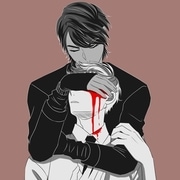
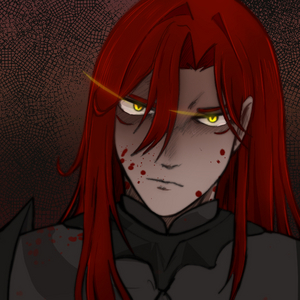
During a celebration in elven lands, something went horribly wrong. By the next morning, Volnir was found in his chamber, covered in blood from head to toe, surrounded by the lifeless bodies of his wife and children.
It is said that a scream echoed across the kingdoms that day. Rumors spread like wildfire: some claimed the monster could not control his thirst for blood; others insisted it had been a trap, orchestrated by those who had never accepted the union.
The only certainty was that when he emerged from the room, his arms stained crimson, the leaders of both races were waiting. They accused him of being a monster, of slaughtering his supposed family—a beast whose thirst for blood could never be sated. The wildest dragons seized the opportunity to rebel, while the elves demanded justice for their princess.
Once again, Lovetar intervened, seeking to calm both sides. To the elves, he promised to seal Volnir forever, imprisoning him deep beneath the earth, where he could harm no one again. To the dragons, he offered distant lands, teeming with wild creatures, where they could unleash their fury without crossing paths with the elves ever again.
Both sides accepted the terms.
But Volnir, consumed by rage and helplessness, swore he would return. The day his chains rusted and his seal broke, he would rise again and engulf that wretched world in fire. Some say he still sleeps beneath the earth to this day, chained and filled with hatred—impatient, waiting for the moment to break free, fulfill his vow, and turn the world into a hellish inferno.





Comments (0)
See all