
❧
Thirty minutes.
It sounds short. Manageable. A harmless wait.
But inside Adrian’s sealed lab—white walls too clean, machines too quiet, air too still—it feels like a lifetime stretched thin.
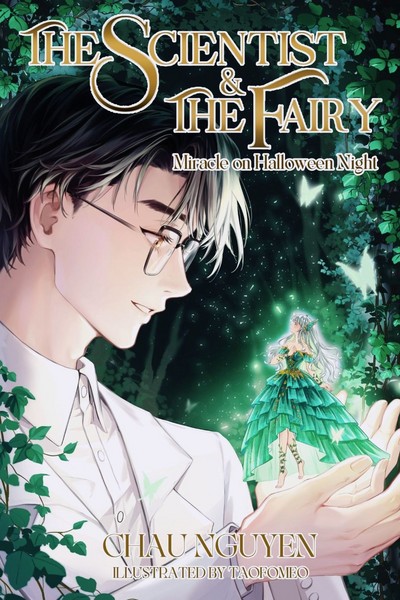
Mira shifts on the edge of the lab desk, her knees pulled up to her chest, bare feet pressed against the smooth steel surface. The lights overhead don’t flicker, and the machines don’t beep dramatically, but everything hums in that low, clinical murmur that makes her feel less like a person and more like a variable.
Adrian is moving with unhurried precision, checking readings, adjusting the analysis stream, annotating data like this is all perfectly ordinary—like it doesn’t involve someone shrinking down to fairy-size and handing over a strand of hair to confirm whether her DNA is secretly written in an ancient language of transformation spells.
She watches him from her perch, arms wrapped around her knees.
The lab coat doesn’t help. The gloves. The full concentration. The reflection of numbers and diagrams on his glasses.
He looks like the exact kind of shady underground scientist people whisper about in medical thrillers.
All serious angles and cold focus, with just enough mystery to make it worse.
He hasn’t spoken since the countdown started.
And the silence presses on her more than the walls do.
“The DNA scan shows no major abnormalities in protein-coding regions. But there are structural anomalies in the non-coding sequences—regions that don’t show up in standard human reference panels. Some of them are stable, but others look like they’ve recently changed.” He finally speaks, calmly, precisely. “It’s not definitive, but it suggests an alteration. Or an activation. Possibly triggered by the bloom.”
Mira says nothing, so he continues, more cautiously now.
“I’d need to monitor how those sequences shift over time. Track what activates them, how they correspond with your episodes. If we observe enough cycles, we might—”
She crosses her arms slowly. “You want to keep testing me.”
“I want to understand what’s happening.”
Mira’s jaw tightens.
“No.”
She stares at the far wall, voice low but firm. “I’m not your project.”
“You’re not,” he says simply.
Mira takes a breath and steps back. “But that’s how it feels. I didn’t ask for this. I didn’t ask to be rewired, or cursed, or whatever this is. And I definitely didn’t ask to be studied like a case file.”
She tries to keep her voice steady, but the tremor pushes through anyway.
“I know you want to help. I know this is what you do. But when you talk like that—about tracking me, testing me, mapping my genes—I can’t think straight. I can’t breathe. I feel like you’re putting me under glass and waiting to see what happens when I crack.”
Adrian doesn’t interrupt.
She turns slightly away, one hand pressing over her mouth for a moment before dropping.
“I’m not ready for that,” she finishes quietly. “Not now. Not like this.”
A long silence stretches between them. The air shifts. Then Adrian steps back from the desk, and his tone shifts with him—lighter, more neutral.
“Then we work with what we know.”
She looks up, cautious.
Adrian continues, voice even but stripped of any pretence.
“And what we know here,” he says, “is nothing.”
He steps closer to the console, not looking at her as he speaks.
“The fungus only affects you—not me. And more importantly—we have no idea how to turn you back.”
Mira stiffens, arms still folded.
Adrian’s fingers rest lightly on the edge of the terminal. “There’s no existing research. No experimental precedent. Nothing in bioalchemy, neuromodulation, or even fringe gene therapy explains this kind of somatic shift. So…”
He finally looks at her.
“…let’s say the only information we can count on right now—is the fairy records.”
Mira looks up at him, blinking hard. “Wait—wait. The most brilliant scientist in the world is seriously talking about fairy records now?” Her voice pitches somewhere between disbelief and panic. “You’re not… teasing me, right?”
Adrian says nothing.
“Adrian—did you…have you ever read a fairy tale in your life?”
He turns to her, completely unfazed. “What makes you think I’ve never read fairy tales?”
She opens her mouth. Then closes it. Then lifts a hand, gesturing wildly. “What makes me think—Adrian. What makes me think you ever read fairy tales—that’s the correct question.”
Adrian exhales through his nose, quiet but unamused. “There’s an ancient archive,” he says. “Under the Meridian wing. A sealed floor. The entire collection is catalogued as ‘Folklore and Non-Scientific Traditions.’ with old books. Bound in bark, fungus-cured leather, pressed petals. All filed under a forgotten system. I read all of them.”
She stares at him as if he’s grown a second head. “You’re saying…” Her voice drops into a half-whisper, half-laugh. “You’ve spent two years in Vermillion Crown—attending elite lectures, heading research projects, building synthetic brain models—and secretly reading the fairy tale archives in the basement?”
“More or less,” he doesn’t deny it.
Mira’s mouth stays open.
Of all the shocks today—the sudden shrinking, the mushroom, the sterile lab, the looming possibility of never returning to her normal size—this might be the one that finally breaks her.
Adrian Vale, prodigy of the generation and walking enigma of logic and poise, said he stayed at the most prestigious university in the world to read fairy tales.
She doesn’t even know what stuns her more anymore—the fact that she’s two inches tall… or the fact that Adrian Vale might have voluntarily read books with hand-painted dragons and curses and dancing flower spirits.
This life is insane. This must be a fever dream.
She finally covers her face with both hands, then peeks out at him.
“Adrian,” she says, voice small and sincere, “tell me this is just in my dream.”
Adrian doesn’t answer her plea.
“There are… three prevailing theories,” he says at last, his voice steady, precise, but softer than before. “In the fairy records, I mean.”
“The first,” he continues, “is environmental. Accidental contact with enchanted flora—usually fungi—rooted in threshold zones. Places where the veil between this world and the other is thin. That matches your case. Barely.”
He turns slightly, adjusting a nearby console out of habit. “The second theory is what the old records call soul-surge—a transformation triggered not by spell or touch, but by emotion so vivid it breaches the boundary between realms. In scientific terms, it’s emotional resonance. When someone carrying fairy genes, especially one with a hyper-reactive emotional system, enters a peak state—joy, fear, connection—it can spark morphological instability. A shift.”
He pauses, then adds quietly, “And the third… is through mutual enchantment.”
“What does that mean?”
“It means,” he says slowly, “that the shrinking happens when a human forms a bond with someone tied to the fairy realm—through blood, through magic, through history. Not just affection. Not desire. Something deeper. A connection strong enough to breach the threshold between worlds.”
His voice lowers.
“Willingness. Sacrifice. Love that bends the rules of what belongs where.”
“Which records are you talking about? Because I’ve read dozens of fairy tales. Shrinking doesn’t always mean some grand cosmic love story.”
She presses on.
“Sometimes it’s a punishment. Or a curse. Or the result of drinking something you shouldn’t or stepping into a circle at the wrong time. Some tales say humans turn into fairies because they steal fairy food. Others say it happens if you help a dying sprite or get caught in moonlight during the wrong solstice.”
She huffs. “And turning back? That’s just as chaotic. You wait for dawn. You kiss someone you love. You find the original flower. You trade your name. You leave behind something precious. You bargain with a witch. Or you don’t turn back at all.”
A pause.
“Not everything is about love that bends rules.”
Adrian doesn’t reply immediately.
He can’t tell her yet.
The fragments of fairy records are buried in the university’s oldest wing—kept there because the Vale family once owned them, protected them, translated them, and encrypted them in a language only bloodline scholars still know.
His family has always held that tie.
A gene expression that makes them suited for thresholds, for gates, for the subtle places where human and fairy converge. But that doesn’t mean he understands it.
The shrinking is still a myth, and everything about how the fairy bond works is scattered across versions—oral, written, poetic, or distorted.
Mira’s frustration isn’t wrong.
Her tales are valid too—told through too many generations, folded into bedtime stories, and whispered into lantern light by grandmothers who’ve heard five different endings to the same song. The original meaning is murky at best. That’s how fairy logic works. Truth diluted by wonder.
So Adrian says nothing of what he knows.
Instead, he studies her for a long moment, then nods slightly, almost to himself.
“Then try. You know the stories. Test them. Find your flower, your moonlight, your bargain.”
He leans back from the console, letting the shadows of the screen flicker across his features. “We have no map. If this is a story, it’s not written yet. So whatever ending you believe in—start there.”
Then, after a pause, his voice shifts—practical again, quiet but precise.
“The full moon was yesterday. If that matters, we’ve missed it. It’s still afternoon now. Three hours until sunset. If you’re trying to replicate whatever happened this morning, we won’t get another proper attempt until tomorrow.”
He glances toward the sequencing display. “The full DNA results will be ready in two hours.”
A beat.
“So, in the meantime,” he says, standing and brushing his coat lightly, “we’re getting you some food. And proper clothes.”
Mira blinks slowly, as if her brain is still buffering. Of all the surreal events that have unfolded—the shrinking, the theories, the terrifying uncertainty of what she had become—it should’ve shattered her completely. But Adrian, in his maddening calm, speaks of food and clothes like it's just another Thursday afternoon, and somehow, impossibly, that anchors her.
And with that quiet absurdity, they leave the lab.
❧


Comments (0)
See all