
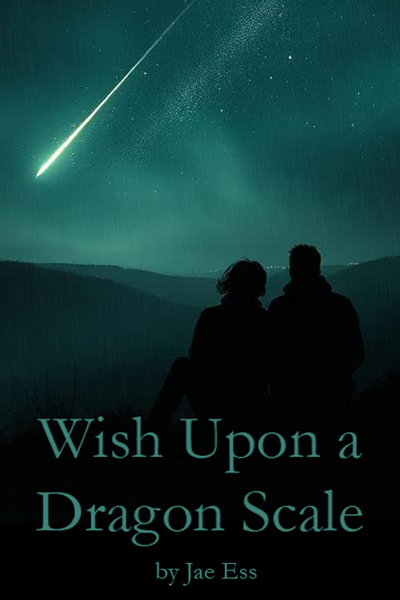
“I’m beginning to think that meteorologist lied to us.”
“Oh? The meteorologist and the entire internet?” Maja quips back.
“Well? The light show was supposed to start ten minutes ago.”
“Maybe your watch is fast. It’s your own fault for refusing to carry a phone unless its for work.”
“Where’s your phone?”
“I don’t know. Think I forgot it in the house.”
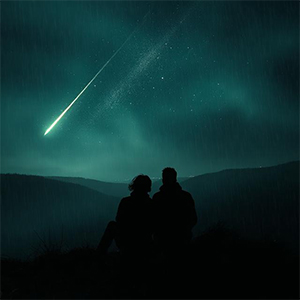
I sigh, frustrated, staring in vain up at the stars.
“Maybe it’s humanity’s fault. The space dragons have forsaken us. There will be no more scales rained down because the earth is filled up with evil.”
“Don’t even talk like that. The dragons would never abandon us. At least Pavle wouldn’t.”
“Unless Monet finally caught up with him.”
Sensing my frustration, Maja asks me, “What’s wrong, Žarko?”
“Oh, it’s these foolish tales. Thinking of them again, I can’t help wishing…wishing they really were true.”
If anyone ever needed a miracle…
“What would you wish for if you found a dragon scale?” Maja asks me our old childhood question, a smile in her voice. Playing with me, when she knows very well my heart is breaking in two.
“Don’t mock me,” I say bitterly. “You know what I’d wish for.”
Maja goes silent. After a minute of sulking, I start to feel guilty.
It’s not fair to blame her. She didn’t ask for this. Neither of us did.
“If I found a dragon scale…” she says wistfully, staring up so the stars reflect in her velvety eyes, “I’d wish to have a baby.”
Her words surprise me. After spending her entire childhood looking after her siblings, Maja made me swear we’d never try for children. She wanted to live for herself, and make up for all the things she never got to do as a kid.
“You never told me you wanted a baby,” I say softly.
“I didn’t want one. Not until...”
“Until when?”
“Recently,” she confesses. “After we found out...”
“Regrets?”
“Not really. But, when I imagine it…when I think of how lonely you’re going to be...”
Sensing her need, in an instant I’ve pulled her into my arms, and not a moment too soon. Maja clings to me with all her feeble strength and shakes with a sudden onslaught of weeping. I cling back, gritting my teeth in an effort to hold back my tears, giving my all for her sake.
Oh, Pavle, I think, glaring up at the stars as they blur together. Won’t you show yourself, already? I only need one scale, just one.
Just one.
“I don’t want you to be lonely, Žarko…”
***
Yugoslavia
2000
Goran and Tamara Zlatić were in their forties, wealthy and successful in their chosen fields, he an architect for the city of Belgrade, she an economist and stock broker at an investment bank. They’d always intended to have a child, but work had forced them to push their plans back indefinitely, until Aunt Tamara had reached an age where she no longer felt safe carrying one of their own. They had recently begun to consider adoption when the family welfare people finally got in touch with them, explaining Tamara’s sister had died, leaving her eleven year old son an orphan. They agreed without hesitation to take me in, and so I came to live with them in Belgrade.
How can I describe the shock of moving from Baba’s one room apartment with her plastic furniture and single burner stove to a penthouse at the top of a high rise? After signing the papers and seeing the welfare person off, Aunt Tamara took just one look at me in my ragged second hand clothes and marched me straight back to the elevator to go shopping.
“How have you been living till now? In a gypsy camp?”
“Baba took me in,” I said defensively, already predisposed to dislike this woman with her shapeless, rectangular business suit and blunt bob. “She spent her pension money to buy me these clothes.”
“Indeed?” Aunt Tamara arched a critical eyebrow. “I must be sure and send her a small token of my appreciation.”
“I’d thank you to do that, and include flowers. Her favorite color is lavender.”
Aunt Tamara’s eyebrow climbed even higher. “Quite precocious, aren’t you? Well, you are your mother’s son.”
Was that a compliment or an insult? I couldn’t tell.
Perhaps sensing I had questions, on the long elevator ride to the ground floor, Aunt Tamara told me a little about her relationship with Mama.
“She was younger than me by twelve years. After our parents died Goran and I took her in. She was sixteen. We did our best to treat her well, but I’ll admit we were too inexperienced. We felt our strictness was for her own good, but she resented it too much, and finally ran away from home.”
I listened wide-eyed to Aunt’s account, somehow picturing it all very easily. This no-nonsense, clean cut woman couldn’t be more opposite to my free spirited mother. Mama would have suffocated, trapped under so many rules.
“She was always high-strung, incapable of seeing any point of view but her own,” Aunt Tamara recounted with a frown. “Always the victim, never culpable for her own actions. Ah. But it is wrong of me to speak ill of the dead. And she was your mother. You must have cared for her. I did too, of course, in my way, though she wouldn’t see it that way. She’d have preferred a sister that recited sweet platitudes and praised her every action to one who told her the truth.”
In the car park, I remember my eyes fairly bugged out of my head when she walked me to a shiny new Mercedes-Benz. She got inside, then rolled down the passenger window to call over to her slack-jawed nephew.
“What are you waiting for? Get in.”
This new life of mine…it was going to take some getting used to.
“We heard she’d married,” Aunt Tamara continued her narrative as she weaved expertly through busy Belgrade traffic. “Against our will, of course. Your father was… Well, perhaps you’d be happier not knowing what kind of man he was.”
“Was he a druggie?” I guessed. “A skinhead?”
Aunt Tamara pressed her lips and did not answer, which led me to believe I hadn’t been too far off the mark.
“I knew it wouldn’t last between them. He was violent, I told her. Men like him didn’t just settle down. But she said she was old enough to make her own decisions, and she married him. We heard they divorced about a year later, though she never came to us for help. No one ever told me she’d had a child.”
“And, what happened to my father?”
“We don’t know what happened to him. Frankly, I’d be surprised if he were still alive.”
I was quiet a minute, staring out the front windshield, watching the heads bobbing in the Yugo just ahead of us to blaring turbo-folk music.
“What was his name?” I finally worked up the courage to ask.
She glanced sideways at me, then her eyes snapped back to the road.
“Aca.”
“What are kids wearing now? Brand names?” she asked me later after she’d parked the car.
“I don’t know…”
“Well, what do you like? Athletic clothes? You prefer a brand? Nike? Adidas?”
I shrugged.
“Nike,” she decided for me, then with absolute confidence, strode off towards the shopping center.
We went to several stores that day, but Aunt never checked a single price tag. She simply took the items she wanted me to wear, and had me try them on. If they fit and I liked them, she bought them.
Sensing I was feeling fatigued from all the shopping by our last stop, she gave me permission to wait outside while she finished up buying a few things for my uncle. This I did with an immense feeling of relief, though outside wasn’t much better than inside. In fact, in a way, it was worse. After a year of living in a quiet city of just a few thousand people, Belgrade was overwhelming all of my senses; too many noises, too many smells, too many people.
A dog’s growl a little ways off made my heart jump. It was a dalmatian belonging to a filthy faced young man who squatted on the street corner, smoking while his untethered dog snarled at anyone who got close. He seemed to find it amusing, but the dog’s yellow fangs and curled lips revealing glistening pink gums set off panic signals in my brain. Ever since that night at the Jovanović house, when the old dalmatian attacked Maja’s baby brother, I’d been terrified of the breed. This one seemed even meaner than the dog from that night. And it sensed my fear.
I wanted to back away from the pair, but my legs wouldn’t move. Not even my brain seemed to work right as I continued to stare at the snarling animal. Run! it seemed to say, and, don’t move! at the same time. Which was right? I knew there was no hope of outrunning a dalmatian, and that thing was getting closer, hackles raised, red eyes gleaming.
“Oi,” I said to the man in a shaky voice. “Call off your dog, man.”
He stuck his cigarette behind his ear and pretended not to hear.
Bože. Would I have to fight it off? What if it bit me? My heart was beating so fast it hurt; I could hardly see for the tears in my eyes.
Then, out of nowhere, Aunt Tamara appeared with handfuls of shopping bags. Seeing the situation, she juxtaposed herself unflinchingly between me and the aggressive dog. I remember looking up at her broad back, the padded shoulders of her slick business suit. Every inch of her seemed to radiate power and authority as she spoke succinctly to the man.
“Oi, kurac. Control your animal. Or I’ll call someone to do it for you,” she said, and my eyes went wide with wonder as she pulled a real mobile phone from her purse and pulled up the antenna. I couldn’t see his reaction though I could hear the dog had stopped growling. Something about her presence had impressed itself on the animal’s mind, and evolutionary instinct had kicked in. It knew an alpha when it saw one.
The next thing I knew, the man had called off his dog, and the pair of them retreated quickly down the street.
“We used to be a decent country,” she murmured to herself as she turned. “Haven’t the unemployed got anything better to do?” Seeing me, white as a ghost and drenched in sweat, she paused. “You alright?”
I nodded.
“Don’t like dogs?”
“Dalmatians...”
She didn’t ask why, but simply handed me a share of the bags.
“Come on,” she said, sharp gaze fixed ahead. “Let’s get you something to drink.”



Comments (1)
See all