
Sebastian Cross no longer had power. That was the first thing he had to accept, even before regaining his freedom. It was not a sudden revelation nor a spectacular fall; it was a slow, silent, almost bureaucratic defeat. No one feared his name, much less awaited his orders or needed his approval.
Years later, when the prison doors finally opened, he did not walk out with grand plans, nor anything resembling a second chance. Only with an uncomfortable certainty for someone like him: the world had kept functioning without his presence.
He returned to the cabin out of pure inertia, unsure of what else to do. To his surprise, it was still standing. It had not been looted. The roof held, the windows were intact. It was a modest place, devoid of luxury, made up of little more than old furniture and worn wood, but it was enough. More than enough for someone who no longer knew what to do with excess.
During his time in prison, he had undergone therapy. It was not a healing or revelatory process. It was humiliating, in fact —slow and brutal in its honesty.
“Why do you need to control?” the therapist asked him once, without raising his voice.
Sebastian did not answer right away. The silence stretched until it became unbearable.
“Because if I don’t control…” he said at last. “I disappear.”
There was no comfort after that confession. Only another note added to a file that promised no absolution.
Upon entering the cabin again, Sebastian set his bag down on the floor and sat on the couch. Free of cobwebs. As if he were trying to erase invisible traces, as if cleanliness could replace what he had lost.
Then he understood: someone had been there in his absence, taking care of the place.
Damien, undoubtedly.
The certainty did not bring relief or gratitude. Only an old fatigue.
“You don’t need me anymore,” Sebastian murmured, almost to himself. “Because I don’t need you anymore.”
It was not a victorious statement, but a real boundary.
Therapy did not help him redeem himself in Noah’s eyes. That was no longer possible, nor desirable. It helped him —barely— to understand what remained when there was no one left to dominate, when desire could no longer be imposed, and when love —if it ever had been that— revealed itself as another form of possession.
Some nights, he thought of Noah. Not as an unattainable longing, but as a belated recognition of what he had failed to protect, of not having won him in the right way, by his own logic.
Not far from the cabin, watching from the distance he himself had chosen, was Damien.
Older and more tired. With the same elegant bearing that had always defined him. Unlike Sebastian, his lawyer never went to therapy. He did not believe he needed it. Loneliness, however, struck him with a violence he had not anticipated.
Without Sebastian, without a clear purpose, without someone to validate his usefulness, the world became flat. Boring. Unbearable. He tried to replace him, watched others. Measured, tested, seduced —but it was no longer the same.
He had lost something essential: absolute control.
***
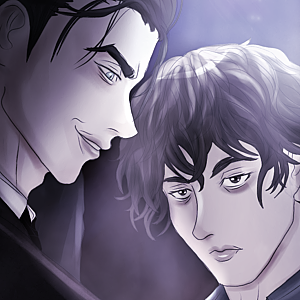
Their reunion happened by chance. Cheap coffee, a gray afternoon. Sebastian recognized him first. Damien, for his part, smiled as before, expecting something that never came.
“I thought you wouldn’t want to see me,” Damien said, in his usual, calculated tone.
“I’m not sure I want to,” Sebastian replied. “But I appreciate you taking care of the cabin. I thought you’d be in prison too.”
They sat down. There were no immediate reproaches, and no promises either.
“I was,” Damien admitted. “But I got out. I have connections, and I decided to take care of your… place. Termites were a problem… at first.”
“You didn’t have to do that,” Sebastian said. “Either way, I’ve been trying to change.”
Damien watched him with renewed interest.
“And is it working?”
Sebastian considered the answer with uncomfortable honesty.
“I don’t know,” he admitted. “But at least… I don’t hate myself as much anymore.”
Damien did not respond. Not because he understood, but because he was already analyzing, measuring, evaluating —as was his habit.
When they parted minutes later, neither knew whether they would meet again.
“Take care, I suppose,” Sebastian said before leaving.
But his former lawyer did not answer. He simply watched him walk away with an empty gaze.
Sebastian returned to his cabin with a minimal life to build, without dominating anyone.
But Damien, on the other hand, was already searching. And although he had lost the game, although the world no longer belonged to him as it once had, deep within his mind an uncomfortable truth persisted:
He admired that man, his lackey.
Not for who he was now, but for who he had been when he could break everything.
THE END









Comments (0)
See all