
I dress quietly in my gi, the fabric rough and cool against my skin. Today’s lessons await, and I don’t know if the door will be unlocked. After yesterday’s dream with Kitsune—after the fleeting warmth of his presence—I’m no longer certain of anything. Still, I prepare myself. Better to be ready.
A new determination coils inside me. I will harden myself into a steel sword—unyielding, unbreakable. No one can touch me. Not the clan. Not the yokai.
Steel doesn’t cry. Steel doesn’t beg. No more crying. No more begging. That version of me is gone.
Yesterday, I lost control. I cried, begged—begged to go home. I told the yokai I hated them all, that they were monsters. That part of me, the child desperate for comfort, burned away in tears and anger. Now, only steel remains.
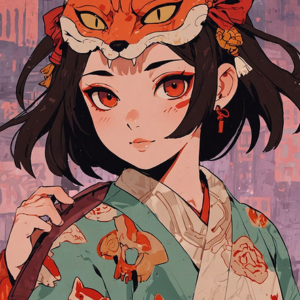
The door clicks open. My stomach clenches. The yokai in the okame mask waits there, carrying a tray of food. Its expression is hidden, but somehow, I know it watches me. I follow silently to the small table, eat mechanically, and keep my eyes down.
Don’t speak. Don’t react. Just survive.
I will speak to no one. I will perform my duties. I will keep every yokai at arm’s length.
When I finish, I follow the masked figure to the library for my lessons. The room is quiet, shelves heavy with antique texts and scrolls—once closed to me, they seem to stir and awaken as I pass, as if recognizing something new in me.
Do they sense it—that I’m different now? That I won’t break again?
At the center, Teacher looks up, hesitating the briefest moment, perhaps gauging the temperature of my anger.
I don’t look at him. I bow slightly and slide into my seat.
I feel Teacher’s eyes burrowing into me, examining me, testing me. I don’t flinch. I don’t meet his gaze.
“I suppose it’s all business then,” Teacher says softly.
I say nothing.
Business is safer. Business doesn’t hurt.
“Please open to page five hundred and one. We will continue with your incantations.”
I obey, flipping the pages methodically. My hands are steady. My mind, a fortress. Steel.
I know I nail the incantations this morning. Whatever Teacher throws at me, I ace. When the temple bells ring, signaling our time together has come to an end, my escort arrives to take me to Lady Hoshiko.
I stand, finally allowing my eyes to meet Teacher’s.
“You did well today, Rin. I am very proud. I was hoping to have a few moments of your time before you leave.”
I lock eyes with him, bow silently, and then turn on my heel. I follow the okame yokai in silence, keeping my thoughts tightly wound.
Pride means nothing. Words mean nothing. Not anymore.
As we walk, a small pang flickers in my chest. I like Lady Hoshiko—her warmth, her kindness, the gentle way she guides me—but I can’t let myself trust anyone. Not yet. I will treat them all the same, keep them at arm’s length, protect myself.
Even kindness can be a trap.
The pavilion comes into view. Lady Hoshiko stands inside, robes flowing around her silk, catching the sun. She looks as graceful as ever.
“Good afternoon, Rin. Shall we begin where we left off?”
I bow slightly, my only acknowledgment, then move to the center of the room and assume first position.
“Is something troubling you, child?”
I say nothing, letting my body speak instead. I begin the dance from where we ended in the previous lesson. Lady Hoshiko watches me, but offers no further words.
Let her wonder. Let them all wonder.
“Good, Rin. Head up, shoulders back.”
She dances beside me, demonstrating the next set of steps. I mirror her movements, flowing with her guidance, each motion precise and controlled.
By the end of class, I’m exhausted, sweat cooling against my skin. Every ounce of energy, every fragment of will, goes into the dance.
“Rin, you performed admirably today,” Lady Hoshiko says, smiling warmly.
It pains me to remain silent, to not let my appreciation show. I bow deeply, offering only the quiet farewell my walls allow.
I want to thank her. I want to say something. But I can’t.
The okame yokai takes me to our final destination. As always, she draws my bath—our evening ritual, silent and seamless. We move around one another in practiced rhythm, circling like dancers who know every step but never touch. I bathe, steam curling against the chamber walls, then wrap myself in the robe she lays out. She brings food, and I eat. She clears it away. And so it goes, the same pattern every evening, unbroken, unspoken.
When at last I return to my room, I sit on the edge of the bed, plaiting my hair. The okame yokai lingers in the doorway, her mask unreadable, but I know the gesture: she’s waiting, signaling her retreat for the night.
I can feel her watching me.
“Tell Zashi—” I clear my throat. No. Not Zashi. “Tell the zashiki-warashi that she is no longer welcome in my room.”
The words sting, but I force my face to remain still. Once, I called her Zashi, laughed with her,
thought—foolishly—that she was my friend. But that night, when I fell apart, I told her to leave. She cried. And I didn’t call her back. Zashi is no longer a friend.
Friends are dangerous. Friends make you weak.
The okame yokai tilts her head, considering me. I don’t flinch from her scrutiny. After a long moment, she gives a single nod of acknowledgment, then turns and slips away into the corridor’s shadows.
The silence she leaves behind closes in, heavy as the night.





Comments (0)
See all