
“Get up!”
After barely sleeping at all, Izzi’s eyes opened on the sneering face of her stepmother, Nezta.
Izzi closed her eyes again hoping that next time she opened them her life would be magically back to normal. Was it too soon for Bal to grant her just that simple wish?
The hardest thing was not that Nezta was old and ugly and vicious, because that was not the case. Nezta was only a few years older than herself, and quite beautiful, with fine sharp Zakrian features and more silky hair than she really needed. The vicious part was true, unfortunately.
“Izbel, my newest maid,” she said with obvious pleasure at the idea of having someone else to boss about. “Penza, dearest beloved, has informed me of your overdue fall from undeserved grace. Finally with all that clutter gone from your crone-of-a-mother’s rooms, I am able to take up full residence.”
Izzi stared at Nezta, but knew better than to respond. She instead catalogued unpleasant ways she might get revenge later.
“Dress yourself modestly and eat with the staff, then be available at the tasking muster for the morning chores. This afternoon you will be taken for lessons with Nazli and Aisha, where you will learn proper skills for a young lady rather than sorcerous Kyth mumbo-jumbo.”
“Yes, Nezta,” Izzi said meekly. So it was true that Father intended her to go back to that horrid school of dust and drudgery.
“And quickly,” said Nezta as she left.
Izzi stared daggers after her.
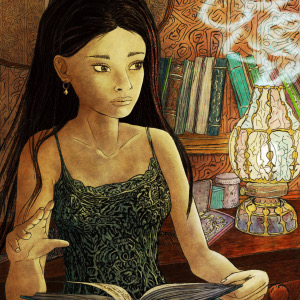
She threw on her most robust and nondescript dress, making sure that the locket on its chain was well hidden and secure under the fabric, then she brushed her hair with thirty-seven strokes while chanting under her breath the lines her mother had taught, which started like this:
One stroke for the dawn that breaks the dark
Two strokes for the noon that marks the peak
Three strokes for the dusk that paints the sky
Four strokes for the night that brings my sleep
Five strokes for the sun that bakes the sand
Six strokes for the shamals that move the dunes
Seven strokes for the moon that rides the sky
Eight strokes for the rains that are a lie
And went on to the final line:
Thirty-seven strokes to bind my desert life
When she finished Izzi applied a single drop of rose oil to one of the woollen strands, and wound her hair in her brightest teal scarf, as a token of rebellion, leaving some strands of hair and wool showing as usual. They might take her belongings, but they would never erase her memories, or dim her spark.
Before she left her room she laid a ward on the closed door to gently deter any entry, and to alert her if anyone tried. There was no mechanism to lock it because all the household was trusted. Some of her own jewellery and dresses were of value, but no one would take them. Mostly she was keen to protect Balthazar’s book from prying eyes.
✨
It’s not true to say that Izzi had never done a spot of hard work in all her life; she had often been called upon for chores—her mother had ensured she’d not grown up spoiled. However, of course Nezta gleefully assigned her the worst of duties. After spending most of the morning cleaning mould from the grooves between the tiles in the baths of the hammam, Izzi’s hands were red raw, her clothes were damp and filthy, and she was exhausted. She’d kept her mind active wondering when she should seek again the help of the djinni, but avoiding a little hard work was not enough reason.
After a quick lunch with the staff, she’d been allowed a moment to freshen. The ward on her room was intact, and the precious book was still in the bed chest where she’d hidden it. She washed in cold water leftover from the morning, and changed her soiled dress to one fit for school, before Yasmin arrived at her door with Nazli and Aisha in tow. The two girls were daughters of some of the other household servants, and a year or two younger than Izzi. They alternated between staring at her and looking away to not be caught staring.
Yasmin seemed genuinely apologetic.
“I am so sorry this has happened to you, Izbel. Your mother would have been devastated.”
“Myzina would never have let it happen,” said Izzi. “You know that.”
“Of course not. She was very proud and strong, and very proud and protective of you.”
Yasmin glanced sideways at the other two girls, and then whispered to Izzi. “One moment…”
She asked Nazli and Aisha to wait outside, and gently clicked the door shut for some privacy.
“I really am ashamed at how you have been treated,” Yasmin said softly to not be overheard. “I loved Myzina, she was always kind to me—even helped me keep my son Saeed when they would have taken him from me. I will try to help you with whatever you need—just ask. And, I am not proud of it, but I have something of hers, and I want to return it to you. Since everything else went to the furnace—Laleh made sure of that—this may be one of the few things of hers you can keep. I secretly saved it from the flames intending to keep it for myself, but now I am ashamed.”
She held out her hand and unwrapped a silk handkerchief to reveal a ring. It was a simple band of gold with a flat face. On the face was engraved a triangular symbol that Izzi did not immediately recognise, and at certain points of the symbol small green stones were set, seven in all. Although Izzi remembered it from the collection she’d kept on her dresser, she’d never paid it much attention. She’d tried it on years ago when it was still too big for her fingers.
“Why this one, Yaz, of all the pieces you could have chosen?”
“I don’t know, it called to me I think. And I remember it was one she almost never took off, even to the end. And honestly, with those real emeralds, I think it may have had the most value. Most of her jewellery was Kythian caravaner trinkets.”
Izzi thought back to the last times she remembered her poor sick and frail mother, before she passed. She took the ring and clasped it in her palm, probing its tiny magesty. Did she remember, or did she just imagine, Myzina turning it on her finger?
Laleh and Yasmin had not exactly been particularly kind to her recently, so Izzi was not entirely ready to completely forgive her. Even if Laleh had set the tone, Yasmin had not exactly defended her.
“Thank you Yaz—it is a great treasure and relief to me to have at least this one token to help me remember her. I know I don’t need to ask you to keep it a secret.”
Yasmin nodded. “Of course. Now, be ready quickly, I must take you and the others to lessons.”
Izzi would not leave the ring unattended in her room, and she could not wear it openly lest it be recognised, so when Yasmin left the room she quickly snuck it into the locket near the tiny, dark chunk of coal.
✨
Young Rahim, one of Hakim’s men, escorted the four women through the city. Early afternoon was the quietest time, steeped in a natural after-lunch lethargy. City folk gathered lazily around backgammon boards or smoked hookah, while tribespeople and refugees crowded into the thin shadows, haggard and exhausted by the relentless heat.
They descended a flight of stairs into a narrow winding alley. A gang of ragged children were scratching hurriedly on the stone walls with white chalk, and sprang up guiltily, scattering as if caught in some nefarious deed. As Izzi passed the chalk markings, she saw they’d only been tracing the city’s protective glyphs, mysterious shapes etched into buildings by the city’s magian founders. The sinuous symbols were everywhere—etched into stones and timbers alike, even spontaneously appearing in new construction—so ubiquitous that no one ever paid them any heed. She briefly wondered why the children were highlighting them, but the thought slipped from her mind when they entered the sunny dazzle of a larger street. She raised a hand to shield her eyes, squinting while they adjusted.
A cry rang out in the distance, followed by a scream, and then the roar of a crowd. In unison with everyone else, Izzi turned toward the sound, and raised herself high on her toes to see. Around a fountain there was some kind of squabble, and already the watchers were sounding the alarm with shrill whistles, and setting yelping dogs on the troublemakers.
“Not our business,” Rahim said, seemingly to himself as much as them, but he was gripping the hilt of his sword. He ushered them across the street and into another lane, and they continued through the lesser ways to come out eventually at the same tall stone madrasa that Izzi had attended before she’d been admitted to the Magekadeh.
Rahim left them at the entry, unable to hide his joy at being freed from such an onerous task. And once she’d seen them safely inside, Yasmin also sped away on some errand.
They were just in time for the afternoon classes, and joined a dozen others in the adjoining fire temple to hear a familiar voice droning on about the great wisdom of Ahura Mazda. Izzi felt like she had heard these words one thousand times, and her thoughts started to drift away to pleasant dreams of imagined futures with all her wishes granted. A change in the tone of the words of the zaotar startled her to attention.
“This afternoon we have the great honour of helping with the work of the Yazata in this time of great upheaval and need. We will be helping to distribute bread to the refugees.”
Izzi’s mood lightened at this, at least they’d not be doing hours of tedious needlework while being prattled at about the virtue of being meek, and they’d get out into the fresh air away from the temple where the sacred fire made the air stuffy and her head drowsy.
The young women were ushered out of the hall by robed and veiled herbads, and Izzi fell into line behind Nazli and Aisha. Most girls were subdued in reverence to this duty, but Izzi wanted to shout and run in joy at being out of the temple.
A troop of palace guards waited outside with stoic expressions, along with merchants with wagons laden with rounds of unappetising looking flatbread. The square where most of the refugees gathered was only a short walk, but by the time the mules were all coaxed into motion the afternoon shadows were already lengthening.
Izzi estimated there were half a thousand refugees in the square, mostly crowded around makeshift tents and palm-leaf structures in the shade of tall administration buildings on the western side, or under the few plane trees that circled the fountain. At the sight of the approaching wagons, many rushed forward and she feared they’d be overrun, but the guardsmen waved their swords and shouted sharp commands, mustering them into not exactly orderly lines.
Under direction of the herbads, Izzi and the others doled out one loaf per person, ignoring any demands for more, even from those pleading that they were collecting for their entire family. Even though they started with five full wagons, the bread was almost gone, and many refugees remained empty handed, although Izzi was sure some still in line had already been handed loaves earlier.
Whistles sounded with short sharp blasts, and a troop of watchers and their snarling dogs marched down into the square from the inner city gates. Immediately behind was a phalanx of the palace guard, armour flashing. All up there were about a hundred men.
The herbads did not seem to know what to do. Izzi kept handing out bread, but the refugees were distracted by the commotion. The leader of their own small contingent of palace guardsmen left to confer with the newcomers, and when he returned his mouth was a grim line.
He conferred closely with his men, but Izzi mouthed a tiny incantation that helped her hear his quiet words.
“… this is going to be messy,” he was saying. “There has been an uprising in the refugees, led by Kythian spies who have infiltrated the city by hiding among them. At the king’s decree, the general has ordered all refugees of Kythian appearance to be rounded up and incarcerated in a separate enclosure. We must help.”
A whistle blast sounded so close it pierced through her thoughts. Before she could even react, rough hands grabbed her arms, twisting them cruelly behind her back. Pain speared her shoulders. Her cry of protest drowned in the chaos of shouting voices.
“I’m not a Kyth—I’m a citizen!” Izzi shouted as loud as she could, but her voice croaked with desperation. She struggled wildly, thrashing and kicking, but the armoured grip only tightened, twisting her wrists until agony blurred her vision. Her captor’s cold, unfeeling gaze met hers briefly through the narrow slit of his helmet. She twisted harder, panic rising like bile. Her silk dress tore beneath brutal hands, and her feet, vulnerable in delicate slippers, were stomped and bruised by his heavy boots as she was dragged across the square.
Why wouldn’t they listen? They must see who she was—Penza’s daughter, great granddaughter of a grand vizier! With her fine silk dress and brightly embroidered headscarf—surely no one could mistake her for a refugee? Her anger flared hotter; her mother’s heritage, marked plainly on her face, betrayed her: she looked Kythian enough, and that alone sealed her fate.
But she was Zakrian! Her father would surely set this right—he would never allow her to be treated like an alien, a refugee. Then her indignation wilted under the cold realisation that the guards saw only what they wanted to see: another Kythian refugee, nothing more.
Her throat burned from screaming. Tears of shame and betrayal blurred her vision. Her protests merged unheard with countless other pleas of outraged innocence.
She scanned the crowd for Nazli, Aisha, anyone who might recognise her plight and speak out. She called their names. But all familiar faces had already vanished, whisked safely away, leaving her abandoned amidst ragged Kythian strangers, penned in by a circle of snarling dogs and their impassive handlers. Izzi’s cries blended hopelessly with others, unheard, meaningless in the guards’ cold, distant eyes.
Shrill whistle blasts repeated, louder, harsher, driving Izzi forward with a surge of panicked bodies. She stumbled, her dress filthy, its elegant hem shredded, trampled beneath uncaring feet. Every shove, every careless elbow bruised more than her body—it stripped away her very sense of self. Gasping, she fought desperately for footing, for support, for air, her terror overwhelming. Hopelessness enveloped her, carrying with it an eerie detachment, as if this nightmare belonged to someone else. It couldn’t possibly be her.
Then, with abrupt, desperate urgency, a firm hand grasped hers, pulling her back from the abyss of despair.






Comments (0)
See all