
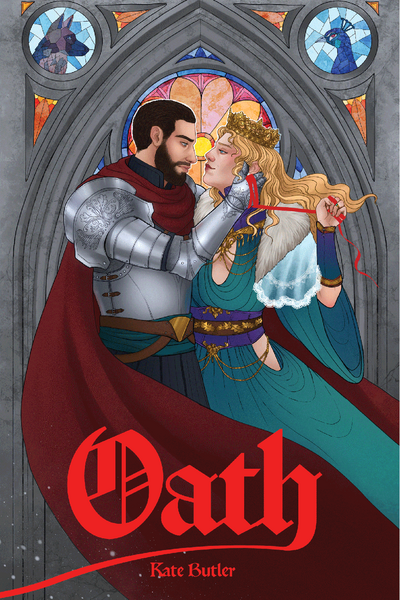
The morning light spilled over the high balconies of Valemont Keep, turning marble halls to ivory and silk to fire. In the eastern wing, where the scent of rose oil and spiced wine never truly faded, Lord Aerion Valemont reclined on a velvet chaise, bare-chested, one leg dangling lazily as two handmaidens fawned over his golden hair.
“I said waves, not curls, Merina. I’m not some prize mare,” he drawled, voice as smooth and biting as citrus wine. He tapped a jewelled finger against the silver mirror lifted before him. “There. Now I look exactly like the disappointment they want to seduce.”
He rose without modesty, stretching like a cat before shrugging into a loose linen shirt. The handmaidens stepped back as he selected a doublet dyed a deep sapphire to match his eyes. Golden clasps shaped like thorns hugged his chest, and gold glittered at his wrists. Jewels weighed down his fingers—blue, red, black—a peacock adorned in mourning.
The great hall echoed beneath his heeled boots as he made his daily descent into court: one hip tilted, chin lifted, lips twitching with mischief. As always, his entrance made men sneer and women whisper. As always, Aerion gave them nothing but a smile that meant everything and nothing.
“Good morning, Lord Chamberlain,” he said, brushing past a stiff-faced old man buried in parchment. “Is my dear father still dying, or has he found the strength to scowl again?”
“My lord,” the chamberlain intoned with forced civility, “the Archduke’s health remains unchanged. I am told Sir Clyde arrives today.”
Aerion stopped mid-stride. “Sir who?”
“The knight assigned to your personal protection, per the king’s orders.”
Aerion scoffed. “Another leashed brute. How thrilling.”
The chamberlain bowed and retreated, leaving Aerion to roll his eyes toward the vaulted ceiling.
Meanwhile, beyond the gilded gates of Valemont, hooves clattered against stone as Sir Clyde of Blackholt rode beneath the capital’s arch. His horse was lathered with sweat and dusted white with salt from long roads and harsher seas, its breath steaming in the morning chill. The knight’s armour bore the wear of travel—no polish, no fanfare—just scratches and dents that told stories no one asked to hear.
A hood shadowed his face, though the guards at the gate parted for him without hesitation. They had all heard the name.
Clyde swung down from the saddle without help, movements clipped and efficient. He adjusted the broad sword strapped across his back, checked the dagger at his hip, and left the reins with a stableboy too frightened to meet his eyes.
Inside the keep, the corridors stilled as he passed. Servants ducked behind tapestries, hands full of linens or baskets of bread. A steward with a scroll tucked under his arm pressed himself flat against the wall. Even the dogs that haunted the kitchens slunk out of sight, tails between their legs.
A child peered from behind a column, wide-eyed, and whispered to a nursemaid: “That’s the Hound.”
The name clung to him like a curse, though Clyde gave no sign of hearing it. He ignored them all, boots striking hard against the marble as he strode toward the great hall with the quiet assurance of a man used to being obeyed—or feared.
At the doors, the chamberlain bowed stiffly. “Sir Clyde. His lordship awaits you.”
Clyde only nodded, pushing through as the iron-bound oak swung wide.
The hall hushed. His boots struck the polished stone, each step echoing in the vaulted space. servants turned, heads angling to watch the figure who strode with soldier’s certainty toward the dais. He moved without flourish, without hesitation, until he came to stand before the sapphire-clad lord who lounged across a velvet chaise.
Then, without pause, Clyde dropped to one knee, gauntleted fist braced against the floor. His voice carried low, iron-wrapped: “My lord Valemont. By my sword, my shield, and my life, I am sworn to your service.”
Aerion did not immediately answer. He lounged like a painting, one arm draped across the back of the chaise, a goblet of honeyed wine balanced with languid precision in his hand. His legs were crossed as though the angle itself had been calculated, an artist’s signature of carelessness. Sunlight spilled in from the high windows, catching on the rings at his fingers, the gilded thread of his doublet, the molten fall of his golden hair.
He didn’t look up when the door had first groaned open. Now, he tipped the goblet, watching amber light ripple across its surface.
“You’re late,” he said, as if time itself were his servant.
Clyde remained silent. He stayed at the threshold of conversation as firmly as he had the door, still as stone, his shadow cutting across the marble floor. The silence thickened, taut as a bowstring. Aerion let it stretch, savouring the defiance of it.
At last, with a theatrical sigh, he lifted his eyes.
And paused.
The man before him was not what rumour had promised. No greybeard dragged from retirement, no brute stitched together by scars and ale. Clyde was younger than Aerion’s steward—perhaps early thirties—but the years of war had carved him into something older: lines scored at the corners of his eyes, shadows gouged beneath his cheekbones. His jaw was clean-shaven, his expression unreadable. Like a statue left to weather in the rain.
Aerion’s lips curved, glass-bright and cutting. “Gods, you’re younger than my steward. And you look as though you eat rocks for breakfast.”
Still no reply.
“Do you speak,” Aerion prodded, his tone a velvet barb, “or is growling your only tongue?”
Clyde rose, boots striking the marble in steady rhythm. He bowed once, short, sharp, nothing ornamental in the gesture. “Sir Clyde of Blackholt. At your service, my lord.”
Aerion arched one perfect brow. “Charmed.”
Clyde straightened. Silent again.
Aerion’s gaze roamed him shamelessly: the scuffed armour, the calloused hands, the breadth of shoulders worn down by burdens heavier than steel. His eyes lingered a beat too long on the mouth, firm and unsmiling, before lifting back to those slate-grey eyes.
“The king sends you to guard me?” Aerion drawled, swirling his wine until it lapped the rim. “What did I do to deserve such an inspiring hound?”
“I go where I’m ordered.”
“And I speak when I’m bored,” Aerion replied. His smirk tilted like a blade, gleaming in the torchlight. “You’ll have to get used to that.”
A beat passed. Clyde’s gaze shifted deliberately to the window, as though to dismiss him entirely. His voice was quiet, almost careless. “I’ve faced worse burdens.”
Aerion blinked.
The words landed with the soft thud of a gauntlet. Not shouted, not sharp, just laid on the floor between them, insolent in their simplicity.
His jaw tightened, his eyes narrowing, catching the light like glass knives. How dare this man—this slab of stone, dressed in scars and silence—speak of him as if he were an inconvenience.
But Clyde was already turning away, his gaze moving with soldier’s instinct: measuring walls, counting doors, noting every exit. Not in deference. Not in curiosity. In duty.
Aerion tipped his goblet again. The wine slipped golden around its rim. He smiled, but the smile was all teeth—sharp, dangerous, and hungry for the game that had just begun.
“Well,” he murmured, voice rich as velvet and just as deadly, “this should be fun.”
The next morning, pale light poured through the arched windows of Aerion’s solar, painting the chamber in soft gold. The air smelled of rose oil and spiced resin from the brazier, but beneath it lingered something harsher—the faint tang of steel and leather, clinging to the man posted at the door.
Sir Clyde had not moved since dawn. He stood as though carved from the very stone of the keep, boots planted, hands folded behind his back, every line of his body proclaiming endurance. He did not glance at the servants who flitted in and out. He did not blink when the handmaidens laid out Aerion’s wardrobe.
Aerion, meanwhile, stretched across the chaise like a cat in sun, his robe of thin silk slipping down one shoulder. He rose with theatrical languor, letting the fabric fall into a careless heap on the floor. “If you must haunt the corners like a gargoyle,” he drawled, “at least do it with flair. You’re depressing the curtains.”
Clyde said nothing. He kept his eyes forward—except when he didn’t.
Aerion, fastening the first clasp of his emerald doublet, felt it: a weight pressing down on his back. He turned, catching Clyde’s eyes on him, just for a moment too long.
It was not hunger in the knight’s stare.
Disdain.
Cold, measured, the look of a man assessing a battlefield and finding the commander unfit to lead. Clyde’s gaze flicked away too late, snapping to the window with the stiff precision of discipline.
Aerion froze, his fingers lingering on the clasp. A flush of heat climbed his neck, not shame, never that, but something raw and stinging.
“Oh,” he said at last, his voice cutting through the silence like a blade unsheathed. “So, the Hound does have thoughts. Do you find me amusing, Sir Clyde? A painted peacock unworthy of your time?”
Clyde did not answer. His jaw tightened.
Aerion stalked closer, each step deliberate, his smile sharp as glass. “You dare watch me like some bored stablehand? I should have you dragged out and whipped for insolence.”
Still nothing. Clyde’s eyes stayed fixed ahead, cold, impassive, as though Aerion’s words were arrows broken on stone.
That only stoked the fire. Aerion leaned in, lowering his voice to a venomous whisper. “You are sworn to guard me, not to judge me. Remember your place, Sir Hound.”
The handmaidens shrank into the corners of the room, exchanging nervous glances.
Aerion lingered a heartbeat longer, then turned away with a sudden laugh, light and cruel. He lifted the goblet of honeyed wine from his dressing table and tipped it, letting the gold liquid catch the sun.
“Ah well,” he murmured, almost to himself, “every dog growls. It’s when they bite that things get interesting.”







Comments (0)
See all