
Hunger burns through me, ravaging everything in my body, in my mind, in my soul. It hurts, it hurts, it hurts so much. But it’s not a type of pain that is flamboyant, it’s not a type of pain that is bombastic. It’s a type of pain that is deeper, and more far reaching than any other type of violence. Though no-one classifies this pain as violence. They simply classify it as not their problem.
“Could you spare some change?” I ask the passing men and women who are going off to do their shopping. They do not look at me, instead looking straight towards the shops that they are headed towards. Their indifference cuts deep into me like a poisoned blade, but it is a poisoned blade that I have grown deeply accustomed to over the years. Their indifference sits heavy and choking in my chest, but this heaviness, too, I have grown accustomed to over the years.
There are beggars all around me, forming a line, leaning against the edge of the hard, rough wall of one of the shops in the plaza. I am well acquainted with all the beggars here. They are nice people. They are weary people. Empty people. Aching people. People with death in their eyes and death lingering behind them with each breath that they take. Yet, despite all of their crippling poverty, they are rich in spirit. They are much more rich in spirit than the people going on their daily shopping trips are.
I am aching too. I am empty too. Death waits close by for me, ready to carry up my soul in the first opportunity that it gets. But honestly, I am waiting for my soul to be taken up as well. This life is not a life. It’s an open wound that is constantly in the process of bleeding. In death I could be reunited with my boyfriend, who I miss more than I’ve ever missed anything before. I’ll be reunited with all the people who have passed on. But nevertheless, I have people I need to take care of. I cannot die right now. And so, I have to keep begging.
“Will you spare some change, please?” It’s hard to hold my hand up constantly. But it’s not nearly as bad as what most other people have to do to make their income. I don’t envy the factory workers, or the servants, or the farmers. They have more money than us beggars, sure. They can get more food for that money, more water. But at the end of the day they don’t have nearly enough and we don’t have nearly enough and all of us are on the same boat, a boat that is being completely sabotaged by forces beyond our control.
They look us in the eyes, sometimes, these shoppers. They meet us in the eyes for the briefest of seconds, out of curiosity or out of boredom or even sometimes out of a perverse sense of pleasure, of schadenfreude. They also meet us in the eyes by accident sometimes. But whatever their reason for meeting us in the eyes is, whatever they are doing it for, they never hold eye contact with us for a long time. They always avert their eyes as quickly as possible. I would say that they are horrified by what they see in our eyes but they’re not. They’re not horrified. They’re disgusted.
Every once in a while I will get the odd shopper who does not ignore me, but rather politely declines giving me anything. Every once in a while I’ll get words that seem apologetic, a voice that is almost sympathetic. I would feel bad for them. But I don’t. I don’t feel bad because, even as they say that they are sorry that they can’t help, I see them with bright paper shopping bags in their hands. I see them with shining stones adorning the rings on their fingers and the necklaces around their necks.
There are also those who rebuke me harshly, sneering at me with their hateful mouths and eyes. They call me filth, they tell me that I am dirtying up their streets and I am a burden to society. Their words cut deep. Of course their words cut deep. But what cuts so much more deep is the fact that they are saying it around all my friends, who are hearing it too. They are saying it to all my friends, who are having to deal with it too. And what is even more horrific is that they’re saying these things in front of their own children, who are having to learn and grow up on such hatred.
But anyways, no matter what happens, I have to keep begging. And all my friends all around me have to keep begging. There is a horrible cacophony of desperate voices all around me, all begging for any scraps that the middle class can throw our way. We all sound desperate, all sound broken, all sound hollow. We all are desperate, all are broken, all are hollow.
But at the end of the day, when the streets are clear, we pool all of the money that we made together, and redistribute it so that everyone gets an equal share. This way the people who did not make much today will not have to go without having any food at all. It’s more fair, this way. And, even though it hurts to come back with less money than you had at first, this is one of the many ways that we all take care of each other.
“Do you know that people have gone to the moon?” a girl with a withered arm named Malia asks us all, as we gather together in the street, keeping an alert eye out for the police.
“What?” a blind person named Ali asks.
“Humans. They’ve gone to the moon in a giant metal cylinder with a pointed top,” Malia answers.
“How do you know that?” a man named Koro asks her.
“A girl told me,” she replies. “She was rich. She sad that if they can send people to the moon, someone will invent a way to help us too.”
“Do you believe they’ll help us?” A teenaged girl named Isa asks earnestly.
“No,” Malia replies.
“I don’t think so either,” a man named Faroko echoes.
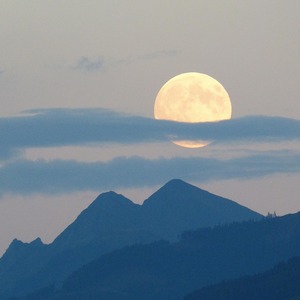
I look at the moon, visible in the darkening sky. It’s so beautiful. But now people know how to get up to it. Now the middle class knows how to get up to it.
A deep feeling of dread overwhelms my heart.









Comments (0)
See all