
The interior was a labyrinth of cold, turquoise steel. I descended thirty flights of stairs, passing floors marked with strange, abstract "Commission" sigils—a golden compass overlaid with a black gear. These weren't Roberts' inventions; they were part of a global architecture of control. I finally reached the heart of the lair. Surveillance monitors focused on Amelia’s life, a physical violation that made my blood run cold.
Taped to the center monitor was a ledger. I scanned the pages: Project Titan funded by The High Commission. Subject Amelia Rose: Bio-reactive potential verified. If the subject resists, the QX-1100 will initiate the 'Wither' protocol.
"John Roberts didn't act alone," a cold voice sneered. I turned to see Zack, holding the symbol-coded remote. "My father was the architect. The sector provided the steel. They want a world of giants they can switch off with a button."
Zack signaled his guards, but I was faster. I used a heavy fire axe to shatter the terminal, sending a feedback loop through the facility. In the chaos, I tackled Zack, our bodies spiraling toward the observation ledge. I saw the remote skitter away. I lunged, punching the symbols I’d seen on the doors—Circle. X. NO.— as the remote turned a brilliant blue.
Below us, the 500-foot Titan let out a mechanical groan. The "Wither" protocol I had accidentally tripped didn't stop the machine; it sent a psychic back-blast through the air. The Titan tilted, its internal stabilizers shrieking, before it tipped over. It slammed into the canyon floor with the force of a falling moon, vanishing into a blinding eruption of green bioluminescent mist and electrical fire.
"AMELIA!" I roared, sliding down the mountain path as Zack vanished into the dark abyss of the canyon.
The ground was a graveyard of twisted metal and massive, scorched midnight colored fabric. The explosion had severed the frequency, and Amelia had shrunk instantly. But the scale of the disaster was terrifying. I found myself standing in a desert of heavy, house-sized folds of denim and canyons of raven cotton—the remains of her 50-foot outfit.
"Amelia!" I screamed, my voice muffled by the thick, charred layers of fabric. I realized with a jolt of horror that she was buried under tons of her own clothes. To a five-foot-seven girl, her own shirt was now a heavy, suffocating mountain range.
I swung the fire axe, hacking through a Towering, five-inch-thick seam of denim. I climbed over a "ridge" of a brass button the size of a manhole cover. Below, I heard a faint, coughing. I ripped through a final layer of scorched obsidian cotton and found her. She was curled in a ball, gasping for air, her skin glowing with a fading green light. She looked so small, so fragile, hidden in the ruins of her own greatness.
"I've got you," I whispered, pulling her out of the fabric tomb.
Two days later, in the hospital, the peace felt like a lie. My phone buzzed—Amelia’s father.
"Richard? I found the ledger. The machinery wasn't built; it was funded by a group called The Sector. Come to my house immediately!"
The line went dead. I looked at Amelia, her hand soft in mine. I then decided to let her rest and go straight over there to see what he found. After I had left the room, Amelia’s eyes snapped open. They weren't blue; they were glowing with an emerald spark that looked like a digital fire.
"Richard?" her voice was a deep, chest-thumping vibration. "The bed... it's getting smaller."
But no one was there in absolute horror as the heavy steel footboard began to groan and bend. Her toes pressed against the metal, her skin radiating a heat that smelled of ozone. The room began to shrink in real-time. The hospital floor buckled, and the ceiling tiles began to crack as her head rose toward them.
"Not again," she whispered, her voice a tectonic rumble that shattered every glass in the room.
Chapter 13 The Shadow Revealed
Apr 16, 2026


Recommendation for you
-

Recommendation
What Makes a Monster
BL 76.9k likes
-

Recommendation
Nimue's Bar
Fantasy 1.5k likes
-
Recommendation
Touch
BL 15.7k likes
-
Recommendation
Secunda
Romance Fantasy 43.5k likes
-
Recommendation
Primalcraft: Scourge of the Wolf
BL 7.3k likes
-
Recommendation
Silence | book 1
LGBTQ+ 27.9k likes
-

Feeling lucky
Random series you may like
522 views3 subscribers
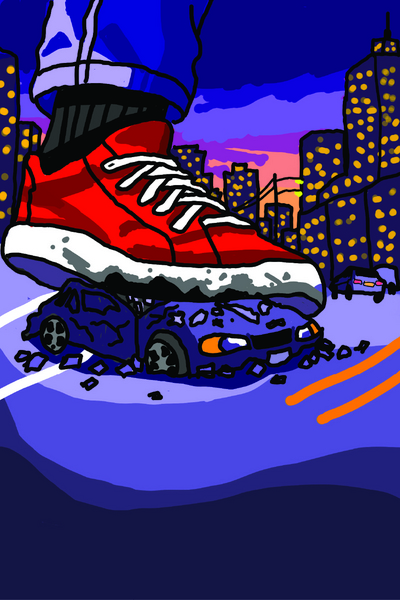
Dating a giantess isn't easy!
Amelia Rose, once a brilliant inventor's daughter, is now a towering, unstoppable colossus.
With monstrous creatures invading the city, her new size may be the only thing powerful enough to stop them.
Can Richard and his giant friend save the world... and survive the chaos?

Comments (0)
See all