
A calm wind whispered; leaves trembled.
A tiny, round bluebird swept down and landed on a low branch beneath the tree. It shook its head and cocked an eye at the sleeping boy. He shivered; the bird hopped from the branch, fluttered up and settled on his shoulder, light as a thought, jabbing its beak at the marching ants.
His chest stuttered. He drew a sudden breath; his head snapped up and the bird launched. He stayed frozen—mouth ajar, eyes blown wide—shaking in fits.
"Hah. Hah. Hah…" He stared at the rolling hills and the green field, blinked, and closed his mouth. He rubbed his eyes; his fingers lingered at his brow.
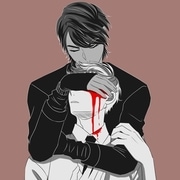
Warm slickness clung to his skin—thick and sticky. He lowered his arm. His fingers trembled, stained with blood; his skin split in thin, aching sores.
His heart hammered, his mouth widened again. He set his hand in his lap and leaned back against the tree, staring at the sky.
An engine rumbled distant, then a thud and a harsh screech. Wind rose, tearing at the clouds. Sirens began to wail—close now, layered and keening. Sunlight pricked his eyelids as footsteps closed in; voices murmured—urgent, muffled.
The sun beat down on his muddied face, matting his thick, dark curls with grit. His hazel eyes, usually bright, were now blown wide and vacant.
Hands reached for guns; fists tightened; weapons leveled. Two men stepped forward—one in black, one in white—plain‑suited and unblinking amid armored soldiers bristling with plates. Their jaws locked; brows knitted.
"What did you do?" the man in white demanded, drawing a quick line between his eyes. The blood slid across the blade, but the boy said nothing. He didn’t flinch; he just kept staring at the sky.
The man in white sheathed his blade. The man in black nodded. "Take him."
Soldiers surged. They yanked his arms, forced him face‑down, bound his wrists, clamped a gag across his mouth. The crowd's murmur swelled into a single low tide.
"Konin! Konin!" a thin voice called—high, trembling with something like hope. The name brushed the edges of his mind; he could not answer. Memory ripped him backward—to the night of rain, to the small, ordinary room a month ago.
A month earlier, rain hammered through the night, echoing down the halls. He lay awake beneath a shadow and listened to thunder crack and lightning rip the sky.
He pushed the sheets aside and swung his feet to the floor. Posters and game cases lined the shelves; letters were pinned on the wall. At his desk the lamp haloed the page. He opened a letter: "Thank you for all the letters you sent me, Konin. I feel better knowing someone so kind is looking after me. I'll be home soon."
He folded it closed, pulled a book from the pile, and read until his lids drooped.
Morning found wind chimes singing and the house still damp from the rain. Water dripped from the sink; incense threaded the air. A woman knelt before an altar; a photograph of a man sat at its center. She bowed, prayed. Footsteps yawned into the hall.
The boy paused, eyes fixed on her. He walked over, knelt beside her, and clasped his hands. Silence settled. They bowed, then raised their faces. She smiled. "Thank you, Konin."
"Yeah," he smiled back.
Her smile faltered. She touched his cheek. "Did you sleep enough?"
He sucked his lips, gently pulling her hand away. "Yeah—was reading."
He helped her up. "I've got exams."
"Already?" she said, surprised. "But you just started."
He shrugged. "Guess that doesn't count." He pulled a bottle of milk from the fridge and glanced at the counter: a lunchbox beside a sandwich on a saucer.
"You made breakfast?" he asked, setting the milk back.
"And lunch," his mother replied, gathering her bags. "Thought I'd give cooking a try."
She looked up; he sniffed the food. "You can throw it away if it's bad—I kind of rushed it," she said, waving her hands.
He sniffed the food, then ate the sandwich she set aside. "Thanks, Mum," he mumbled through a mouthful.
Her eyes fluttered; she pressed her lips to contain a smile and took a breath. "You're welcome."
She swung around and picked up her keys from the living-room counter. "I'll be back by nine," she said, hand on the door. "Want me to take you to school?"
"No—I'll take the bus." He finished the plate and began washing it in the sink.
She nodded. "See you soon."
"You too."
Water ran from the tap. The door shut closed.
He scrubbed the plate's edges, coughed, and pressed his lips together. Setting the plate under the stream, he braced both hands on the sink's rim and frowned until his brow creased. He retched into his hand.
Hand over his mouth, he dashed to the fridge, yanked it open, grabbed the milk, and forced himself to chug. The milk burnt his throat and the churns tasted like copper.
"Bwahhh—ahh," he grunted, slamming the bottle onto the counter. He glared at the sink and took another gulp. He sighed, turned off the tap, set the plate in the rack, and exhaled sharply.
The wall clock chimed eight. "I should get going," he said, drying his hands, tossed the bottle into the bin, and headed upstairs.
He opened the first door on the right and pulled his shirt over his head. "Judy—" his phone lit up. "What's the weather like?"
"It's raining in Kaizawa, New Edo right now. Feels like 49; actual 53..." He walked to the wardrobe and pulled out his uniform. "...Today's high 66, low 44."
He spread the uniform on the bed. "Raining?" He looked out the window. Tiny wisps slid past the glass; the sky was a flat sheet of gray. He rolled his eyes and added a hoodie.
His gaze drifted to the wardrobe mirror. Eyes fixed on his reflection, he turned his face and stroked his cheek; a few stray curls slipped through his fingers. He grabbed a razor from the drawer and shaved off his sideburns. He ran his hand over his face again; it was smooth.
He brushed his teeth, showered, and donned his uniform. He gathered his things and packed his lunch.
"Okay—am I forgetting anything?" He scanned the well-lit, tidy room. "EarPods." He stepped back in, emerged a moment later, and said, "Okay."
He switched off the lights, slung his bag over one shoulder, and paused at the small altar. He stared at the photograph and whispered, "Goodbye, Dad," then closed the door behind him.
Konin lay face down on his desk, ears plugged, eyes fixed on the page; his pencil trembled like a leaf. Black scribbles smudged the margins into a mist.
A man a few feet away wrote equations on the whiteboard. "Konin? Konin?" he called; there was no answer. He glanced down and sighed. The man clicked the marker closed and flicked his wrist, in a quick haze, the marker flew. Konin swatted at it; it struck the window's corner with a sharp crack.
For a heartbeat the glass held, then disintegrated into a million crystalline pebbles. The spent marker bounced off the crumbling frame and rolled across the stark, white room—settling at Konin's feet amid two lone desks and a whiteboard
The man clicked his tongue, meeting the boy’s eyes. "Am I boring you?"
"Yes," Konin said, and returned to his work. The man shook his head, picked up a plate with a half-eaten slice of cake from his desk, and walked over.
He stood beside him. Konin didn't flinch. The man bent to retrieve the marker; as he rose, a cold wind rushed in. Beyond the shattered frame, a dripping tree leaned over a fence that bordered the road; little else showed. Distant children's laughter threaded through the damp air. The man checked his watch—12:30—and tugged an EarPod free. Konin glared.
"Wanna play video games?" the man asked.
"Not today," Konin replied, keeping his face set. He raised an open palm; the man replaced the EarPod. Konin kept his hand up.
"What?" the man said.
Konin flashed a smile at the cake.
"Hell no." Mr. Smith grunted.
The smile faded. "C'mon, Unc."
"What did you call me?"
"Please, Mr. Smith—I haven't eaten at all today," Konin begged, hands clasped.
"What about your lunch?" the man asked, pulling the plate back.
"My mum made it."
Mr. Smith's mouth opened, then closed. He stared into Konin's bright eyes and sighed. He handed the plate back. His other hand shimmered silver, formed a fork, then snapped normal. He placed it in Konin's hand; the boy ate eagerly.
Mr. Smith returned to his seat. "Enjoy it—we've got a test after this."
"Oh, come on," Konin whined.
Mr. Smith smiled and pulled the test sheets onto his desk.
Konin ate, but the expression on his face soon dulled. He became still, turned from Mr. Smith, and stared straight ahead. He took the cake in measured bites.
When he finished he laid his finger against the table.
His fingertip was a drum, beating a steady rhythm.
Mr. Smith murmured as he placed the test on Konin's desk. Konin nodded and stared at the page. "Shut up," he whispered; rage rippled across his face as he picked up his pencil.
"Shut up." He wrote the first line.
"Shut up. Shut up..." he murmured, each repeat harder than the last.
He stopped, dropped the pencil, leaned back, and whispered it again. "Shut up."
He stared out the broken window as the word pushed through him, louder and louder, the room's edges narrowing until—everything went dark.
Air hissed from below.
Glowing lights flecked the night; tall buildings stretched across the horizon. Holograms of a great dragon and its kin soared through the streets, their shimmer reflected in Konin’s window. He leaned against the glass, hair mussed into a loose clump, a slim smile at the corner of his mouth. Passengers climbed the steps and the driver waited for their stop.
After the doors closed, the lights drifted away. Konin watched people move through the city—some like him, others creatures of every kind. An empty lunchbox dangled from his lap and his bag was squashed between his feet.
“It wasn't so bad.” He adjusted an earbud and sat up straighter. “Well, yeah, but that's what made his character so interesting.”
The lunchbox slipped to the floor. He bent to pick it up and when he looked up a pair of eyes met his—childish, wide, curious. He smiled and covered his face with both hands.
“Boo.” He revealed himself, but the child gave no reaction. Konin offered an awkward laugh and hid his face again. This time light passed through his fingers in a faint sheet of mist; his earbuds fell away. When he opened his palms, delicate, flower-like forms unfurled from his head—transparent, glistening in red and blue. They reflected in the child’s eyes and then in the faces of the other passengers.
Shimmers drifted with the floating petals, and the sweet scents of jasmine and rose threaded the air. Phones rose. The child began to smile; at that laugh the flowers receded and Konin’s face brightened into a wide grin. The passengers applauded. Konin laughed, waved, and made one more bloom: a red peony with a stem as clear as water.
As the child reached, the peony dissolved.
Red droplets clung to Konin’s palm. His hands trembled, his breathing hitched. He shrank into the corner, knocking his lunchbox and smearing the glass with the crimson print of his palm. Concerned faces leaned toward him, but he raised one hand. “Get back.”
Shadows darkened his eyes.
“Is everything all right back there?” the driver called. Konin’s head snapped toward the front; a mother scooped her child close to her chest. He fumbled for his phone—dead. He yanked the pull cord, over and over, fingers pressing against the watching passengers who could do nothing but look on.
When the bus finally stopped, Konin fled.
Views blurred into a haze; a distant train rang somewhere far off. Konin’s breath came in heavy, ragged pulls as he hit the ground. The world split into three—sinking and spinning—and lights stabbed at his eyes. He tumbled, rolled along the floor. Mud and water smeared his face; for a long moment he lay still, trying to breathe.
A low grunt—almost a growl—came from nearby. “Are you crazy?” someone snapped.
Konin lifted a hand to his side and pushed himself up. “Sorry,” he muttered, turning toward the voice. Faces swam; he couldn’t make any of them out. He wavered as he tried to steady himself. Another voice soothed the bystander, but before they could do more, Konin bolted.
He ran. He didn’t know where he was going; he only knew he had to get away. Wind tugged at his hair as he tore down the street. He ran until his legs burned and cramped; when he could go no further, he stopped.
“Hah, hah, hah…” He slumped against a wall and sat there, panting. Engines rumbled and people murmured nearby—proof he wasn’t far from home. He tilted his head back and let the cold air fill his lungs.
How long he sat, he didn’t know. When he finally opened his eyes, he found himself staring at his own feet: ants marching on the pavement, cars and buildings filling his view. He glanced down at his clothes—no uniform donned—and noticed dried red on his hand, veins of color dark against his skin. “What are you doing?” he asked himself, lips sucked in, an old habit resurfacing.
He pushed himself up and stepped into the nearest convenience store. The automatic doors beeped and folded open. He went straight to the counter. “Never do that again,” he scolded.
He fell into line and waited. “Everything. From class, to whatever you were doing on the bus,” he continued. Konin looked at the people around him; they stared strangely. At first he blamed the red on his palms, then realized his ears felt light—empty—without his EarPods.
He shook his head. You fool, he thought, peering at his hand. The redness seeped away as if sinking into the skin; moments later his hand looked ordinary again.
When it was his turn, the clerk began, “Hi—” but seeing him she went pale, recoiled as if the sight of him had drained her color.
“Emerald Ridge,” Konin said flatly. The clerk blinked, clearly lost. Konin pointed at the display behind her.
“Right—right.” The clerk reached, knocking a few items to the floor. Konin checked the clock besides her: nine PM. She scanned the pack and handed it over. He drew the last useful thing he had—his wallet—and set money on the counter.
The clerk watched him leave, not even realising she'd just sold cannabis to a minor.






Comments (1)
See all