

The sky, the high blue sky swayed above us and time thundered on. I heard the roar of battle and the clash of weapons. The horses bolted and the cart, nearly falling apart, bounced on the bumps in the road. I thought the horses were frightened of the attackers and realised that I had turned, when I saw boundless horror in the eyes of the cart-driver looking at me. The foolish villein screamed, dropped the reins and jumped off the wildly swaying cart, clumsily rolled to the side and, it seems, broke his neck as he hit a tree.
The horses screamed and kept rushing forward. The cart slewed sideways and skidded. I was thrown up and hurled out. Turning over with effort, like a fish thrown out of the water, I landed on the ground, firmly digging in my hooves and the fingers of my right hand, while with my left I held the body of my dead beloved.
Right in front of me, I saw a mounted crossbowman. He even had the nerve to shoot, but his hand trembled and the bolt missed the mark. I reached this brave fellow in two leaps, wrenched the crossbow from him, smashed his head apart with it, and went to look for a quiet place where I could leave Wind Petal for a while.
I walked through the seething battle around me without anger. Fatigue, as after two or three sleepless nights, weighed heavily on me and my eyelids burned, as if someone had thrown sand in my face. I passed by the fighters without interest, observing them indifferently, like an idle onlooker making his way through a market crowd. Bandits would not dare to attack a military convoy, and, at first, I decided that this was some detachment of Almohads, somehow separated from their own. But those were l’Amori’s dogs, who had been tormenting the heart of the south for a year now and who apparently intended to profit from the Southerners’ spoils of war. I did not care.
But it was naïve to think that no one would care about me either. I had been noticed and cries of astonishment and horror echoed from all around. As usual. Having descended to a massive old plane tree growing by the roadside, I heard the thunder of hooves behind me. Five or six of them were in pursuit. One had broken away from the pack. Steel hissed as it cut through the air, but I nimbly avoided the blow and the sword merely grazed the tree trunk, scattering splinters.
They should have simply shot me with their crossbows, those fools. It might have worked. But no. Would a knight miss a chance to duel with a monster? Standing tall, I watched the rider as he struggled to turn his horse for another assault. The agitated Arab stallion whinnied and reared, refusing to come any nearer. I surveyed the other riders. Their horses were mostly decent, but not heavy warhorses, just ordinary mounts. Most likely, they had attacked the convoy on a whim of opportunity.
When the rider finally managed to control his horse and directed it towards me, I shouted:
‘Give me a few more minutes, lumberman. Do not anger the gods. Can't you see — I am saying my farewell to the maiden?’
But the fool, his helmet dented and splattered with blood, raised his sword and charged forward. I laid Wind Petal on the ground, closed her eyes, left her there by the plane tree and, stepping towards him, greeted the horse with a blow between its ears. The rider I struck in the stomach so hard that he was thrown from the saddle. I grazed my knuckles against his chainmail and, suddenly, this insignificant pain ignited my fury. Rage, despair and relentless sorrow overwhelmed me, I roared, head thrown back, my cry surging up into the air like hounds in full pursuit. A flash of lightning split the sky — the clear blue sky. Thunder boomed and black clouds began to crawl from the distant mountains.
Picking up the stunned horse, I hurled it at the others charging towards me, towards their death. Hooves flailed in the air, an exposed white belly flashed, a piercing scream, cries of anger and pain, the abominable crunch of bones. A melee kicked off. I went at them as they scrambled in the dust and behind me the storm unfurled.
The long-horned god, or someone else up there in the heavens, spread darkness above me to heighten the terror of battle. Growling and rolling, the dark clouds crept across the sky, smoky black, sometimes letting through a mocking shaft of sun before closing again, heavy and ominous, and hanging so low, as if the skies had decided to crash down to earth. The wind tore leaves from the trees, broke branches, and white lightning slithered across the leaden belly of the clouds.
A knight charged at me with a cross sewn onto his brigandine, brandishing a Turkish spiked mace. I simply ripped his arm off, grabbed the mace, struck the next one on the head, driving his helmet down to his shoulders, dropped to the ground, broke the horse's legs with the same mace, rolled over and, pushing with my palms, kicked another horse in the chest.
Getting up, whipping my flanks with my tail, I roared again, stretching my neck – and the echo of thunder, rolling across the sky, answered me.
The battle flared up with renewed vigour and the noble knights of the south, those who remained alive, threw themselves at me with the same desperate fury as the northerners they despised. They charged like hounds at a boar and I flung them aside, as a boar flings aside dogs, killing and maiming, and their pitiful cries filled the air. If Petal were alive, oh, if my wonderful Madonna Petal were alive, she could have convinced the southerners to retreat, to save themselves, she could have led the convoy to the fortress on Mount Tabor. But she was dead, and no one was there to reason with them.
In the thunderous rumble, in the flash of lightning, I tossed men on my horns, tore them apart, pierced them with iron and trampled them into the dust — all of them, until none were left. The clouds dispersed without a drop of rain, and sunlight poured down from the heavens, flooding the blood-soaked earth, illuminating the motionless, torn bodies littering the road. Spent, I collapsed upon the corpse of a fallen horse and wept — for the first time, or possibly the second, if we are to admit that I, like everyone else, cried when I was born.
She was dead. My beautiful Madonna Petal was dead. Had I answered for her death? And to whom? To life itself? Had I avenged her death? What was the point? It would not bring her back.
It would have been better if the sun above El Iqab had been my last. Better if I had never seen the light at all, if I had remained in darkness. I cursed the light and the sun, but nothing happened. My curses were powerless. The sun still shone, and a solitary raven circled in the sky, bathing in its rays.
Soon a whole flock of them would gather, I thought, I must hurry. Although there was nowhere to hurry anymore.
I stood up and walked, slipping in blood, guts and filth, looking for the large plane tree under which I had left Wind Petal. I remembered de Bornel's words ‘...I accompanied your beloved when she was looking for you after the battle and we had to pull you out from under a whole mountain of corpses...’ I saw de Bornel. A crossbow bolt protruded from his left eye socket. I was glad that it was not I who had killed him.
Petal lay where I had left her, on her side, her arms oddly twisted. Her braids, scattered, radiated from her head like dark rays. Her body was already beginning to stiffen.
I picked up someone's sword, found a large shield with a sharpened end, laid her gently onto its concave side and carried her on the shield, like a child in a basket.
I passed through the grove and saw a hill below which lay a small abandoned vineyard. I carried her to this hill and, passing through the vineyard, remembered how Wind Petal asked lo Ros ‘is it true that in the pays d’Oc they cut off an ear for stealing a bunch of grapes?’
‘If it were so, Madonna,’ he replied with a laugh, ‘all my countrymen would go around with one ear, or even without ears at all. Even foxes steal grapes here. It's a pity that the time is not yet right, and I can't offer you a taste of these tender, pink berries, but when the grapes ripen, I will definitely steal a bunch for you.’
I thought that the grapes were still green and lo Ros lay dead, there, on the rocky road, along with everyone else. I hoped that it was not I who had killed him.
Climbing the hill, I laid Wind Petal in the dry yellow grass and dug a grave — so deep that even in the daytime, one could probably see the stars from it. I finished closer to nightfall, when there was no need to look at the stars from a grave.
I lifted my dead beloved up in my arms and jumped into the pit. I laid her on the ground and lay down next to her, looking at the stars, soaring in the dark, distant heights. The crickets chirped monotonously; the leaves rustled — perhaps it was foxes making themselves at home in the vineyard? It smelled as it had in the hell where I grew up — of blood and heavy, earthy damp. I thought — should I open my veins, should I stay with her, here, forever? Just like returning home.
The Game of Jart, Gloria Mu
Translated by Simon Hollingsworth
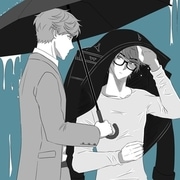
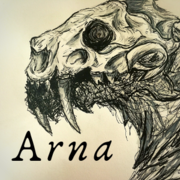
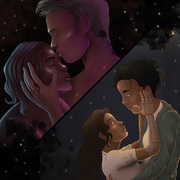
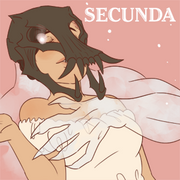
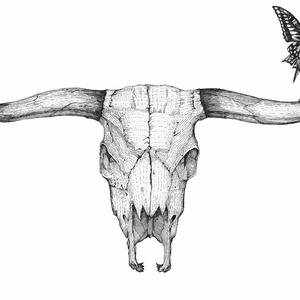
Art by Aleks Klepnev
Published with authors' permission




Comments (6)
See all