
It was one thing for Amalia to declare her intentions to Euphemie. It was quite another to see them through. As her carriage drew itself close to Silberwald Manor, Amalia steeled herself the way she had for some of the most gruesome battles of her career. No matter what carnage she faced, she would keep her goal in mind.
Euphemie’s contract would make it into her hands by the end of the visit.
It was her brother who greeted her when she arrived.
“Eberhard,” Amalia said as she opened the door to the carriage, “how lovely to see you.”
“You as well, sister,” he replied. There was an odd tremble to his voice, and though he kept his back straight, exhaustion was clear enough in the bags under his red eyes.
“Are you sleeping well?” Amalia asked.
“Pleasantly enough,” he replied, helping Amalia step down from the carriage, though he did not have to.
“I am glad to hear it,” Amalia said, though she knew he was lying. The original novel had been quite clear: Eberhard had nightmares. Lady Margaret had naturally soothed these with her touch; if so, why was he looking so exhausted now?
Amalia took her suitcase from the carriage, a leather case packed with a change of clothing for the next few days. With all the effort of travel, she could not justify staying only a day, no matter how much she wished.
Having thanked the coachman and instructed him to spend a few days in the nearby town before returning, Amalia followed her brother indoors.
“You've come at a good time,” he said, ushering her through a grand foyer, passed a parlor room, and out a pair of ornate glass doors to the back garden. “Lady Margaret just finished setting up.”
With that he left without a word. Amalia swallowed her disappointment. How long had it been since they had last spoken? Ever since he had begun courting Lady Margaret, Amalia had found it difficult to see him.
At least, she had thought, her brother was happy. She could have lived with him and Lady Margaret marrying, so long as that was the case. But she had not seen them together since the execution, and could not help but wonder if the book’s portrayal of their relationship left out key details.
But for now, she mustn't think of that. As she strolled through the garden in the direction Eberhard had pointed her, a gazebo appeared among the rose bushes. Like the rest of Silberwald, its architecture seemed drawn together from delicate lace, its white marble threaded with elegant tracery. Someone had draped garlands of flowers upon it. When the wind picked up, it plucked petals out and twirled them through the air.
The scene was so picturesque that Amalia became certain it was intentional.
The four women sitting in the shade of this gazebo were the pictures of elegance, waiting in their pastel tea dresses, cooling themselves with embroidered fans. Their fashion was opulent, their gazes serene as they looked up at her.
Only when they took in Amalia’s visage did their eyes widen.
“Good day,” Amalia said, feeling rather out of place, garbed, as she was, in nearly all black.
Lady Margaret stood to welcome her, an immediate illustration of their differences.
“Lady Amalia,” said Margaret, her voice sweet as syrup. “How wonderful to see you made it.”
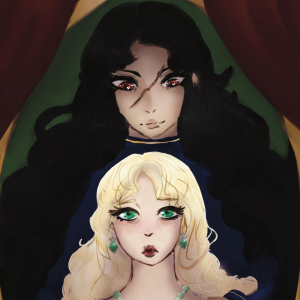
She wore the perfect gown the color of lilac, its neckline swooping, its silhouette cinched. Her pale hair had been pulled back into an elegant bun, her face decorated with just the right amount of makeup.
The protagonist of the novel was the picture of an imperial lady. Amalia could not help but wilt beneath her perfect gaze. It was strange that Prince Leopold had ever betrayed her. She would have made a fantastic queen.
Compared to her and the rest of the guests, Amalia imagined she must look rather terrifying.
In truth, she was accustomed to standing out. Even when she had tried to be a normal woman, her strangeness had been obvious. Further, once she had begun to wear the clothing of her father, once she had taken over the duchy, had fought for the empire, had gotten her scars, she had lost any chance at reaching such perfection.
No matter, she had thought. She did not require the approval of others. And, despite their bitter words, they would still need her all the same, when the time came for another war.
Remembering Euphemie’s advice, Amalia straightened her back.
“Lady Margaret,” Amalia replied, unable to keep the ice from her voice. “Thank you for your invitation.”
She must have made a strange picture. A woman too tall, cloaked in dark hair, her face bisected by a scar. Black boots instead of soft slippers, breeches rather than a skirt, a waistcoat where a corset ought to be, and a dark overcoat. Feeling naked without her sword, Amalia had elected to take her father’s old cane, which she rested her hands upon now.
The women at the table were staring. Lady Margaret smiled, but it was a strange thing between horror and delight.
“What a sharp outfit, my Lady,” she remarked.
“It is not much different than the ones you have seen me in before, Lady Margaret,” replied Amalia.
One of the women stood from the table and approached. “My Lady Margaret means that we had not expected you would wear such an outfit to a tea party.”
She spoke in a lilted, looping sort of accent. This voice, the olive tint to her tan skin, and the thick curls that framed her face, marked her as a visitor from the southern peninsula. Once a great empire, it had shattered into a hundred little city-states, kingdoms, and republics.
The woman’s rosy hair, pulled into a hairnet-wrapped bun, betrayed her name.
This was Beatrice, of the merchant-republic of Lumia. Amalia remembered her well from the book.
She had been an antagonist.
Introduced as one of Lady Margaret’s dearest and oldest friends, who had spent her early days playing alongside her in the Silberwald garden, Beatrice had been shown to be two-faced and terrible, coveting Margaret’s noble title and doing all she could to break her and Eberhard apart.
Amalia’s other self had found Beatrice intriguing, but had been disappointed by her stated motivations. Resenting that your friend was part of the nobility and you were not, when you yourself had more wealth than any god could dream of, was not particularly interesting. Her purpose, it had seemed, was to bully Margaret and be hated for it. But she had only truly gotten started after the death of Euphemie, and had failed to leave the same mark on the audience.
Lady Margaret clasped her hands together. “Now, Beatrice. Lady Amalia defended our empire and may wear what she likes.”
Beatrice smiled. “Of course, my Lady. Why don’t we sit and drink.”
Finally, everyone settled about the tea table. Amalia took stock of the battlefield. Arranged across the circular table was an assortment of delicate little cakes. A pot of tea sat on the table’s center like an ornament. Each lady had her own teacup of translucent porcelain, painted with flowers. It all looked so tiny and breakable to Amalia.
Strolling over from where she had been waiting in the shade of a nearby tree, a dark-haired maid leaned over the table to grasp the teapot, pouring Amalia’s cup. Out of the corner of her eye, Amalia caught the woman’s expression as she examined Amalia through her loose bangs; curiosity was palpable in her gaze.
Lady Margaret threw the first attack. “Lady Amalia. Thank you ever so much for accepting my invitation.” Her smile was sweet but her eyes were piercing. She watched for a reaction.
“Thank you for the invitation,” Amalia said, keeping one hand firmly gripped on her cane. Nobody had touched the tea or food yet. “I hope I did not keep you long.”
“Not too long,” said Lady Margaret. She reached for her teacup; the rest of the women at the table did the same. Finally, they all began to eat in earnest.
“You must be hungry,” said Amalia.
“Nonsense!” exclaimed a woman Amalia did not know. She had blonde hair, fairly common both in the book and in the empire. It had been twisted into an updo of intricate curls, decorated with a little hat. Looking more closely, it seemed she wore a dress just a little too ostentatious for the occasion.
Though the pastel colors were easy on the eye, the cloth flowers fastened upon it were far too bright, the large gems hanging from her neck and ears glimmering like dewdrops in the sun. The color of the rouge on her lips was ever so slightly too dark. It would have been a marvelous outfit for an imperial gala, but here it seemed incongruous.
“We ladies need not eat so often. I suppose someone as...” and here the woman glanced Amalia up and down, her blue eyes wide, her cheeks a little pink, “... muscular as you would need to eat more.”
“Don't be rude, Lady Livia,” said Beatrice.
“It's only an observation!” Livia said. Amalia blinked; she hid it very well, but there was a slight tinge to her accent. It was still of the Holy Empire, but betrayed some regional mannerism she did not want the others to perceive. Was this a character the original book had mentioned? Amalia’s other self had not noted her in any dream.
The fourth woman at the table sighed. “Observing does not typically involve speaking.”
There was a serene quality to her voice, just slightly ruined by the malice dripping from it.
“Lady Catherine,” said Margaret, “don't punish the poor girl for not understanding the etiquette. She is provincial, after all.”
Amalia shut her eyes for a moment. The enemy was mighty indeed. Lady Catherine was a villainess’ villainess, with a reputation to match. Lady Margaret had avoided her terribly in her first life, and immediately sought her out in her second. She had been a major ally, and Amalia’s other self had enjoyed the friendship between them.
Her hair, styled in an elegant bun, was a bright red. With her white dress she seemed as breathtaking delicate rose in winter.
Livia pressed her lips together, then spoke. “I apologize, Lady Amalia.”
“I am used to talk, Lady Livia,” said Amalia. “Nonetheless I appreciate your apology, though I do not mind your curiosity.” She leaned back in her seat, wondering what to say. A proper lady would eat something delicate, even when her brothers ate large meals.
Euphemie’s advice came to her once more. Holding in a sigh, she leaned forward over the table.
“In truth, I do eat more than is ladylike. It keeps me strong.”
Lady Catherine blinked. “And why do you need to be strong, Lady Amalia?”
There was something cruel about her smile.
Amalia grinned, feeling sharp. “When you've gone to war, Lady Catherine, perhaps you will understand.”
Livia opened her mouth. “Perhaps you mightn't have gone to war if you weren't,” she gestured to Amalia, “the way you are.”
Amalia smiled. “Perhaps, Lady Livia. But it's all done with, for the moment. And it is far too late to become a proper lady now.”
Finally, she sipped her tea. It was a little bitter, but not as much as she had expected.







Comments (0)
See all