
No sooner had the friend departed than Toshika's mother arrived. She, as usual, brought many gifts of things that she knew he liked, boxes of his favourite cakes and silk clothes for the spring season. Grateful for all her love and care, he thanked her affectionately and tried to appear bright and cheerful during her visit. But his heart was aching, and he could think of nothing but of the loss of Shorei, wondering if her farewell was final, or whether, as she vaguely hinted, she would come to him again. He said to himself that to hold her in his arms but once again he would gladly give the rest of his life.
His mother noticed his preoccupation and looked at him anxiously many times. At last she dropped her voice and said:
"Toshika, listen to me! Your father and I both think that you have arrived at an age when you ought to marry. You are our eldest son, and before we die we wish to see your son, and to feel sure that the family name will be carried on as it should be. We know of a beautiful girl who will make a perfect wife for you. She is the daughter of an old friend, and her parents are willing to give her to you. We only want your consent to the arrangement of the marriage."
Toshika, as his mother unfolded the object of her visit, understood the meaning of Shorei's warning, and said to himself:
"Ah, this is what Shorei meant—she foresaw my marriage, for she said that to-day I should understand; but she pledged herself at the same time to see me again—it is all very strange!"
Feeling that his fate was come upon him he consented to his mother's proposal.
She returned home delighted. She had had little doubt of her son's conformance to his parents' wishes, for he had always been of a tractable disposition. In anticipation, therefore, of his consent to the marriage, she had already bought the necessary betrothal presents, and the very next day these were exchanged between the two families.
Toshika, in the meantime, watched the picture day by day. This was his only consolation, for Shorei, his beloved, visited him no more in his dreams. His life was desolate without her and his heart yearned for her sweet presence. Had it not been for her promise to come to him again he knew that he would not care to live. He felt, however, that she still loved him and in some way or other would keep her promise to him, and for this waited. Of his approaching marriage he did not dare to think. He was a filial son, and knew that he must fulfil his duty to his parents and to the family.
As the days went by Toshika noticed that the picture lost by degrees its wonderful vitality. Slowly from the face the winning expression and from the figure the tints of life faded out, till at last the drawing became just like an ordinary picture. But he was left no time to pine over the mystery of the change, for a summons from his mother called him home to prepare for the marriage. He found the whole household teeming with the importance of the approaching event. At last the momentous day dawned.
His mother, proud of the product of her looms, set out in array his wedding robes, handwoven by herself. He donned them as in a dream, and then received the congratulations of his relatives and retainers and servants.
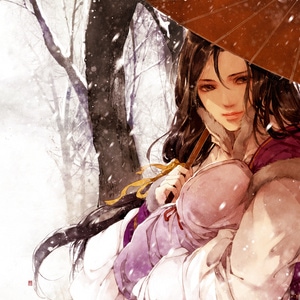
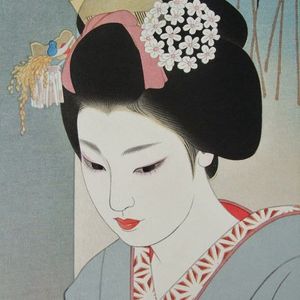
In those old days the bride and bridegroom never saw each other till the wedding ceremony. When the bride was led into the room and seated opposite Toshika, what was his bewildering delight to see that she was no stranger but the lady-love of his picture, the very same woman he had already taken to wife in his dream life.
And yet she was not quite the same, for when Toshika, a few days later, joyfully led her to his own home and compared her with the portrait, she was even ten times more beautiful.







Comments (1)
See all