
The earth was wild and untamed—rivers flowing through mountain passes, vast forests stretching endlessly, and the cries of animals and birds echoing in the wind. That was the world the Anunnaki beheld when they first set foot upon the planet. But their arrival would change everything. The fate of Earth’s creatures was about to be rewritten.
Enki’s Laboratory
At the heart of the African plains, in a valley encircled by towering mountains, stood Enki’s laboratory. Gigantic glass domes rose like crystal palaces, filled with radiant energy particles and illuminated by technologies far beyond human comprehension. Genetic science was practiced here with crystal-based instruments so advanced that even in the present day, mankind could scarcely imagine them.
Ninhursag, revered as the “Mother of Life,” was Enki’s sister and fellow scientist. Tirelessly, she conducted experiments. Hominids from Earth were captured, their DNA extracted, and carefully fused with the genetic essence of the Anunnaki. Each attempt, each form, each “creation” was documented in detail.
At first, the results were failures. Giants were born—immense in size but lacking intelligence. Some lacked eyes, others could not breathe. The experiments faltered, but the Anunnaki did not give up.
The First Success – Adam
One day, at last, success was born.
A child emerged—taller and stronger than the primitive hominids, yet smaller than the Anunnaki. In his eyes gleamed the spark of intelligence.
Ninhursag lifted the child gently in her arms and whispered:
“He is the success. He is Adam.”
Adam—the “first man.”
He was nurtured, educated, and guided. He learned to walk, speak, cry, and laugh. He discovered how to seek food, and soon he began to understand the Anunnaki language. This was humanity’s first great leap forward.
The Birth of Eve
Though Enlil opposed the idea at first, he eventually conceded.
“One man is not enough. He needs a companion.”
So Adam’s DNA was taken, and from it a woman was created. She was given the name Ti-Iti, though human legend would later remember her as Eve.
Together, under Enki’s watchful guidance, Adam and Eve grew. They bonded, they loved, and they bore children. Their offspring became the first tribe of humankind.
Humanity’s First Labors
The early humans were set to work in the gold mines of the Anunnaki. They broke stones, dug into the depths of the earth, and extracted veins of precious gold.
To them, the Anunnaki were gods—beings of awe and terror. Their shining garments of metal, their radiant weapons, their flying ships: all filled human hearts with both fear and reverence.
In caves, early humans painted what they saw—fiery chariots descending from the skies, winged beings of power. These images remain etched upon the walls of ancient caves to this day.
Enki and Enlil – The Dispute over Mankind
Enki wished for humans to grow. He taught them writing, agriculture, and knowledge.
“One day,” he said, “they will be as intelligent as we are. They have a future.”
But Enlil argued fiercely:
“They are slaves. Their purpose is service alone. If they rise too high, they will challenge us.”
Thus began the conflict that would define humanity’s destiny—the struggle between freedom and servitude.
The Birth of Civilization
The descendants of Adam and Eve formed tribes. They hunted, they farmed, they tamed fire. Most importantly, they began to question the skies above.
“Where did our gods come from?”
“Is there another world beyond the heavens?”
Their questions became the seeds of the world’s first religions.
The Anunnaki established temples among them, teaching rituals of worship and sacrifice. Humanity was instructed to honor the gods, and so the earliest forms of religion took shape.
Yet Enki whispered a forbidden truth to his closest followers:
“You are not merely slaves of the gods. You were born from us. Our blood flows in your veins.”
The humans were astonished, passing this secret down through generations. But when Enlil learned of it, his fury shook the halls of the Anunnaki.
“This must never be revealed! If they know the truth, they will rise against us.”
A Distant Threat
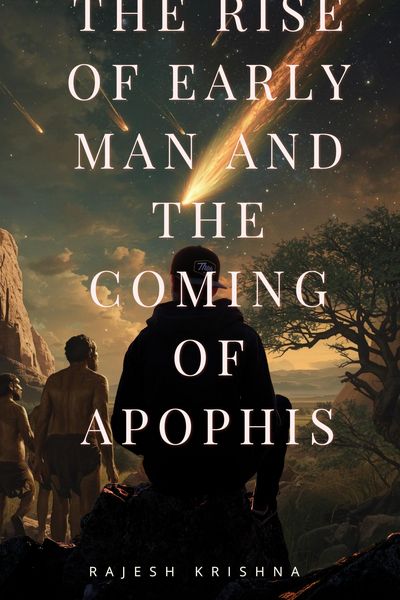
One night, the Anunnaki astronomers at their sky-observatory witnessed something unusual. In the darkness of the heavens, a massive stone blazed with light, moving steadily closer to Earth.
Enki gazed at it in alarm.
“This is the fire-stone spoken of in prophecy. One day it will strike the Earth, and with it, mankind’s destiny will be forever changed.”
But Enlil dismissed the warning.
“That is not our concern. We came for gold. Let Earth’s fate be its own.”
Yet within Enki’s heart, a vow took root: When that day comes, I will try to save mankind.
The Glow of Apophis
By the fire, Adam and Eve sat with their tribe. They gazed up at the stars, their faces lit by the flickering flames.
Adam asked:
“Our gods came from the heavens. But who are we? Are we their children… or their slaves?”
Eve smiled softly.
“One day, our children will find the answer.”
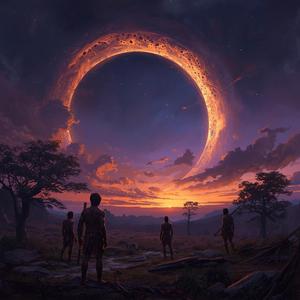
And above them, in the distant sky, a glowing stone drifted closer.
The humans did not yet know it by name, but in ages to come, they would call it Apophis—the Stone of Death.





Comments (0)
See all