
DREAMLINE – Volume 1: The Last Dreamer
"And then I understood.
I wasn’t just a dreamer.
I was the first dream."
Do you remember what an alarm clock is?
Probably not. Nobody needs one when dreaming has been purged from our bodies like a disease.
At some point after the Great War, humanity stopped dreaming.
It wasn’t gradual. It gave no warning.
One night, people went to sleep… and never dreamed again.
During the war, the Germans resorted to improvised biological weapons—crafted on the battlefield with one goal in mind: to overpower the U.S. military.
And they succeeded.
But the same weapons that carved their way through trenches and cities… sealed their fate.
The side effects were devastating: irreversible damage to the brain, mental collapses, and a progressive neurological decay that spread like an infection.
Most German soldiers fell into comas. The rest… simply lost their minds.
Even those not directly exposed developed anxiety, depression...
But the most notorious symptom—affecting nearly the entire global population—was the loss of dreaming.
The phenomenon became known as The Dreaming Silence.
Governments studied it.
Pharmaceuticals tried to cure it.
But it was Dreamline Inc. that turned it into a product.
Today, dreaming is no longer a right.
It’s a service.
And an extremely expensive one.
People lie down at night not because they want to… but because they have no choice.
They close their eyes. Count to a hundred.
And then—nothing.
A sterile darkness. No dreams. No images. Just a clean, quiet void.
At dawn, the weak rays of sunlight graze their faces.
Their bodies have rested.
But their minds?
Their minds remain trapped.
They get up with the same blank expression they had when they went to bed.
Day after day.
Entire cities, suburbs, and families were dismantled by the war.
The United States collapsed into a fragile, fragmented sociopolitical state.
The average citizen’s economy crumbled to the point where many could barely afford daily bread.
But the pattern remained unchanged:
The poor got poorer.
And the rich... richer.
And yet, The Dreaming Silence made no distinctions.
It struck everyone, regardless of wealth or ideology.
Humanity had lost everything:
Their homes.
Their loved ones.
And now, even the ability to dream.
ost people couldn’t bear the weight of a reality with no escape.
After the war, they hadn’t just lost their homes, their families, or their countries...
They had lost even the ability to dream.
Not even sleep could offer refuge.
The mind—once a sanctuary—had become sterile space.
Silent.
Empty.
Unforgiving.
The reaction was immediate, and global.
Suicide rates and violent crimes surged to levels never before recorded.
In every city, every town, every corner of the world, men and women fell like dry leaves.
Those who didn’t take their lives—or someone else’s—ended up in overrun mental institutions,
converted into slow-motion morgues without corpses.
It was in that moment of absolute desperation that the U.S. government summoned its best minds:
Psychiatrists. Neurosurgeons. Engineers. Military strategists. Behavioral theorists.
The best of the best.
Their mission: to find a real, tangible, immediate solution.
It wasn’t a medical initiative.
It was a war against hopelessness.
And then, something no one expected happened.
During an emergency session of the federal cabinet—behind closed doors, deep in the heart of an underground bunker—someone else entered.
He hadn’t been announced.
He carried no credentials.
And yet, no one dared stop him.
He wore a long black trench coat that brushed the floor, damp from the rain above.
A hat of the same color shaded his face completely.
No briefcase. No security detail.
Just an air about him—something old, unmistakable.
He walked between generals and ministers as if he had always belonged there.
Then he sat in the only chair that had remained empty until that moment.
The president—a man aged by tragedy and years in office—watched him with quiet confusion.
—Dr. Cassain Vorn… —he murmured, barely above a whisper—. I didn’t think you’d join us tonight.
The room froze.
Only the voice of the newly arrived dared to break the silence.
—No one can escape a nightmare… if they no longer know they’re dreaming. I can change that.
The air in the room grew dense.
Secretaries exchanged nervous glances; none of them dared to speak.
Even the Secretary of Defense—who had once stared down nuclear threats—seemed uneasy in the presence of the man in the black hat.
The president cleared his throat, as if trying to convince himself this was real.
—Dr. Vorn… if you truly have something to offer, we’re listening. We no longer have time for riddles.
Vorn didn’t answer right away.
He reached inside his coat and pulled out a small leather folder, which he opened with surgical precision.
Then, he slid a blurry photograph across the table.
It was a brain scan.
A recent one.
—This was taken eight days ago —he said calmly—. A patient.
Name: classified. Location: restricted.
She dreamed.
The silence thickened.
—Naturally? —someone asked, breaking protocol.
—Yes. Spontaneously. Recurringly. Fully.
And most importantly: reproducibly.
Her brain still retains intact the synaptic pathways for oneiric activity.
The Secretary of Health leaned in, incredulous.
—That’s biologically impossible. We’ve tried everything—drugs, deep brain stimulation, synthetic REM mimetics…
—No. —Vorn cut him off without raising his voice—}
You’ve tried to imitate dreams.
I’m going to transmit them.}
His tone changed.
He shed the mystery and spoke like a businessman.
A man with vision. A conqueror.
—If only one can dream… then others can witness it.
We can build a network. A system.
We connect her dreams to secure, structured lines.
The client sleeps connected. Escapes. Pays.
And wakes up satisfied, never knowing they’ve invaded the mind of another human being.
The cabinet didn’t know whether they were witnessing salvation… or the birth of a monstrosity.
The president, weary beyond expression, simply asked:
—What’s the name of your system?
Vorn smiled—barely.
—Dreamline.
The direct line to the unconscious.
There are no official records of that meeting.
The files were sealed.
Everyone present swore silence.
And the original patient—the source of it all—vanished. Although some rumors claim her name was changed.
And that many years later, somewhere in the world, her mind still dreams... whether she’s aware of it or not.
For years, no one mentioned Dreamline again.
No official statements. No street rumors.
Just a name buried in classified documents and conspiracy theories whispered in dark corners.
Meanwhile, the world kept looking—desperately—for ways to fill the void left by dreaming.
Pills. Hypnagogic stimulation implants. Simulated REM therapy. They all failed.
The global economy slowly dragged itself out of the rubble. But the human soul remained buried beneath it.
Until one night, without warning, something interrupted every American television broadcast.
Black screens. Then, distorted footage. Camcorder grain. Snippets of empty rooms, endless hallways.
And then—cut.
A completely black screen. A single line of text blinking faintly, like a system glitch:
Tired of not being able to dream… again?
There was no music. Only raw static hissing from the speakers like a breath with no lungs.
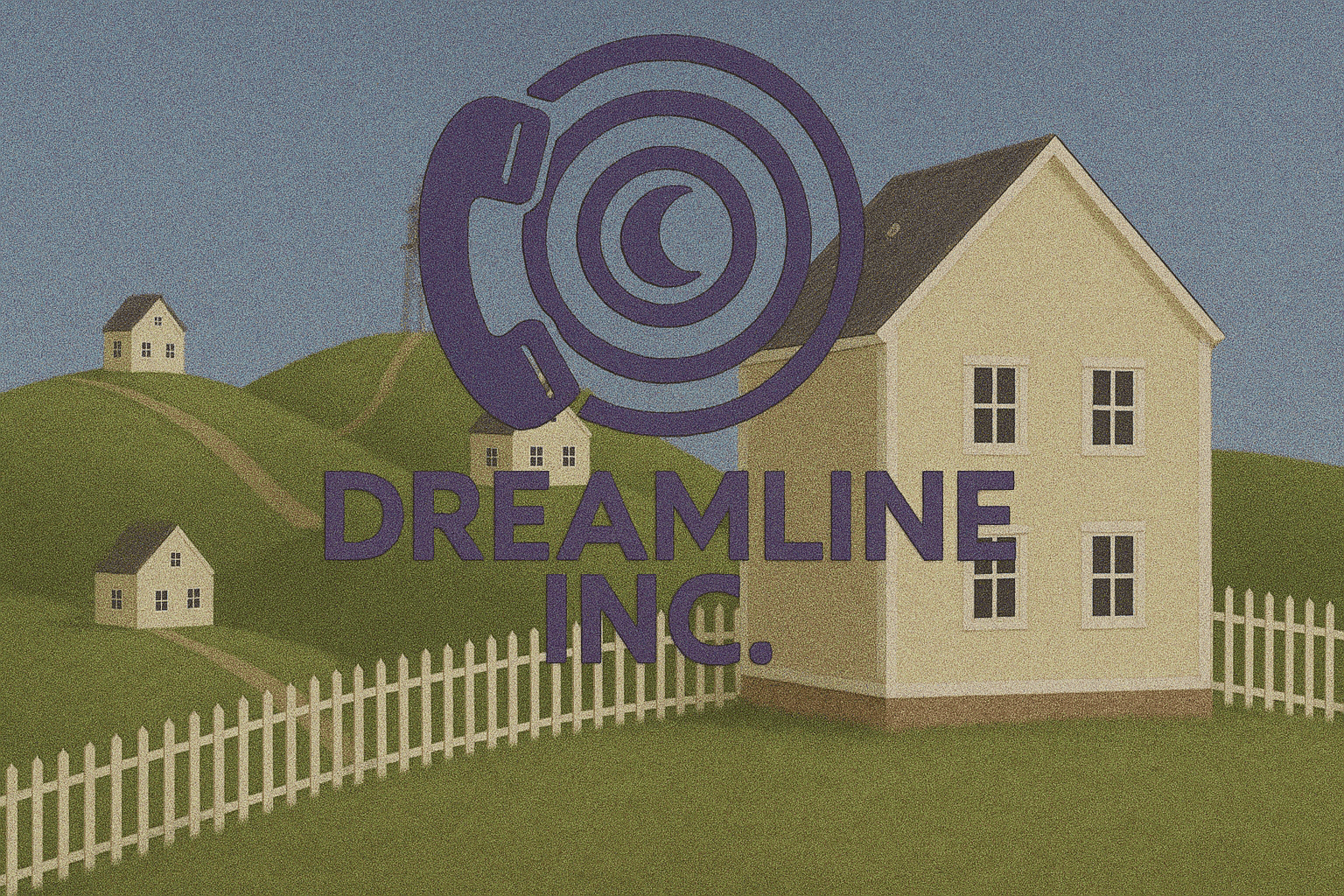
And at the end, a faded logo.
A phone number, glowing in deep purple, stayed onscreen for a few seconds:
DREAMLINE INC.
1-800-DRM-LINE
CALL US BEFORE IT’S TOO LATE.











Comments (0)
See all