
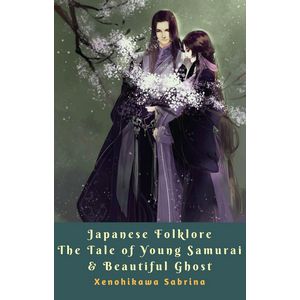
Many years ago, long before the present prosaic era, there lived in Yedo a young man named Toshika. His family belonged to the aristocratic rank of the hatamoto samurai, those knights who possessed the right to march to battle directly under the Shogun's flag (hata), and his father was a high official in the Tokugawa Shogunate.
Toshika, whose disposition was of a dreamy and indolent nature with scholarly tastes, had no occupation. He took life easily, and when his studies were finished, he went to live at the family villa situated in the suburb of Aoyama.
Toshika was not interested in society, and except for an occasional visit to his home or to his favourite friend, he never went anywhere. Far from the world he spent his days quietly and pleasantly, reading books, tending and watering his flowers, practising the tea-ceremony, and composing poetry and playing on the flute. He was a young man of many accomplishments and studied art. He collected curios and specimens of well-known calligraphy, which all Japanese prize greatly, and he particularly delighted in pictures.
One day a certain friend whom Toshika had not seen for several months, came to call upon him. He had just returned from a visit to the seaport of Nagasaki and knowing the young man's tastes had brought with him, as a present, a Chinese drawing of a beautiful woman, which he begged Toshika to accept.
Toshika was very pleased with this acquisition to his treasures. He examined the painting carefully, and though he could find no signature of the artist, his knowledge of the subject told him that it was probably drawn by the well-known Chinese painter of the Shin era.
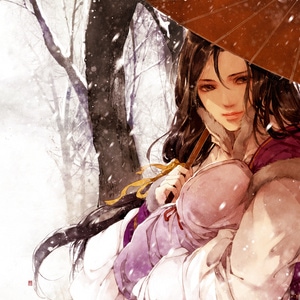
It was the portrait of a young woman in the prime of youth, and Toshika felt intuitively that it was a real likeness. The face was one of radiant loveliness, and the longer he gazed at it, the more the charm and fascination of it grew upon him. He carried it to his own room and hung it up in the alcove. Whenever he felt lonely he retired to the solitude of his chamber, and sat for hours before the drawing, looking at it and even addressing it. As the days went by, gradually the picture seemed to glow with life and Toshika began to think of it as a person. He wondered who the original of the portrait could have been, and said that he envied the artist who had been granted the happiness of looking upon her beauty.
Daily the figure seemed more alive and the face more exquisite, and Toshika, as he gazed in rapture upon it, longed to know its history. The haunting pathos of the expression and the speaking wistfulness of the dark soft eyes called to his heart like music and gave him no peace.
Toshika, in fact, became enamoured of the lovely image suspended in the alcove, and as the infatuation grew upon him he placed fresh flowers before it, changing them daily. At night he had his quilts so arranged that the last thing he looked upon before closing his eyes in sleep was the lady of the picture.
Toshika had read many strange stories of the supernatural power of great artists. He knew that they were able to paint the minds of the originals into their portraits, whether of human beings or of creatures, so that through the spiritual force of the merit of their skill the pictures became endowed with life.
As the passion grew upon him the young lover believed that the spirit of the woman whom the portrait represented actually lived in the picture. As this thought formed itself in his mind he fancied that he could see the gentle rise and fall of her breast in breathing, and that her pretty lips, bright as the scarlet pomegranate bud, appeared to move as if about to speak to him.
One evening he was so filled with the sense of the reality of her presence that he sat down and composed a Chinese poem in praise of her beauty.
And the meaning of the high-flown diction ran something like this:
Thy beauty, sweet, is like the sun-flower:
The crescent moon of three nights old thy arched brows:
Thy lips the cherry's dewy petals at flush of dawn:
Twin flakes of fresh-fallen snow thy dainty hands.
Blue-black, as raven's wing, thy clustering hair:
And as the sun half peers through rifts of cloud,
Gleams through thy robes the wonder of thy form..
Thy cheeks' dear freshness do bewilder me,
So pure, so delicate, rose-misted ivory:
And, like a sharp sword, pierce my breast
The glamour of thy dark eyes' messages.
Ah, as I gaze upon thy pictured form
I feel therein thy spirit is enshrined,
Surely thou liv'st and know'st my love for thee!
The one who unawares so dear a gift bestowed
Was verily the gods' own messenger
And sent by Heaven to link our souls in one.
'Tis sad that thou wert borne from thine own distant land
Far from thy race, and all who cherished thee;
Thy heart must lonely pine so far away,
In sooth thou need'st a mate to love and cherish thee.
But sorrow not, my picture love,
For Time's care-laden wings will never dim thy brow
From poisoned darts of Fate so placidly immune;
Anguish and grief will ne'er corrode thy heart,
And never will thy beauty suffer change:
While earthly beings wither and decay
Sickness and care will ever pass thee by,
For Art can grant where Love is impotent,
And dowers thee with immortality.
Ah me! could the high gods but grant the prayer
Of my wild heart, and passionate desire!
Step down from out thy cloistered niche,
Step down from out thy picture on the wall!
My soul is thirsting for thy presence fair
To crown my days with rapture—be my wife!
How swift the winged hours would then pass by
In bliss complete, and lovers' ecstasy:
My life, dear queen, I dedicate to thee,
Ah! make it thus a thousand lives to me!
Toshika smiled to himself at the wild impossibility of his own chimera. Such a hope as he had breathed to her and to himself belonged to the realm of reverie, and not to the hard world of everyday life. Supposing that beautiful creature to have ever lived and the portrait to be a true likeness of her, she must have died ages ago, long before ever he was born.
However, having written the poem carefully, he placed it above the scroll and read it aloud, apostrophizing the lady of the picture.






Comments (0)
See all