
The sky hung low over the churchyard, leaden and still, pressing against the earth like a lid sealed tight for winter. Frost rimmed the edges of withered grass, clinging to the path with quiet determination. The air held no promise of warmth—only the sting of late autumn’s cruelty, weeks ahead of its time. A damp heaviness settled in the soil, as if the season itself had forgotten how to breathe. Nearby, a mound of fresh earth stood raw and unsettled, framed by wilting lilacs laid gently at its base.
A small congregation stood gathered, their breath rising in pale clouds that vanished before reaching the bare branches overhead. Black coats buttoned tight, gloved hands folded, eyes fixed downward—not out of reverence, but preservation. Silence ruled, broken only by the brittle crunch of boots on frozen soil and the distant caw of a crow circling once, then vanishing. The vicar’s voice—steady and solemn—was muffled by the cold, more rhythm than message, a benediction that hovered but never quite landed.
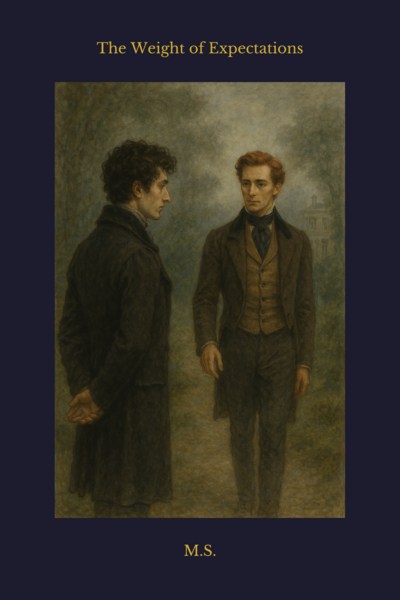
A few steps apart from the rest stood Mr. Henry Blyth, hands folded before him, the hem of his coat brushing the brittle grass. He was not set above the others, only aside—a man pulled slightly out of place by the gravity of grief. His posture, long trained for responsibility, now bore the final weight of inheritance. No longer the son merely bearing his father’s burdens, he stood as the man to whom they had been left. The role fit him outwardly—well-groomed, composed, precise in his stillness—but something in the set of his jaw betrayed that the weight had settled fast and heavy.
Mrs. Josephine Blyth stood at her son’s side, posture unbent beneath the weight of loss. Her gloved hand rested lightly on his arm—not for comfort, but for steadiness, as if to anchor them both in ritual rather than emotion. She had known grief before; she carried it now as she always had—with quiet dignity, unshaken but not unmoved. The wind tugged at the edge of her veil, but nothing in her bearing shifted. She wore her mourning like she wore her lace: precisely placed, perfectly measured, and never meant to unravel in public.
Eleanor and Margaret stood close beside their mother, veils drawn, figures still. Grief wore differently on them: Eleanor, the elder at seventeen, held herself with a composure that mimicked womanhood, her chin lifted as if defying the cold. Her hands were neatly clasped, her expression unreadable but watchful. Margaret, younger by four years, leaned subtly into her sister’s side, her gloved fingers worrying at the ribbon of her sleeve. Her usual exuberance was muted, not absent—held in check by the weight of ceremony and the nearness of the grave. Where Eleanor endured, Margaret trembled and blinked quickly, like someone trying to understand a story with no ending.
The service had been simple, as his father would have wished. A man of reason, of measured words and steady habits, he had no patience for ornament in life and would not have tolerated it in death. Mr. Blyth had seen to it that every detail reflected that sensibility—no choir, no flowers beyond what the family brought, no unnecessary words.
And yet, as the vicar offered the final benediction, as the last clumps of frozen earth struck the coffin with a muted thud, as the murmured amen passed like breath from one mourner to the next, Mr. Blyth felt it—that slow, inevitable shift. The weight of expectation, settling onto his shoulders as quietly and finally as the soil upon his father’s grave.
From behind came the inevitable murmurs, hushed but deliberate—not grief, but expectation.
“A great responsibility for a young man.”
“He will manage, of course.”
“A steady head, like his father before him.”
Mr. Blyth, well accustomed to such pronouncements, received them as he always had—with a composed nod, a quiet word of thanks, and a face trained not to flinch. He had long understood that such remarks were not offered to comfort, but to confirm. People did not speak to discover truth—they spoke to affirm what they had already decided to believe.
It was not grief that made him silent. Grief had settled within him long ago—patient, persistent, and familiar. No, what unsettled him now was the quiet certainty in the voices around him: this was the rest of his life.
The mourners drifted away in quiet clusters, their exit marked by hushed farewells, solemn nods, and the soft press of gloved hands in passing condolence. One by one, they vanished down the path until only the family remained. Mr. Blyth offered his arm to his mother and, with quiet ceremony, led her toward the waiting carriage.
It was only when they had nearly reached it that she spoke, her voice as even as it had been all day.
“You know, Henry… Lingering won’t change anything. You needn’t remain here forever”
The words halted him, as surely as if she had placed a hand upon his chest.
He turned, startled. “Mamma?”
She did not meet his eyes, only moved forward with steady poise, her gloved hand resting lightly on the door as she stepped into the carriage—the motion practiced, unhurried, the posture of a woman who had long since learned to carry on without waiting for permission to grieve.
Eleanor and Margaret had already climbed inside, their veils drawn, their voices quiet beneath the hush that followed them from the grave. With a final glance toward the closed earth behind him, Mr. Blyth followed, closing the door with care.
The driver gave a small flick of the reins.
The road stretched before them, winding through quiet lanes and past fields still bare from winter’s retreat. The sky remained unbroken in its grey expanse—a vast, pressing thing, as though it, too, had resolved to bear witness to their grief.
Mr. Blyth sat opposite his mother, his sisters nestled beside her, their heads inclined toward one another in hushed murmurings. He had not spoken since the churchyard. Her words lingered, unsettled, a stone dropped into still water. The phrase did not sit comfortably within him. It stirred something—an unease, a question—but no resolution.
He turned his gaze to her, though she did not meet it. Her eyes remained fixed on the rolling countryside beyond the carriage window.
“Where else would I go?”
She turned to him then, her gaze direct but not unkind. “Wherever you wish, Henry. The world does not end at the edge of Elversford.”
He considered her, brow faintly furrowed. “It’s not the edge I fear.”
“No,” she said, more gently, “it’s what lies within it. Familiarity. Obligation. The sort of duty that wears a man's name down until he no longer remembers how it began.”
He looked away, toward the window. “It isn’t duty I resent.”
She gave the smallest nod. “Then be sure it does not resent you.”
He was quiet a moment, then said, barely above a whisper, “I made a promise.”
“And you will keep it,” she replied, her voice soft but firm. “But a promise born of sorrow should not be mistaken for a life sentence. Not even one made to the dead.”
The silence that followed was not cold—but it was final. Nothing more needed saying. And yet, everything still hovered, unsaid.
The carriage wheels hummed beneath them, a steady rhythm that filled the space where words had run their course. Mr. Blyth did not offer a reply, but his mother, practiced in such silences, seemed not to expect one. It was how they had always spoken in moments that mattered—with glances, with gestures, with truths too heavy for language. Still, the promise lingered in his chest, a quiet pulse beneath his stillness. It was not a burden born of resentment, nor an oath he wished to escape. It was simply there—unchanging, unyielding—shaped not by pressure but by love, and that more insistent force that people called duty.
His father had never begged for allegiance, never pressed obligation with words. He had only asked—once, near the end, with breath that faltered and eyes that no longer focused—whether Henry would stay. And Mr. Blyth, standing beside the bed as the light failed outside, had said yes. There had been no hesitation, no weighing of future against past, only the instinctive response of a son who had never known how to disappoint the man who had raised him.
So he had remained. Not because ambition failed him, nor because fear held him back, but because something softer and older compelled him. A promise made without ceremony. A life reshaped without protest. A duty assumed so fully it had begun to wear his name like second skin.
So he had done what was necessary, not out of ambition or self-congratulation, but because there had been no other path. The modest home he once acquired in a rare moment of personal independence—a small but deliberate rebellion—had been relinquished without ceremony, the sale quiet and efficient. Its profits, like so much else of himself, had been folded into the estate with dutiful precision. His mother and sisters would be secure, at least in that. The law practice, once his father’s pride and daily burden, had passed into his hands without fanfare. In truth, he had been managing it long before the last breath left the elder Mr. Blyth’s chest, the transition so gradual it had barely been noticed.
There had never been discussion, nor even a formal acknowledgment of what must be done. Only the soft, accumulating weight of duty met without protest. And yet, despite every reasonable justification, despite each tidy ledger and completed brief, the words his mother had spoken—quiet, composed, gently delivered—lingered with the stubbornness of something deeply true. They refused to be reasoned away. They did not accuse, nor demand. They merely remained, like frost on the grass refusing to melt, waiting for something more than obedience.
A silence stretched between them, unbroken but for the rhythmic clatter of the carriage wheels against the road. The sound was steady, almost meditative—like a metronome marking the passage of duty, not time. Across from him, Eleanor and Margaret spoke in hushed tones, the kind reserved for mourning or cathedrals, careful not to disturb the solemn veil that still lingered over the day. He knew he ought to lean forward, to offer a hand, a word—something paternal, now that the role had fallen to him. It was expected. It was proper.
But his mother’s words had lodged themselves deeper than he wished to admit, shaking loose something long settled, something he had never dared to examine. He turned his gaze back toward the window, toward the narrow lanes threading away from Elversford, twisting into a countryside he had known all his life and yet never considered as anything but background.
Not forever. The words echoed again, less like permission and more like possibility. He was not ready to leave—not yet. But the road no longer ended at the churchyard gate. And that, for now, would have to be enough.
At last the carriage passed through the gates of Greymoor House, the name as familiar to local record books as it was to the family that bore it. It was not a grand estate—no ancestral seat with sprawling wings or storied towers—but a house of sound reputation and enduring modesty. There was no great opulence to boast of, nor any visible signs of decline. Instead, it stood with the quiet dignity of something deliberately maintained: neither improved upon nor allowed to falter, as if held in balance by generations too practical for excess and too proud for neglect.
Its weathered stone façade bore the gentle erosion of time, softened by the persistent ivy that crept across its walls, curling through windowsills and climbing along chimneys like a second skin. The land surrounding it rolled gently outward, not dramatic but dependable—gardens orderly, orchards fruitful, tenant farms yielding a modest, consistent return. Long ago, the Blyths had held more—more acreage, more tenants, more influence—but that era had faded with little protest. What remained was manageable, sufficient, and resolutely their own.
As the carriage came to a halt upon the gravel drive, the great oak door opened with quiet precision, revealing the familiar figure of Mrs. Redley, the housekeeper.
She was a woman of broad, solid constitution—shaped not by indulgence but by a lifetime of resolute labor. Not particularly tall, she nonetheless possessed a presence that filled the threshold, an effect heightened by the certainty with which she moved through the world. Her face bore the ruddy hue of one unbothered by parlors or powders, weathered by years of garden wind and hearth smoke. Her hands, though calloused, were deft with comfort—capable of coaxing a fever down or soothing a child’s tears with equal ease.
She had stood in the halls of Greymoor longer than Mr. Blyth had drawn breath, and it was perhaps for this reason that she did not greet him as a servant greets a master, but rather as one might receive a boy returned home, grown into the man the house now required.
“Mr. Blyth,” she said with a slight curtsy, her voice neither overly formal nor lacking in warmth. Her eyes flicked briefly to his mother and sisters, taking the measure of them with a practiced glance before giving a small, satisfied nod. “It is well you’ve come home.”
Mr. Blyth inclined his head and stepped down from the carriage, the crunch of gravel beneath his boots punctuating the moment. He turned to offer his hand to his mother, who accepted it with quiet poise.
Mrs. Redley turned to Margaret and Eleanor, her sharp gaze softening at the sight of their veiled faces. “Come now, dears,” she said, tone brisk but not unkind. “Inside with you—grief may be a heavy thing, but it needn’t come with a chill.”
The entrance hall of Greymoor House received them with its usual hush, the kind reserved for solemn occasions and long absences. The scent of beeswax and old woodsmoke clung to the air, mingling with something subtler—dust, perhaps, or memory. It was just as Mr. Blyth remembered it: the tall-backed chairs aligned with quiet precision, the rug worn at the corners from years of pacing, the grandfather clock ticking on without fanfare.
And yet, it felt colder now.
As he crossed the threshold, he found himself listening—not for voices, but for the familiar sound of his father’s step, the clearing of a throat behind the study door. He knew it would not come. Still, the silence echoed louder for its absence.
This house, always his father's in name and bearing, now belonged to him. Its walls stood firm, its foundations unchanged. But the weight of its inheritance pressed differently now—not as a shelter, but as something that must be borne.









Comments (1)
See all