
How many model rocket engines would it take to launch a real rocket into space?
—GREG SCHOCK, PA
About 65,000, give or take a few.
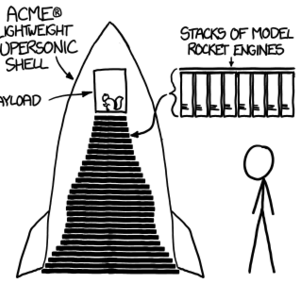
You’d have to arrange them like this:

The rocket would weigh about as much as a tow truck. There wouldn’t be room for anything except the engines, aerodynamic shell, and minimal staging equipment.
Each rocket motor would burn for about three seconds. The layer cake arrangement means that every three seconds, the bottom layer of spent rockets would detaches and the next stage would kick in. It would go through between 25 and 30 of these stages, burning for a total of a minute and a half, after which it would coast upward and just barely brush the edge of space.
(For this design, I’m assuming something akin to Estes E9-4 engines, which are on the large end of the common model rocket engines. There are larger ones—the classes go all the way up to O and beyond—but at a certain point, they stop being model rocket engines, and just become rocket engines.)
A 30-stage rocket is, to put it lightly, an engineering nightmare. This design assumes the non-engine portion of the vehicle is limited to the weight of a person (60 kg). In effect, the spaceship would be a solid block of rocket engines. They’d need to be insulated from each other so the upper stages didn’t ignite prematurely, and the staging and aerodynamics would both be a challenge.
The stack of engines narrows as you go from bottom to top. By the time the top stages are firing, the rocket will have shed most of its mass, so it won’t need as much thrust to get the same acceleration.
The reason the engine stack bulges in the middle is so that the acceleration profile will look like this:

Rockets work best when their thrust is several times greater than the force of gravity. But you don’t want to accelerate too quickly while you’re low down. Air drag increases with the square of your speed, and if you accelerate too quickly, you’ll find yourself wasting all your fuel just to maintain your speed. You want to accelerate slowly at first, then ramp it up as the air starts getting thinner.

Now, as you may have noticed, this rocket will get you into space (for a few seconds, at least), but not orbit. Can you use model rocket engines to dock with the ISS?
No.
Taking into account atmospheric drag, to get into space, you need a rocket capable of accelerating (in a vacuum) to about 2 kilometers per second. To get to orbit, you need a rocket capable of accelerating to about 10 kilometers per second.
If you try to produce an orbital rocket using the same design math we used for the suborbital rocket, it spits out a description of a pancake-shaped mountain of model rocket engines over a mile wide. It would taper to a 10-meter-high spire in the center and would weigh about as much as the Great Pyramid.

Not only would this vehicle never get out of the atmosphere, it would probably not stand up under its own weight.
Frankly, the word “vehicle” is a bit misleading. Essentially, what you’ve created is an unstable pile of gunpowder the size of Central Park. If it went up in flames—which it would—it would break the record for the largest manmade non-nuclear explosion in history. (Interestingly, the current holder of that dubious record is also a rocket that exploded during launch.)
The bottom line is that it would be very difficult, but perhaps not impossible, to launch something up to the edge of space using model rocket engines. However, if you try to build a ship capable of getting to orbit, you will not go to space today.










Comments (0)
See all