
The ring was heavier than I expected.
Not physically. It weighed almost nothing, just a slim band of gold that sat on my finger like it had always been there. But the weight of it. The meaning. The promise. That part pressed against my chest every time I looked at it.
Three days since the Ceremony, and I'd already developed a habit of spinning it with my thumb. Clockwise when I was anxious. Counter-clockwise when I was trying to convince myself I wasn't.
Right now, it was spinning fast enough to generate electricity.
"You're doing it again," Danny said, not looking up from his phone.
"Doing what?"
"The ring thing. The spinny thing. You look like you're trying to unscrew your own finger."
I forced my hand flat against the cafeteria table. "I wasn't spinning it."
"Bro, I've been sitting here for ten minutes and you haven't stopped." Danny finally looked up, his dark eyes sharp with the brand of amusement he reserved exclusively for my suffering. "It's been three days. Relax."
"I am relaxed."
"You literally haven't blinked since I sat down."
"That's. a medical condition."
"It's called being dramatic."
Danny Park had been my best friend since we were eleven, when he'd accidentally hit me in the face with a basketball and then insisted on carrying my books for a week out of guilt. He was loud where I was quiet, confident where I was a mess, and had the emotional range of a motivational poster taped to a refrigerator. He was also the only person in my life who could make me laugh when I felt like the world was ending, which, at this particular moment, felt dangerously close to the truth.
He'd gotten his ring eight months ago. It had matched him to a girl named Megan Cole within the first week, a new record for our district. The rings practically detonated the moment she walked into his economics lecture. According to Danny, he'd been so startled by the glow that he'd knocked his coffee into his lap and spent their first interaction smelling like burnt hazelnut.
"My point is," Danny continued, leaning back in his chair with the easy confidence of someone whose ring had already done its job, "you're eighteen. You got your ring. It's gonna work. Stop acting like it's broken."
"I'm not acting like it's broken."
"You googled 'defective ring symptoms' last night."
I stared at him. "How do you know that?"
"You texted me a screenshot at 2 AM asking if I thought a ring could be 'factory defective.' Your words. Factory defective. Like it's a toaster."
I opened my mouth. Closed it. He had a point, and I hated that.
"The average time to find a match is 4.7 months," I said, because when I was stressed, I defaulted to statistics the way other people defaulted to breathing. "Some people wait over a year. Derek waited a whole year."
"And Derek is happily matched now, and you will be too." Danny pointed a french fry at me. "Also, stop memorizing ring statistics. It's not a healthy coping mechanism."
"You don't know that."
"I literally do. Megan is a psychology major. She told me."
The thing about getting your ring is that everyone treats you differently afterward. Not in a dramatic way, no one rolls out a red carpet or hands you a trophy. It's subtler than that. It's in the way people look at you, the slight shift in their eyes from kid to potential. Like you've been upgraded from a rough draft to a feeling that might actually matter.
My mom was the worst about it. Not in a bad way. She was thrilled, ecstatic, practically vibrating with happiness every time she saw the ring on my finger. She'd already called every relative within a three-state radius to report the news, complete with a detailed description of the ring's color, size, and "energy."
"It's got a beautiful warmth to it," she'd told Aunt Carol on the phone, holding my hand up to the kitchen light like I was a showcase item on a shopping channel. "A real golden glow."
"It's not glowing, Mom."
"It has a warm energy."
"That's just. gold. Gold is warm-colored."
She'd waved me off and continued her call, describing the Ceremony in a level of detail that suggested she'd taken notes.
Dad was different.
He didn't say much about the ring. He'd congratulated me at the Ceremony, squeezed my shoulder, smiled. But in the three days since, he hadn't brought it up. Not once. When Mom would start talking about it at dinner, the possibilities, the timeline, whether my match might be someone we already knew, Dad would nod along, but his eyes would drift to the window, or to his plate, or to the ring on his own finger that glowed steadily against Mom's.
I'd caught him looking at me once, the morning after the Ceremony. I was standing at the kitchen counter, cereal untouched, staring at the ring and willing it to do something. Dad had paused in the doorway with his coffee mug, and when I looked up, there was that expression again, the shadow I'd first seen when I was eight, standing on his shoulders in Heartstone Hall. That flicker, a mix of sadness and recognition, like he was watching me walk toward a door he'd already been through.
"Morning," he'd said.
"Morning."
He'd taken a sip of coffee, eyes on my ring for just a moment, and then walked past me to the table.
"Cereal's getting soggy," he said.
That was it. That was all he said.
I didn't know what to do with that. So I ate my soggy cereal and pretended I wasn't unsettled.
After lunch with Danny, I headed to the bookstore.
Not a chain, a real one. Inkwell & Ember, tucked into a narrow storefront between a dry cleaner and a noodle shop on Birch Street. The kind of place where the shelves leaned slightly and the air smelled like aged paper and the owner's cat slept on the philosophy section like it owned the place.
I'd worked there since I was sixteen. Part-time, mostly after school and weekends, doing the things that the owner (a wiry, white-haired man named Graham who communicated primarily through grunts and literary references) couldn't be bothered to do himself. Shelving returns. Cleaning the front window. Answering the phone when customers called to ask if we had something in stock, which we usually didn't, because Graham ordered books based on what he thought people should read rather than what they actually wanted.
I liked it. The quiet, the routine, the way the hours dissolved into a comfortable blur of scanning spines and straightening shelves. It was the one place where my brain slowed down enough to stop cataloging everything I was worried about.
Today, though, even the bookstore couldn't turn off the noise in my head.
I shelved returns on autopilot, my mind looping through the same questions it had been stuck on for seventy-two hours. Why didn't it glow? Is it normal to feel nothing? What if 4.7 months is just an average and I'm an outlier? What if I'm the statistical anomaly who never finds a match?
I caught myself spinning the ring again. Counter-clockwise this time. I stopped, flexed my fingers, and reached for the next stack of books.
"You look like someone stole your dog," Graham said from behind the front counter, not looking up from whatever ancient hardcover he was reading.
"I don't have a dog."
"That's probably why you look so miserable. Everyone needs a dog."
"I'm not miserable."
Graham glanced at me over his reading glasses. He had a stare that could make bestselling authors feel illiterate. "You've shelved that same book three times in the last ten minutes."
I looked down. He was right. I was holding a copy of The History of Heartstone Mining and I'd apparently been putting it on the shelf, taking it off, and putting it back again without realizing.
"I'm distracted," I admitted.
"Clearly." Graham turned a page. "Ring trouble?"
"How does everyone keep..." I stopped. Took a breath. "It's only been three days."
"Mmm."
"The average wait is..."
"Four-point-seven months, yes, you mentioned that yesterday. And the day before." Graham dog-eared his page, a crime against literature, in my opinion, and fixed me with a look. "Here's a statistic for you: one hundred percent of the people who spend their first week obsessing over their ring wish they hadn't. Go shelve the fiction returns. There's a whole cart in the back."
I went to shelve the fiction returns. Graham was annoying, but he was usually right.
The fiction cart was massive, three shelves of returns that had piled up over the weekend. I grabbed the first stack and started working my way through the alphabet, settling into the familiar rhythm of it. Anderson, Atwood, Brontë, Calvino.
The bell above the front door chimed. I heard Graham grunt a greeting, which was his version of rolling out a welcome mat. Footsteps moved through the store, light, unhurried, accompanied by a faint sound I couldn't quite place. A soft tapping, like fingers drumming on something hollow.
I rounded the corner of the fiction aisle with an armful of Hemingway and nearly collided with someone.
"Whoa..." I stepped back, clutching the books to my chest.
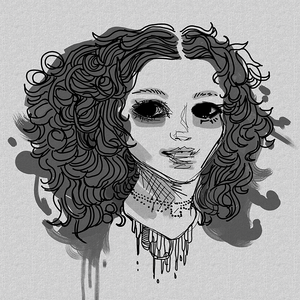
The someone was a girl. About my age, maybe a year younger, with dark hair that fell just past her shoulders and eyes the color of coffee, the real kind, not the watered-down stuff from the campus cafeteria. She was wearing a denim jacket with patches sewn on the sleeves, band logos I half-recognized and a few I didn't, and she had a messenger bag slung across one shoulder that clinked faintly when she moved. The tapping sound, I realized, was her fingers drumming on the strap of the bag. Not nervously. Rhythmically. Like she was keeping time with a song only she could hear.
"Sorry," she said, and immediately turned back to the shelf she'd been scanning. Not flustered. Not lingering. Just a one-word acknowledgment and back to business.
I stood there for a moment, Hemingway pressed against my chest, trying to remember what I'd been doing.
"You work here?" she asked, still scanning the shelf. She ran her finger along the spines, reading titles with the focus of someone who knew exactly what she was looking for.
"Yeah. Can I help you find something?"
"Maybe. I'm looking for a book, Before the Heartstone by Aldric Voss. It's out of print. Ancient. Probably not here." She said this without looking at me, the way you'd tell someone it probably won't rain while already carrying an umbrella.
I knew the book. Not because I'd read it, it was a historical text, dry and academic, about the era before Heartstone was discovered. Most people had never heard of it. The fact that she was asking about it at all was unusual.
"I don't think we have it on the floor," I said. "But Graham might have it in the back. He keeps a stash of stuff he hoards for himself."
That made her turn. "Graham?"
"The owner. Old guy behind the counter. Communicates through disapproving looks and occasional sarcasm."
The corner of her mouth twitched. Not quite a smile, but close. "Sounds charming."
"He grows on you. Like moss. Or a persistent cough."
This time she did smile. Quick, there and gone, like a light flickering on and off. But I saw it.
She turned back to the shelf. "If he has it, I'd appreciate you asking. I've been looking for a copy for months."
"Sure. I'll check after my shift."
"Thanks." She pulled a different book from the shelf, something with a cracked spine and a cover I couldn't make out, and tucked it under her arm. Then she reached into her jacket pocket and pulled out a guitar pick, turning it between her fingers absently as she moved toward the next aisle.
I watched her go, still holding the Hemingway stack like an idiot.
She hadn't looked at my ring. Most people looked, it was reflexive, the way you'd glance at someone's shoes or their watch. A quick scan to check: Ringed or Ringless? Glowing or waiting? Everyone did it. Everyone.
She hadn't even glanced at my hand.
I set the books down slowly and flexed my fingers. The ring sat there, quiet and dull, exactly as it had been for three days.
But for some reason, I was thinking about guitar picks.
She left twenty minutes later. Bought the cracked-spine book, a collection of folk songs from the northern provinces, Graham told me, ringing her up with slightly less hostility than usual, which was practically a standing ovation.
She didn't give her name. I didn't ask.
After she left, I found something on the shelf where she'd been standing. A guitar pick, small and white, wedged between two books like a bookmark. It had a treble clef printed on one side.
I held it up to the light. It was warm from being in her pocket.
I should have put it in the lost-and-found box behind the counter, the cardboard shoebox where Graham collected abandoned bookmarks, forgotten reading glasses, and the occasional love letter that fell out of returned books. That was the protocol. That was what I did with everything.
Instead, I slipped it into my jacket pocket.
I told myself it was so I could return it to her if she came back. That was the reasonable explanation. The logical one.
But as I locked up the store that evening and walked home in the early dark, my hand kept drifting to my pocket, fingers closing around the small, smooth triangle of plastic.
My ring was cold and silent on my other hand.
The guitar pick was warm.
I walked home, and for the first time in three days, I wasn't spinning the ring.
I didn't know her name yet. I didn't know anything about her. Where she lived, what she did, why she wanted an out-of-print book about the time before Heartstone, or why she carried guitar picks in her jacket pocket like loose change.
I didn't know that she was going to dismantle everything I believed about rings, destiny, and the neat little story I'd been telling myself since I was eight years old.
All I knew was that she hadn't looked at my hand. And for some reason, that felt like the most important thing that had happened to me since the Ceremony.




Comments (2)
See all