
I think that I read somewhere, I forget exactly where, that you quickly get used to the stars in the sky, no matter where you travel to. I’m not convinced that this is possible on Sevrin, because our sky is so incredibly complex and different from anything those old writers of Earth would have thought familiar. They probably never thought mankind would ever travel so far. And even at the extremes of the Earth, there is virtually always something familiar in the sky.
Look at our sky now, picture in your mind the complexity of it all and you just have to stop and wonder how a person could ever get used to this.
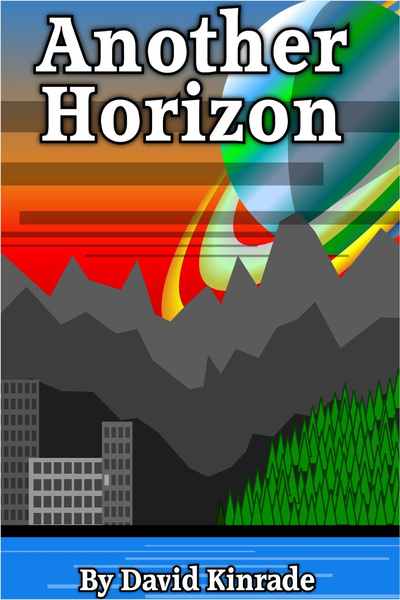
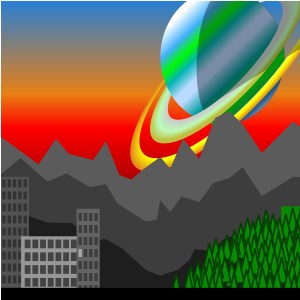
It’s a pleasant Sunday evening, like so many on Sevrin are. There’s less than a standard day to go until dawn and, although it is nominally still ‘daytime’ the only significant light in the sky is the reflected brightness of Artan. Artan and her rings cover almost 10% of the sky, almost unmoving, but ever changing.
I’m walking along in the reflected light of our gas giant then, almost as bright as a cloudy day in full sunlight and certainly bright enough to allow for Rayleigh scattering to drown out most of the stars in the sky. The sky has the usual blue-green glow that one expects in full sunlight but it is impossible to drown out the majesty of Artan.
Naturally, in many lessons at school, we learn about the details of our solar system and the mechanics of our complex position within it. These details are compared to Earth, as that’s really our only point of reference.
Our star, Chara, or more properly in Earthly terms Beta Canum Venaticorum, is a little under thirty light-years from Sol – and Earth – and almost it’s twin in every respect. The rest of the system, however, is very different. Artan is the fourth planet, but it orbits at a very similar distance from Chara as Earth does from Sol. Artan, however, is a gas giant, almost the same size as Jupiter and with a pair of broad, bright rings, not dissimilar to Saturn.
Like any large gas giant, Artan has many moons, probably too many to count or worry about. We recognise fourteen, as they are the ones that can be seen as they dance in our skies. Sevrin is nominally the sixth out from Artan, at a distance of around a million kilometres. This gives us a roughly seven-standard-day orbit and we are tidally locked to Artan, with one face always turned towards the planet.
Sevrin’s night lasts somewhat over three standard days and, during that time, the only ‘daylight’ is that reflected light from Artan and the rings. This is perhaps the time when Artan is seen at her best. The rings are currently angled towards Chara by about ten degrees and we are well over half-way through the night-time part of our orbit. The terminator on Artan is clearly visible, as are the shadows of Artan on the rings as they curve into the dark side.
Being so relatively close to Chara, Artan is a turbulent world, banded with colours ranging from golds and greys to blues and greens, boiling with huge cyclones and turbulent swirls of storms along the edges of each band. She really is a weird hybrid of Jupiter and Saturn, just fortunately with lower levels of electromagnetic radiation and all the benefits of being in the goldilocks zone.
Our weather and climate are, well, complicated. The size of Sevrin’s orbit around Artan is enough to amount to about one percent of the distance to Chara in total difference and this change happens over the course of a single long day. It actually ends up balancing out pretty well. We are closer to Chara when the dark side is towards the star and then further away when the light of Chara is overhead.
We have chosen to live primarily on the side of our moon that faces towards Artan, although there are scientific and experimental stations on the far side, along with the huge floating farms on the Far Ocean. The heating and cooling of the far side, more extreme than the norm on the near-side, is one of the driving forces for our weather.
Winds stream from one side of the moon to the other in a regular cycle, depending on the position of Sevrin in her orbit of Artan. The huge ocean on the far side, bigger than the central sea on the near-side, feeds storm systems that then water and fertilize the fields that maintain life and support our population centres.
Right from the time of our landing on Sevrin, we’ve continued to use standard time when counting years. The orbit of Artan is almost a perfect circle and there’s very little seasonality because of this.
We count a year as three hundred and fifty local short days. One of our short days is a fraction longer than an earth-standard day, but it is easier to divide our orbit around Artan into seven and forget about the difference. So, our 350-day year is virtually the same length as an Earth year and only the number of days is different. A week is a single rotation about Artan and begins with the rising of Chara in Sevrin City as we follow our orbit.

Humans need a circadian rhythm and Nexi, our Nexima AI pilot turned planetary administrator, knew this right from the start. Adjusting a few minutes in the length of a day was fine, but more than that would probably have been impossible. She ensured that our clocks and calendars were set up in such a way that we can thrive and survive on this strange world.
It all seems to work and, for a person who is born into the dance of our system, it all feels perfectly natural and normal. Some days are spent in sunlight and some in the glow from Artan, but you soon become able to tell what day it is from the play of the terminator and shadows on the rings.
Oddest, of course, is the Thursday Eclipse. For almost four hours every week the orbit of Sevrin passes into the shadow of Artan and we are plunged into almost total darkness for the only time in a week. There’s the faintest glow from the diffraction and diffusion near the terminator of Artan, but otherwise this is the only time that the sky turns black and the stars come out.
Here, for a few hours, the dance of the other moons becomes truly visible, a series of fast-moving points of light both inside and outside our orbit. A couple of the inner moons are almost as large as Sevrin, but their atmospheres are thin and their surfaces barren. They have the misfortune to be close enough that the radiation belts of Artan begin to have an appreciable effect on them. They race along overhead, being in a complicated set of reference pairs with Sevrin.
The stars and constellations appear. Some of them would be almost familiar to a visitor from Earth, but some are distorted beyond recognition. Sol itself is a fairly faint star, but visible to the naked eye, in what would be the constellation of Cetus from Earth. As far as I know, nobody has ever bothered to rename or redefine a set of constellations for us, we simply don’t see the stars often enough for them to really impinge on our consciousness. I’m told that, from the far side of the planet, they can be spectacular. Perhaps one day I will go and take a look.
So, we keep a very similar calendar to old Earth, and, now that we have a communication link back to Earth, we can ensure that we keep our years and months in synchronisation.

Getting here had taken more than fifty years.
Now I lived on a thriving planet with a steadily growing population of more than 200,000 people.
One of my distant ancestors, Michael Corlett-Quilliam, had developed a means of putting a human into deep-sleep – a form of suspended animation – that was the first step in making travel between the stars a possibility. Michael’s grandson, my direct ancestor, had decided to be one of the passengers on the first such flight.
Ben-my-Chree had been built in orbit around Earth. Hundreds of launches had been required to assemble the components and then hundreds more were needed to bring aboard the colonists, equipment, seeds, supplies and, above all fuel mass to enable a departure with a chance of success.
The ship was built as a world-wide programme, using the resources of the whole of Earth, as seen fit by the AI network. The idea, however, had been first promoted by the same Nexima organisation responsible for both the bio-neural implants that every Earth adult used as well as the hardware and original software behind the AIs. About 70% of the colonists were, therefore picked from the population of the Isle of Man. That tiny part of the British Isles had long-since become a centre for technology and AI-related projects. Others colonists were then a scattering of experts and volunteers from around the world.
The ship was given the traditional Manx name Ben-my-Chree, roughly “Woman of My Heart” and the name of several sea-faring craft in the history of the Isle of Man.
Many potential stars, all within a 40-light-year radius of Sol had been surveyed by the massive space telescopes at the disposal of Earth and the AI network had debated and deliberated for many months.
Making use of the best information available at the time the ship had set off on a journey to Chara. That journey used fusion-powered ionic engines to exceed 50% of the speed of light and make the 27-light-year journey in just fifty-five years.
When the ship finally arrived here almost two hundred years ago, it found this complex system. Nexi decided that, despite the complexity of the orbital mechanics and the potential difficulties with diurnal differences, it could become another home for humanity. It does seem that there was little choice for the colonists in such a situation.
It took that onboard AI, a computer system so complex that it could be considered sentient, several months and numerous probes sent to the surface of Sevrin to determine that the moon was safe and suitable for human life.
In a final act of faith, using the last of its fuel reserves, Nexi had Ben-my-Chree de-orbited and landed on a small equatorial peninsula that extended out into the ocean almost exactly facing Artan.
Nexi then began the process of waking the travellers from their slumbers. Once the first few colonists were awake and their safety was confirmed, Nexi immediately sent a high-power signal back towards Earth, advising them that our group had arrived safe and were on the surface of a suitable planet. That message would then take more than 27 years to get back to Earth.
Eight hundred colonists worked hard to start a new outpost of human civilisation on this strange new world and soon ran into problems of logistics that would take years to overcome. They built homes, started farms and began to grow a new society, subtly different from the one they left behind.
Sevrin is so earth-like in so many ways that, when you can ignore the sky, it looks and feels just like the old pictures and recordings of our home world. Under the surface, however, it is very different, having formed as a moon, rather than as a planet. Our crust is metal-deficient compared to Earth and finding sources of minerals and ores has been a major problem right from the start. One or two metals, rare even on Earth, are totally absent here, notably Samarium and Gadolinium. Oddly, considering our proximity to a gas giant, we also have no Argon in our atmosphere.
Ben-my-Chree had small-scale manufacturing facilities on-board and these small factory-machines were able to build larger facilities once suitable ores had been located. The first generation of colonists had to make do with log cabins, but they always had electricity and clean water. Well, not exactly logs, but the equivalent plant-stems from the local plant life.
They also always had the advantages of Mesh-based communications and the Nexima implant technology that they had enjoyed on Earth. Sure, Mesh coverage wasn’t as universal on our original world for the first few years, but it worked well in the growing towns and the surrounding farmlands.

The colony has, however, survived and eventually thrived. Earth-born plants thrive here in soils that are rich in lighter elements and a climate that is generally temperate, moist and mild. Most plants adapted quickly to the differing light levels and food production has never been an issue.
Nexi quickly helped to determine that the native plants and animals, while not suitable as food for humans, made excellent raw materials for organo-plastics and the native tree-like plants produced excellent timber. There were no animals larger than insects, but many of them were able to act as pollinators, in a similar way to bees and other insects, as required by many of our plants.
By the time that the first message response from Earth arrived in Earth Year 2205, the colony had grown to a few thousand inhabitants and the second native-born generation was beginning to start school.
Apparently, other colony ships had been sent out since we left, but as they were all going to similarly distant targets, we were the first to respond with a successful outcome. Earth began to send regular communications, soon daily, vastly expanding the knowledge of Nexi and the colony as a whole. We quickly caught up on almost a century of technological advances.
In 2264, a working design for an instantaneous communication system was sent and our best scientists, along with Nexi of course, quickly built the first prototype. The singularity link used the latest ideas in wormhole technology. Having already been tested in Earth’s solar system, we had very few doubts that it would work, but it was still a momentous occasion when real-time communications were established with Earth for the first time. We were once more connected with the bulk of humanity.
Our clocks were resynchronized – we had drifted by a couple of days because of the time-dilation effects of our slightly over half-light-speed peak velocity on the long flight – and our technological advances on both sides were merged into the general pool of human knowledge.
The system was so simple, so reliable and offered so much bandwidth for such a relatively low energy cost that we were soon fully reconnected with the Mesh network on Earth. The descendants of family members left back on Earth were brought back into contact with one another for the first time in more than a century.
The people of Earth marvelled at our planetary system and our unusual sky. We, in turn, took note of their crowded and vast cities, huge industrial capacity and overwhelming ability to all be happy.
More than 100 years have now passed since the first real-time communication link was established and three other colonies are also in touch with Earth and, by association us. Humanity is a multi-planetary civilisation and Sevrin is the largest of her colonies with a population of more than 200,000 people.




Comments (1)
See all