
Later that day, Harold went to his laboratory—not one of the student-run ones owned by the Institute, of course, but his own special, private laboratory, which no one but he and Theodore knew about. It lay in the eastern section of the city, beneath an abandoned warehouse that, as far as Harold could tell, had not had a proper owner in quite some time.
As he lifted the weathered old rug in the corner of the warehouse and descended through the trapdoor that lay beneath, Harold thought back to his earlier conversation with Theodore. Much as it might pain Harold to admit it, Theodore had indeed been “totally right.” Granted, new advancements in the field of neogenics were happening practically every week, so in a way, a new line of bat-winged hybrids wasn’t too surprising. But then again, the Institute published a journal called Historiae Neogenetica, which documented current progress in the field in extensive amounts of detail. It came out with new installments every month or so, and covered everything related to the science of genetic modification, from the biggest breakthroughs to the tiniest pet projects. A quick glance at the latest volume, however, had revealed no new research being done into bat neogenics. This meant either that the Institute knew something about it and wasn’t telling, or, alternatively, that there was someone out there conducting experiments in secret. Neither option boded particularly well for his investigation. Talk about a rock and a hard place, Harold thought as he reached the bottom of the long ladder beneath the trapdoor.

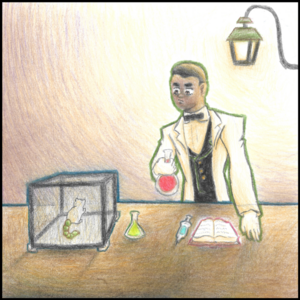
He strided down the long, narrow tunnel that led to the lab and, upon reaching the thick metal door at the end, used his key to let himself into the large room that served as his base of operations. It comprised the laboratory with all of his scientific equipment, which was set up on the left-hand side of the room, as well as a sort of living space, which took up the right-hand side and included an armchair, a coffee table, and a small sofa. Between the two sections was a trio of doors. The door on the right led to a locker that he used for storage, and the one on the left to his refrigeration unit. The third door, which sat in the middle and served to bifurcate the room, led to the cages, tanks, and vats that he used to keep and grow live specimens. It was ten-by-ten feet large, and made out of half a foot of solid steel. Harold always made sure to keep that door locked tight whenever he wasn’t using it.
After setting his things down by the coffee table and pulling on a lab coat and a pair of gloves, Harold got to work. He had already known that the bat-lion was a chimeric type, but he studied some of the blood that he had extracted beneath a microscope anyway. It appeared that the genetic material that had been used to create the lion had come from seventeen different organisms. Of the seventeen, he could only identify the DNA of five: bat, lion, crocodile, ostrich, and daffodil. What use a flower would be in making a monster, Harold didn’t know. He made a note to follow up on it later.
Harold spent a few hours in the lab studying, updating his notes with the findings from the lion DNA, and working on various unfinished projects. Eventually, he placed the remaining monster’s blood in the refrigeration unit with the samples collected from the other chimeric-type monsters. Having done what he had come to do, he left the laboratory. He didn’t have any afternoon classes that day, so he was in no particular rush to return to the Institute, and instead decided to take a walk.
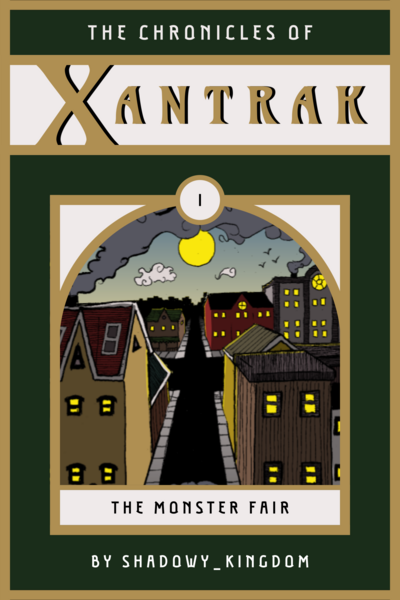
Harold had been born and raised in this city, and had never lived anywhere else. But as far as he could tell, the island of Xantrak was just like any other university town in America. It had a chancellor—or, in Xantrak’s case, a director—who, in addition to running the university, worked closely with the mayor to see that things in the town were all as they should be. There was the college newspaper, the Wyvern’s Eye, which was the main source of news for most permanent residents. There were the banners, statues, and posters scattered throughout the city, depicting the Institute’s mascot, Wendy the Wyvern, and the little shops where people could buy merchandise and so indirectly support the college. And, of course, there was the giant automaton, Iron Albert, which was used to defend the city in times of danger, and which had, like most automatons on the East Coast, been constructed during the Second War of the Engine. All in all, the city of Xantrak was normal in every aspect. Except for one.
The Monsters.
Having lived in Xantrak his whole life, Harold knew all about them. Abominable amalgams and corruptions of existing plants, animals, and even humans, the Monsters were a blight on what should have been a prosperous city, what had been prosperous until twenty years ago. Almost everything wrong with Xantrak could be laid at their feet. They were the reason for the strict curfew keeping citizens from wandering the streets after 8 pm. They were the reason that Iron Albert had to be deployed almost every night to deter crime. They were the reason for the extensive patrols conducted by the police, and the harsh crackdowns on anyone suspected of using neogenics unlawfully. They were the reason that his parents were dead. And, they were the reason that he was studying neogenics at the Xantrak Institute, which was probably the best possible place in the world to do so. All of it was the work of Monsters.
Fortunately, it was a solvable problem. Or at least, Harold thought it so. He’d encountered 100 of them in his time—including the one that had attacked him earlier today, and the one that had orphaned him—so he was usually pretty good at getting rid of them. He’d also begun collecting samples from the monsters he fought in the past three years, which he was sure would go a long way toward understanding what the Monsters were, where they came from, and, ideally, just why they were being made.
In spite of this, however, it seemed that he was no closer to ridding the city of monsters than he had been three years ago. It seemed that, no matter how many monsters were caught, secret laboratories destroyed, or mad scientists captured, there were always more, hiding underground in the extensive catacombs beneath Xantrak, or in the ocean that surrounded it. Always lurking. Always waiting. Hell, there was even a rumor going around that there was some sort of underground sanctuary called the Mutant District, where monsters and abhumans came to meet and plan their next move. Harold wasn’t usually the type to believe in urban legends, but given that he’d been unable to come up with an alternate explanation for the attacks, he couldn’t exactly discredit the idea.
He’d hoped that attending the Institute would aid him in his mission, but if anything, it had put even more thorns in his side: a nosy, trouble-making roommate in Theodore, who seemed to follow him everywhere he went; rivals, in the form of Ralph Matheson and Olivia Tailor, who seemed dedicated to one-upping him at every turn; and, of course, busywork in the form of homework, quizzes, and tests, which never seemed to end. Thorns and more thorns, every step of the way.
As Harold walked back to the Institute, he felt a quiet frustration begin to build inside him, and the sky, which had by now turned an angry shade of orange, seemed to share his sentiments. He knew that something needed to change, but he wasn’t sure what more could be done that he wasn’t already doing. It was a maddening feeling.
After a while, Harold returned to the Institute and met up with Theodore at the Refectory. “Where have you been?” his roommate asked.
Harold could have asked the same of him. Theodore had never been a particularly well dressed person: he usually wore the black waistcoat and teal-green Xantrak pin that were not quite required, but definitely encouraged of students to wear; but he wore the coat unbuttoned, and instead of a normal shirt and tie, he for some reason took to wearing gaudy, oversized, overly-colorful sweaters beneath it. Instead of regular shoes, he wore knee-high leather boots which had the effect of making him look somewhat like a cowboy, albeit a very diminutive one; Harold rather suspected that this was the intent. This was what, for Theodore, constituted normal attire. It was what he had been wearing during the attack on Carter library.
Now, however, the coat and pin were gone, and the sweater—a vivid shade of blue that contrasted sharply with his hair—was covered in dirt, blood, and what looked suspiciously like claw marks. He only wore one boot—the toe of which was missing—and his red curls, which could best be described as untamed at the best of times, now rather resembled a hedgehog that had been set on fire.
Harold didn’t respond to Theodore’s question, and after a moment the other boy looked down at himself and realized how startling his appearance must have been. “Oh, this?” he said nonchalantly. “It’s a long story.”
Harold shook his head and kept walking. “Don’t bother,” he said. “I don’t want to know.”






Comments (0)
See all