
The World of Life had become more than a home.
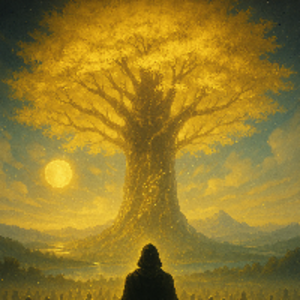
It was history in motion—a living weave of gods, bloodlines, and stories that stretched across generations. Shrines rose like constellations across the land, each tied to a name, a lineage, a divine root. The God Clan thrived. Children were born carrying the traits of those before them. The soil was rich with memory. The air hummed with promise.
But to Elyon, it was not enough.
Not yet.
Without resistance, growth folds inward.
Without challenge, ambition curdles into decay.
He saw it forming before anyone else—long before the first argument beneath a shrine, before the first god began to hunger for more than inheritance.
So, he acted.
Not by weakening the God Clan.
But by creating balance.
He seeded divine space with others—not one race. Not five. Many.
Each was born of different essence. Shaped not as a counter—but as an answer. And none were placed within the World of Life.
That realm belonged to the firstborn.
Instead, each race was given a world of its own—formed from Elyon’s hand, but molded by the nature of the race it was meant to house. These realms drifted far from one another, floating through divine space like scattered seeds. Separate. But not forever.
In the west, beneath silver-leaved canopies and mirrored skies, a forested realm shimmered into being. The Elves were born here—tall, deliberate beings with luminous skin and measured grace. They did not rush. They observed. When their homeland cracked beneath the weight of a falling star, one figure stepped forward and split the meteor in two. Aeris’tal, their First Light. She led not by command, but by simply being.
To the south rose a land of fire-veined stone and cavern cities carved into the bones of mountains. The Dwarves awakened here—compact, enduring, skin etched with glowing veins where divine energy flowed like molten ore. They were builders. Forgers. When a quake buried half a city, it was Grumdran who clawed through rock and ash for four days, saving them not with words—but with will.
In the far east bloomed jungles of crystal and bioluminescent mist. The Insectoids—humanoid in form, their bodies armored in smooth carapace—took root here. They communicated in pulses of scent and shimmer, their antennae flickering with emotion. Their unity came not through conquest, but empathy. Zeraph, the first Broodmother, brought the scattered hives together not by dominance—but invitation.
A realm of permanent dusk formed in the deep spiral—crimson moons drifting over stone cities and black-glass towers. The Vampires emerged from this shadowed world. Not undead. Not cursed. Alive, elegant, and sharp. They fed on divine energy, drawing it into their veins to refine mind and body. When chaos bloomed among them, Valion stilled it with silence—offering his own essence to anchor the storm. His restraint became structure. His sacrifice became law.
High above, in the drifting skylands of the north, a realm of constant storms and floating peaks gave rise to the Dragonkin. Elemental in spirit, winged and crowned with horns, their bodies shimmered with divine scale. Many challenged Thal’Ryx, including his own kin. He fought none. Instead, he snapped off his horn and handed it to his brother. “Take it—if power means more than peace.” No one challenged him again.
And still, there were more. Many more. Races born of the divine, but shaped to be distinct. Independent. Alive.
Elyon chose none of their leaders. He gave no instructions. He offered no law.
He gave them space.
And the promise of trial.
Because balance wasn’t enough. Power needed something more.
It needed opportunity.
And so, between the divine realms—in the spaces where light thinned and silence gathered—Elyon shaped something new.
Secret Realms.
Floating fragments of possibility. Neither land nor law, but places of potential. Some were towers of endless combat. Others were forests where time moved backward. Some breathed. Some dreamed. Each one unique. Each one hidden.
They could be stumbled upon—or summoned by fate.
But every one could be conquered.
And once conquered… it awakened.
[SECRET REALMS ACTIVATED]
Ownership: Granted upon successful conquest
Realm Functions Unlocked:
– Name the Realm
– Set Entry Permissions
– Choose Gate Location
– Generate Realm-Based Resources
– Produce Divine Cards
From these realms came Divine Cards—living sigils of power. Some offered temporary boosts. Others held unique techniques, rare materials, or bloodline enhancements tied to the realm’s nature. A realm of fire might produce a card that scorched the soul. A realm of silence might grant invisibility from the gods themselves.
Cards became currency.
Trade.
Temptation.
And each realm’s gate was its own signature. Once placed by the owner, it reflected the world it guarded. Lava gates for fireborn domains. Blossoming vines and runes for healing sanctuaries. Some pulsed. Others whispered. No two gates were ever the same.
And access was not free.
Owners chose who entered.
Some demanded favors.
Others asked for belief.
A few offered blood.
Tournaments began. Challenges were issued. Realms became battlegrounds.
To prevent chaos, Elyon let another truth resurface:
Trials.
They came without warning—triggered by growth, by choice, by destiny.
Trials tested not only strength, but leadership. Strategy. Wisdom. Mercy.
Victory offered more than prestige.
It gave titles.
Relics.
Power.
Paths forward.
But with power… came domination.
And so returned the practice of Willbinding.
Contracts formed through divine battle. When one god lost and chose to live, they could offer themselves to the victor. Not as allies. Not as kin.
As property.
Bound by Will.
Enforced by Law.
Controlled completely—unless released.
It was rare.
But not forbidden.
And so the world changed.
The God Clan remained untouched on their sacred soil. Elyon left them alone—watched them from afar. But he did not deny the others their rise.
Each race had its own world.
Its own story.
Its own hunger.
War had not yet come.
But the pieces were placed.
Some races whispered of destiny.
Others watched… and waited.
Elyon wasn’t their ruler.
He demanded no oaths.
He offered no crowns.
He created them for one reason:
Not to worship.
But to challenge.
To make the divine… earn it.
To make the world more than just eternal.
To make it alive.





Comments (0)
See all