
VOLUME I — THE WEIGHT OF SILENCE
Prologue — The Weight of Silence
The city did not celebrate.
Markets opened as usual. Temples rang their bells. Guards stood at their posts, polished and obedient — as if obedience alone could keep stone from cracking.
Yet beneath routine, every step carried caution. Every conversation ended too early. Every laugh sounded rehearsed, like a man laughing at a funeral because silence would be worse.
Kael Verin watched from the tower he had claimed as a vantage point. He didn’t call it a refuge. Refuge implied fear. This was a nest, high enough to see patterns in the streets below — the way citizens avoided certain alleyways, the way soldiers formed triangles instead of lines, the way messengers began taking longer routes as if distance could protect the truth.
The capital moved with unnatural calm, the kind that followed disasters no one fully understood. This was not chaos.
It was hesitation.
Silence pressed against Kael’s chest heavier than any scream ever could, and he recognized it the way one recognizes weather: not by sight, but by pressure in the bones.
Power, Kael realized, was not taken by force. That was a soldier’s fantasy.
Real power was claimed quietly — in the spaces between lies.
Chapter 1 — The Council That Should Not Exist
The council gathered without royal decree. That alone was treason.
Deep within the citadel, seven figures sat around a circular table carved from blackwood. Torches burned low, starved of air. The room smelled of wax and old iron — the scent of a system that had been cleaned too many times, as if scrubbing could erase sins from stone.
Nobles arrived with perfumed confidence, generals with stiff backs and scars they believed were credentials. They spoke carefully, measuring each word like a coin that might later be used as evidence.
And then Kael saw the anomaly: Lord Avaren.
Avaren did not fidget. He did not perform courage. He listened as if the room itself were lying to him.
Kael’s agent whispered from the shadows behind the latticework. “They suspect a hand behind the
collapse,” he said quietly.
Kael’s lips curved almost imperceptibly. “Good. Fear sharpens enemies. What do they plan?” “They don’t know yet,” the agent admitted.
Kael dismissed him with a small motion. Uncertainty was dangerous — but also exploitable.
Inside the chamber, the council tried to name a threat. They spoke of the king’s weakness, of the prince’s disappearance, of foreign plots. Each theory was a torch held too close to their own faces.
They believed they were plotting against Chancellor Thorne, the visible spine of the post-coup regime. They did not understand that the real war had no throne, no banner, no battlefield.
It was a war of direction.
Avaren’s eyes lifted once, briefly, and Kael felt the sensation of being measured — not seen, but calculated.
For a heartbeat, Kael wondered if Avaren could smell the lie in the air the way wolves smell blood. Then Avaren spoke in a calm voice: “You are all asking the wrong question.”
The table stilled.
“What question?” a noble demanded.
Avaren’s gaze moved from face to face. “Not who took the crown. But who benefits from the silence.”
Kael did not smile.
He did not need to.
The council had begun walking in the direction he wanted.
Chapter 2 — The Night the Crown Fell
The palace burned like a living beast.
Flames hungrily consumed banners and marble alike, licking gold until it became black. Smoke thickened into a ceiling that pressed down on screams. Somewhere a choir of servants prayed. Somewhere a soldier laughed — the kind of laugh that meant a man had decided the world was already damned, so he might as well enjoy the fire.
Kael ran. He did not know where he was going — only where he could not remain.
He passed statues of ancestors with faces cracked by heat. Their eyes looked accusing in the
flicker. He nearly slipped on blood that had already cooled to stickiness. The air tasted like metal and burnt cloth.
Then he froze.
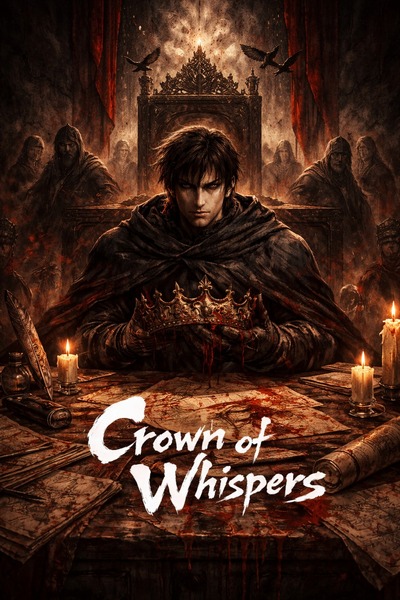
His father, King Rowan Verin, lay on the floor, stabbed and bleeding into the stone. The king’s hand trembled, fingers grazing the crown as if trying to hold it one last time by touch alone.
The crown slipped.
It rolled.
It stopped at Kael’s feet like a verdict. Kael did not cry.
He felt the urge — a sudden pressure behind the eyes, the instinct to collapse into grief — and he watched that urge the way one watches a bird land on a branch.
Then he let it go.
A soldier raised a sword to finish the prince. The blade hovered, hungry. A voice stopped him.
“Leave him.”
The soldier obeyed as if the voice had always been his master. Kael’s first lesson in control was not strategy.
It was physiology:
Grief was a luxury. Observation was survival.
As the soldier retreated, Kael saw it — not the sword, not the blood, but a servant behind a shattered column, clutching a small wax-cylinder recorder used for court music practice. The servant’s hands shook too badly to hide his mistake.
He was recording the coup. Kael did not save him.
He did not kill him.
He simply remembered his face.
In that moment, Kael acquired his first asset without lifting a finger. The crown was still on the floor.
Kael stepped around it.
He understood something else then:
Titles were loud.
Systems were quiet.
Quiet lasted longer.
Chapter 3 — Silas and the Value of Lies
Kael was taken to a nameless village, quiet and unremarkable — perfect for secrets.
The house they kept him in had walls that sweated in winter and baked in summer. A single window looked out onto muddy fields where peasants worked like they were digging their own graves one harvest at a time.
Silas arrived without announcement.
Thin, worn, and older than his posture suggested, Silas carried the stillness of someone who had seen enough violence to stop reacting to it. His eyes were the sharpest thing in the room.
He sat across a board game set between them — polished pieces, simple rules. The kind of game noble children learned to make war feel clean.
“People believe truth is powerful,” Silas said. “It feels righteous.”
Kael watched his fingers place two sealed letters on the board like pieces.
“Truth is heavy,” Silas continued. “Slow. It doesn’t travel well. If you throw it at someone, it bruises you too.”
He tapped the second letter. “Lies are practical. Light enough to carry. Sharp enough to cut only the target.”
“One is true,” Silas said. “One is false. Both can destroy a man. Choose which you would send.” Kael reached out, paused, then chose the false letter.
Silas did not nod.
He did not praise.
He watched Kael’s face like a physician watching an infection settle into a wound. Kael realized then that this was not a lesson.
It was an experiment.
Silas leaned back. “Good,” he said quietly. “Not because you chose correctly. Because you chose quickly.”
Kael’s stomach tightened. “You wanted speed.”
“I wanted certainty.” Silas’s voice was gentle, which made it worse. “A man who hesitates can still be human.”
Kael did not answer.
He moved a game piece forward.
Silas smiled as if he had just confirmed a prediction.
Chapter 4 — The Necessity of Cruelty
The Whisper Crown began as a rumor and became a machine.
Kael needed a villain the public could see. A face to concentrate fear. A scapegoat to absorb the questions that might otherwise drift upward like smoke into the tower.
He chose a young messenger — loyal, bright-eyed, proud of his insignificance. The kind of boy who believed serving the kingdom was holy.
Evidence was planted.
Ink was forged.
A confession was coerced in a room where no one shouted — where silence did the beating.
The trial lasted one afternoon. The verdict lasted one heartbeat. The boy’s name became poison.
But Kael left subtle clues pointing elsewhere — not enough to reveal the truth, but enough to split suspicion like a wedge. Two factions inside his own network began accusing each other. The fear made them attentive. The paranoia made them obedient.
When the boy was marched through the square, Kael watched the crowd’s faces. Not the anger.
Not the pity.
The hunger.
People wanted a story simple enough to swallow.
The boy met Kael’s eyes once — not recognizing him, not knowing he was looking into the void that had decided his life.
The boy’s lips moved.
Kael could not hear the words. Later, the whispers changed.
Some said the messenger had confessed to protect others. Some said he had tried to resist the unseen manipulator.
Some said he had been innocent and therefore heroic. Kael’s scapegoat became a myth.
Kael learned the second law of information:
Once released, it does not belong to you. It breeds.
Chapter 5 — A Game Between Monsters
Kael met Lord Avaren in the library because the library was the only battlefield where blood could be spilled without staining floors.
Shelves rose like cathedral pillars. Dust hung in the air like old prayers. Scholars moved quietly, pretending not to notice the tension, because noticing would make them participants.
Avaren stood near a table of open ledgers. He did not turn when Kael approached, as if he had already heard him from the rhythm of footsteps alone.
“Prince Verin,” Avaren said, voice calm. Not respectful. Not mocking. Accurate. Kael stopped. “You speak a name that is politically inconvenient.”
“Names are only inconvenient when they are true.” Avaren looked at him then, and Kael felt again that measuring sensation — like a knife balanced near skin.
They spoke of stability. Of famine routes. Of tax reforms that would starve one district to feed another. Of the coup’s aftershocks. Their words were polite. Their meanings were not.
Avaren said, “The kingdom feels… curated.”
Kael replied, “Order feels unnatural to those addicted to noise.”
Avaren’s mouth twitched, almost a smile. “You speak like someone who has read too many histories.”
Kael leaned slightly closer. “You speak like someone who intends to write one.”
Avaren placed a parchment on the table between them — a report about missing grain wagons. Kael saw the flaw immediately: the numbers were too clean, the handwriting too steady.
Misinformation.
A test.
Kael let his eyes linger a moment too long, then looked away, as if he had not noticed. Avaren watched him, expression unreadable.
The library remained quiet. Around them, pages turned softly, like distant wings.
Kael understood:
This man was not a soldier.
He was a mirror — and mirrors were dangerous because they showed you what you were becoming.
Chapter 6 — Fractures Within the Crown
The Whisper Crown began to crack — not from discovery, but from strain.
Agents hesitated. One outright betrayed him, selling names to a rival house for coin and the illusion of safety. Another acted independently, deciding he understood Kael’s “vision” better than Kael did.
Kael silenced them all without spectacle. The betrayal did not anger him.
It interested him.
Humans were variables. Variables created noise. Noise threatened control.
Yet as he tightened the system, he felt the paradox: the more pressure he applied, the more fragile everything became, like ice turning clear before it shatters.
That night, Kael stood alone in the tower, listening to the city’s distant murmur. Wind pressed against the windows like fingers trying to get in.
He opened a sealed letter meant for a noble. The words were precise.
The lie was elegant.
And yet, as he read, he realized something:
This letter could be interpreted in three different ways. All three would cause damage.
Two would damage him.
Control was not a lock.
It was a direction.
Kael burned the letter and wrote another with fewer words.
Fewer words meant fewer meanings.
Outside, a red moon rose behind clouds, and for a moment it resembled an eye half-open in the dark.
Kael did not believe in omens.
But he understood the function of dread. Chapter 7 — Shadows and Mirrors Kael dreamed of Silas.
The board game was overturned. Pieces lay scattered like teeth.
Silas stood over him, face half in shadow. “You wanted to win,” Silas whispered. “You never asked what winning meant.”
Kael reached for the pieces, trying to reorder them. His fingers passed through them like smoke.
Silas’s hand pressed down on Kael’s shoulder — heavy, cold, final. “You cannot rebuild what you have decided to sacrifice.”
Kael woke drenched in sweat.
His heart beat too fast — an animal response his mind disliked. He sat up and listened, waiting for the sensation to fade.
In the quiet, he realized the real horror was not what he had done. It was how quickly it was becoming normal.
Chapter 8 — The Rise of the Shadow King
By month’s end, the kingdom whispered of an unseen force shaping events.
Fear became respect.
Respect became belief.
Belief became a legend.
They called it the Shadow King — not a person, but a presence. A rule without a ruler. A hand without a body.
Kael did not correct them. Correction was attention.
His agents spread rumors intentionally, but the myth grew in directions he had not planned. Citizens began attributing actions to the Shadow King that Kael had never ordered — mercies,
cruelties, punishments, miracles. Power had taken on a life of its own.
Kael stood again at the tower balcony, watching lanterns drift through the streets like fireflies trapped inside a cage.
He understood the final lesson of Volume I: If people believe you are everywhere,
you do not need to be anywhere.






Comments (1)
See all