
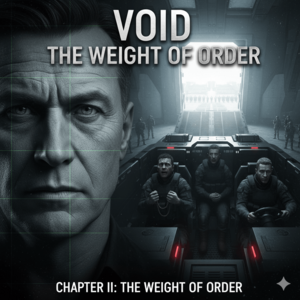
CHAPTER III: THE WEIGHT OF ORDER
SCENE I – THE ROOM WITHOUT WINDOWS
Base Theta did not resemble a place where human beings lived. It resembled a machine designed to process them.
The armored transport vehicle approached the third perimeter gate, its heavy tires grinding against the reinforced concrete with a low, vibrating hum that traveled up through the chassis and into the bones of the passengers. The gate mechanism engaged—a series of hydraulic locks disengaging with the sound of breaking bone—and the steel barrier slid aside just enough to permit entry.
Inside the transport, the air was stale. It had been recycled too many times through filtration systems designed to screen out radiation and particulate toxins, but which failed to scrub the scent of cold sweat and recycled breath. The cabin was dim, lit only by the low-power red emergency strips running along the floor.
Sorro killed the engine. The vibration stopped. The silence that followed was heavy, suffocating, a physical weight that pressed against the eardrums.
For a long time, no one moved.
Sorro gripped the steering wheel, his knuckles white, his eyes fixed on the blank dashboard. In the rearview mirror, he could see Leik in the back. The soldier sat hunched over, his prayer beads wrapped tightly around his fingers, the plastic clicking softly as his hands trembled. He had stopped reciting the verses hours ago. Beside him, Trom stared at the floor, his posture collapsed, like a marionette whose strings had been cut.
They were alive. That was the failure.
In the strict binary logic of Pragna, survival was only a virtue if the objective was met. They had met the preliminary objective—locating the anomaly in Draka—but they had retreated. They had brought news of a ghost, but they had not stopped it. They had prioritized the biological imperative of survival over the systemic imperative of order.
"Open the door," Trom whispered. His voice sounded thin, foreign in the enclosed space.
Sorro reached for the lever. His hand shook, a betrayal of the nervous system he could not control. He pulled. The hydraulics hissed, a sound like a dying breath escaping a lung, and the rear ramp began to lower.
The light inside Base Theta was artificial and absolute. Massive floodlights cut through the eternal grey gloom of the enclosed intake bay, casting shadows that were too sharp, too black. The facility was a grid of concrete and steel. Soldiers moved in precise lines, their boots striking the ground in unison. Transport trucks idled in designated lanes, engines rumbling at a uniform pitch. Mechanics worked on walkers and surveillance drones with rhythmic, clanging efficiency.
Everything had a place. Everything had a function. There was no wasted movement.
As Sorro, Leik, and Trom stepped out of the vehicle and onto the intake platform, the activity around them seemed to undergo a subtle phase shift. It wasn't a stoppage—Pragna never stopped—but a hesitation. A wrench paused mid-turn. A conversation on a localized radio frequency cut off. Heads turned, not with curiosity, but with the cold assessment of a system identifying a glitch.
They were the unit that had seen him.
They walked toward the personnel intake sector. Other soldiers watched them. There was no pity in their eyes. There was no camaraderie. There was only calculation. In a world defined by absolute order, those who encountered chaos and ran from it carried the contamination with them. They were vectors of a disease called fear.
"Keep your heads up," Sorro muttered, though his own chin was trembling, his eyes darting to the floor. "We are soldiers of Pragna."
"Are we?" Leik asked softly, stepping into the harsh light. "Or are we just the ones he didn't bother to kill?"
They reached the decontamination checkpoint. It was a mandatory procedure for all units returning from the uncontrolled zones. They stood on the metal grate. Nozzles descended from the ceiling. A fine mist of chemical disinfectant sprayed over them, smelling of ozone and bleach. Scanners washed over them with vertical bars of blue light, reading biometrics, heart rates, cortisol levels.
A mechanical voice announced the results from a speaker on the wall.
Biological status: Unharmed. Psychological status: Compromised. Cortisol levels: Critical.
An officer waited for them at the end of the corridor. He held a datapad and did not look up from it. His uniform was pressed, his rank insignia polished. He was a creature of the base, untouched by the dust of the outside world.
"Unit 32," the officer said. He did not ask. He verified.
"Yes," Sorro said.
"Debriefing in Command Room 1," the officer stated, tapping a command into the pad. "The High Er is waiting."
The three men stopped. The name hung in the air, heavier than the reinforced concrete ceiling above them. The air in the corridor seemed to drop in temperature.
"The General?" Trom asked, his voice cracking.
"The High Er," the officer repeated, finally looking up. His eyes were blank, uninterested. "Move. Do not delay the schedule."
SCENE II – THE ARCHITECT
The Command Room had no windows. It did not need them. Windows created illusions of a world that existed outside the data, and Pragna had no need for illusions.
The walls were smooth, metallic, colorless. The air was kept at a constant, chilly temperature to preserve the server banks humming behind the panels. In the center of the room, a long table made of black synthetic material reflected faceless silhouettes. Around it, people in high-ranking uniforms stood with straight spines and neutral faces. They were not individuals; they were extensions of the room's processing power.
On the main wall, massive screens displayed the world as Pragna saw it: a series of variables to be managed. Satellite feeds displayed the grey wastes in high resolution. Heat signatures tracked convoys moving resources between the surviving cities. Algorithms predicted food consumption, energy output, and population density with decimal-point precision.
It was a room where the world was reduced to data, manageable, clean, and silent.
In the center of the room, standing before the main display, was General Jakal.
He was old. In a world where life expectancy had collapsed following the War of the Living, his age was a testament to his extreme utility. His hair was cut close to the scalp, grey as the dust outside. His uniform was immaculate, devoid of the medals that lesser officers used to hide their insecurity. Jakal did not need to display his rank. He was the rank. He stood with his hands clasped behind his back, his breathing slow and undetectable.
He did not turn when the soldiers entered. He continued to watch a screen displaying a topographic map of the Draka sector. A single white dot was blinking on the grid—a predicted path moving steadily East.
"Report," Jakal said. His voice was not loud. It was dry, textured like paper rubbing against stone. It carried to the corners of the room without effort.
Sorro stepped forward and saluted. The motion was stiff, brittle. "Unit 32, sir. Patrol sector 4."
"I know where you were," Jakal said. He turned slowly. His face was a map of deep lines, his expression one of absolute neutrality. His eyes were pale, washed out, but they missed nothing. "I want to know why you are here, and not there."
"We encountered the target, sir," Sorro said. He swallowed hard. "Blue-eyed Voi."
A ripple of tension went through the officers manning the terminals. Keyboards went silent for a fraction of a second. The name was a virus in the system.
"And?" Jakal asked.
"He... he engaged a civilian target," Sorro stammered, his eyes losing focus as the memory returned. "He destroyed a structure. We attempted to intercept."
"You reversed," Jakal corrected him. He gestured to a side screen. "Vehicle telemetry shows your transport retreating at maximum speed. You did not engage."
"Sir, we requested an airstrike!" Leik blurted out. He stepped forward, desperation breaking his military discipline. "We called for support! He is a Pika. He is a monster. We couldn't—"
"Silence."
The word was spoken softly, but Leik's mouth snapped shut as if stitched by wire.
Jakal walked toward them. The sound of his boots on the metal floor was a slow, deliberate metronome. Click. Click. Click. He stopped in front of Leik.
"You wanted an airstrike," Jakal said. "You wanted me to deploy a bomber. To consume aviation fuel. To drop a payload worth thousands of resource units. On a single man."
"He isn't a man," Trom whispered, looking at the floor.
"He is a biological entity," Jakal said. "He occupies space. He has mass. He has a circulatory system. If you cut him, does he not bleed?"
"We don't know," Sorro admitted. The shame was palpable. "We didn't shoot."
Jakal shifted his gaze to Sorro. He was shorter than the driver, but he seemed to loom over him, a monolith of judgment.
"You didn't shoot," Jakal repeated. "Because you were afraid."
"Yes, sir."
"Good."
The soldiers blinked, confused. They had expected rage. They had expected a summary execution.
"Fear is a function," Jakal said, turning back to the screens. "It keeps you alive. It tells you when you are outmatched. You ran because your instincts calculated that you could not win. That is acceptable for animals."
He pressed a button on the console. The screens shifted, showing a live feed of the base exterior. Thousands of soldiers were visible, moving in formation, maintaining the perimeter walls.
"Do you see this?" Jakal asked. "This is not just men and metal. This is a structure. A dam holding back the ocean. Animals run. The Dam stands."
SCENE III – THE LOGIC OF PEACE
"The world wants to die," Jakal continued. He spoke to the room, but his words were directed at the three survivors like projectiles. "It has been trying to die for fifty years. The War of the Living was a global suicide attempt. We are the doctors who stopped the bleeding. We are the ones who strapped the patient to the bed."
He looked at Leik, observing the prayer beads.
"You think Voi Dione is a monster because he kills," Jakal said. "He is not a monster. He is a symptom. He is what happens when the straps loosen. He represents entropy."
"He killed a child in Draka," Sorro said, his voice trembling. "He didn't hesitate. It wasn't combat. It was... procedure."
"And you hesitated," Jakal said. "That is the difference. Voi Dione is consistent. You are variable. Consistency builds walls. Variability creates cracks."
The General walked to the reinforced window overlooking the assembly ground.
"Don't forget you were born for this," Jakal said, his voice gaining a hard, metallic edge. "We were born for this. To maintain this peace as long as we can. Are we soldiers?"
+1
The question hung in the air, a test of their fundamental programming.
"Yes, sir!" Sorro shouted. It was a reflex, drilled into him since the academy.
"Then why are you alive?" Jakal asked.
The silence returned, colder than before.
"A soldier protects the structure by removing the threat," Jakal explained, as if teaching a child basic mathematics. "If the threat cannot be removed, the soldier becomes the obstacle. You removed yourselves from the equation. You preserved your biology at the cost of the mission."
He signaled to the guards by the door.
"Take them to Reconditioning," Jakal ordered. "If they cannot fight with weapons, perhaps they can serve as data. Their fear response is calibrated correctly. We can use that."
"Sir?" Sorro asked, panic rising in his chest. "Sir, we came back! We reported!"
"You brought me fear," Jakal said coldly. "I have no use for fear. I need results."
The guards grabbed the three men. Sorro shouted. Leik began to pray again, louder this time. Trom went limp, his legs refusing to support him. They were dragged out of the room. The door slid shut, cutting off their protests instantly.
The silence returned to the Command Room. The staff returned to their screens. The processing of data resumed.
"Sir," an aide approached Jakal cautiously. "The tracking data. Voi is continuing East. Toward the convoy routes."
Jakal watched the white dot on the map. It moved slowly, steadily. It did not rush. It did not hide.
"He is not attacking," Jakal murmured. "He is walking. He wants us to see him. He is demonstrating the flaw in our coverage."
"Shall we deploy the air wing?" the aide asked. "We can level the grid square."
"No," Jakal said. "Air strikes are for armies. You don't bomb a cancer. You cut it out."
SCENE III – THE COST OF ORDER
Far from the base, in a city designated Sector-12, the sun was trying to break through the smog.
Sector-12 was a model of Pragna's success. Names had vanished years ago. Numbers were more efficient; they did not carry history.
The streets were clean, swept of the ash that covered the rest of the world. Lines of people stood quiet, waiting for the daily ration distribution. Food was distributed at precise intervals. Calories were calculated to sustain labor, not leisure. Cameras watched from every corner, their lenses adjusting with mechanical whirs. Soldiers stood at intersections. They did not shout. They did not brandish weapons unnecessarily. Their presence was the weapon.
A young boy, perhaps fourteen, stepped out of the ration line.
He didn't run. He didn't scream. He simply stopped moving forward with the queue. He looked up at the grey sky.
A soldier grabbed his arm. The grip was firm, not violent.
"Documents," the soldier said.
The boy searched his pockets. His hands trembled. He patted his chest, his hips.









Comments (0)
See all