

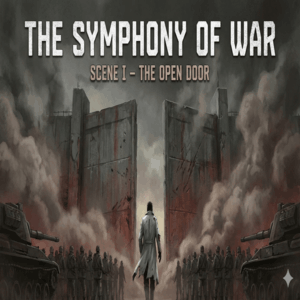
SCENE I – THE OPEN DOOR
The smoke from the rocket barrage did not simply clear; it sedimented. It was too heavy to drift. It coated the cracked asphalt of the approach in a thick, suffocating layer of particulate grey matter—sulfur, spent fuel, and the pulverized silica of the desert floor. The air was not merely hot; it was pressurized, compressed by the thermal shock of the explosions, distorting the visual field into shivering waves of heat-haze that made the black walls of the Capital appear to breathe.
The main gate was a slab of scarred tungsten eighty-five meters high. It did not move easily. When the command was given, the initial sound was tectonic—a deep-earth grinding of gears the size of houses turning against decades of rust and inertia. The vibration traveled through the soles of boots, rattled the teeth of every living thing within a kilometer, and shook the dust from the sensor arrays high above. Slowly, agonizingly, the massive slabs parted.
They did not open to release Voi Dione. They opened to consume him.
Inside the courtyard, the atmosphere was solid with tension. Ten thousand soldiers stood in perfect, geometric formation. They were the Grey Legion, the elite infantry of Pragna, bred in the barracks and conditioned for the singular purpose of expiring on command. They did not cheer. They did not scream. They stood with rifles raised, bayonets fixed—a sea of faceless helmets reflecting the dying firelight of the bombardment. Behind them, heavy tanks idled, their cannons leveled at the widening gap in the wall, their engines growling with a low, predatory frequency that vibrated in the chest cavity.
Then, the acoustic weapon activated.
From the massive speakers mounted on the needle-towers—arrays large enough to shatter glass—the Sister Castle symphony began. It was not music in the traditional sense. It was a weaponized arrangement of frequencies designed to bypass the conscious mind and stimulate the reptilian brain stem. The brass instruments screamed like dying animals, a high-pitched wail that induced nausea and adrenaline. The drums did not keep a beat; they assaulted the listeners, hitting with the physical force of artillery shells.
Bum-bum-BUM.
The rhythm was the heartbeat of a panic attack, amplified to the volume of a god. It was designed to erase the individual thought process, to synchronize ten thousand heartbeats into a single, terrified pulse.
Voi Dione stepped through the smoke.
To the soldiers, he appeared as a ghost—a singular white pixel in a high-definition image of grey war. He did not rush. He did not hesitate. He walked with a terrifying, rhythmic neutrality, his boots crunching softly on the debris. He did not look like a warrior. He looked like an inevitability.
He looked at the army. He looked at the tanks. He looked at the wall of steel waiting to crush him.
To any other man, this was death incarnate. To Voi, it was simply noise. It was a collection of atoms arranged in a hostile pattern, vibrating with the wasted energy of fear. He observed the geometry of the formation and found it inefficient.
"So many," Voi whispered, his voice a flat line lost under the screaming brass. "So much effort for one empty room. So much mass to protect so little meaning."
He observed the trembling hands of the front-line soldiers. He saw the sweat running down their necks, the dilation of their pupils behind their visors. Their bodies were locked in the rigor of discipline, but their minds were fraying. They were terrified, screaming internally, yet they stood rooted by the machinery of the state. They were not men anymore; they were bricks in a wall of meat, stacked to absorb impact.
Voi did not draw his sword yet. He walked until he was twenty meters inside the gate. The massive tungsten doors began to grind shut behind him, the locking mechanisms engaging with a sound like a thunderclap, sealing him in the kill-box. The echo of the lock reverberated around the courtyard, a final punctuation mark.
A voice boomed from the walls, amplified to a volume that caused the dust on the ground to dance. It was High Er.
"EXECUTE."
The air disintegrated.
Five thousand rifles fired simultaneously.
The sound was not a series of gunshots. It was a singular, white-hot crack that erased all thought, a sonic boom that ruptured eardrums and shattered the reinforced windows of the lower towers. The air filled with lead. It was a physical wall of metal moving at supersonic speeds, a density of projectiles so high that the space between them was negligible. It was a wave designed to turn a human body into a mist, to erase biology through sheer kinetic volume.
Voi did not dodge. The concept of dodging implied that he acknowledged the threat as valid.
He moved forward.
The bullets struck him. Thousands of impacts per second. They tore through his white coat, shredding the fabric into ribbons. They punched into his skin, cratering the pale flesh. The force should have thrown him backward; it should have liquified his organs and stripped the meat from his bones.
But Voi Dione was a Pika. He was an error in the code of the world.
His body absorbed the impact. The kinetic energy dispersed into his void. The physiology of the anomaly knitted flesh together almost as fast as it was torn. Wounds opened and closed in the blink of an eye, forcing out the flattened bullets like rejected shrapnel. Steam rose from his body—the heat of friction evaporating the blood before it could fall. He walked through the lead rain, his white hair whipping in the wind of the bullets, his blue eyes unblinking.
He drew the Red Sword.
The movement was slow, deliberate, almost lazy. The blade emerged from the sheath, a dull, rusted red line in the grey world. It did not shine. It did not reflect the muzzle flashes. It absorbed the light, a stripe of negative space cut into reality.
"The sword way," Voi said.
He swung.
He was thirty meters away from the front line, but the laws of distance did not apply to the void. The air split.
A wave of kinetic pressure, sharp as a molecular razor, erupted from the swing. It traveled through the courtyard, invisible save for the distortion of the dust and the sudden drop in air pressure. It was not wind; it was a severance of space.
The front row of fifty soldiers simply ceased to be whole.
There was no scream. There was no time for pain. One moment they were standing, rifles raised; the next, their upper torsos slid off their waists. Armor, flesh, ceramic plates, and steel rifles were sheared cleanly in half. The cut was so precise that for a microsecond, the blood did not know it was supposed to flow. The biology held its shape for a heartbeat, suspended in shock.
Then, gravity took hold. Fifty bodies collapsed into a heap of wet, red ruin.
The music played on. The drums beat. The slaughter began.
SCENE II – THE CONDUCTOR
High Er stood at the panoramic window of the Command Center, two hundred meters above the carnage. The reinforced glass vibrated against his fingertips, resonating with the screaming frequencies of the Sister Castle symphony.
He looked down at the red bloom spreading across the grey courtyard. To him, it did not look like tragedy. It looked like data. It looked like the necessary expenditure of resources to prove a hypothesis. The red was merely a variable changing color on the map of his city.
"Beautiful," he murmured. "The machine is working."
Ani stood beside him, his hands clasped tightly behind his back. His posture was rigid, a mirror of the General's, but his eyes betrayed a flicker of deep, internal tension. He watched Voi Dione moving through the legion. Voi was not fighting; he was harvesting. Every time a cluster of soldiers surged forward, bayonets gleaming, the red sword moved in a minimal, efficient arc, and the soldiers ceased to function. It looked less like combat and more like a man walking through tall grass with a scythe, clearing a path through weeds.
"He is killing them, Sir," Ani said. His voice was steady, disciplined, but tight with the strain of witnessing the futility. "He is killing them by the hundreds. The tanks are firing, but he moves between the shells. The targeting computers cannot lock onto a variable that refuses to act like a target. The men are frightened."
"Let them die," High Er said coldly. He did not blink. "Every bullet he blocks, every swing he takes, consumes energy. Even a void has a limit, Ani. We are feeding him meat to choke the engine. We are drowning him in mass."
"They are the Grey Legion," Ani noted, watching a squad disintegrate under a single, lazy blow. "They are the best we have. They were trained for ten years for this moment."
"And that is why their death matters," High Er replied, turning from the window to face the holographic display. "If we fed him conscripts, he would be bored. If we feed him the elite, he must work. Sacrifice is only valid if it has value, Ani. If you burn trash, you get no heat. We are burning gold. We are buying time with the most expensive currency we possess."
He pointed to the countdown timer floating in the center of the room. It was not just a clock; it was a gestation period. A ritualistic counter ticking down to the birth of a new form of violence.
P-UNIT ACTIVATION: 00:42:00
"Forty-two minutes," High Er said. "That is the price of victory. Five thousand lives for forty-two minutes. It is a fair exchange. The ledger balances."
Ani looked at the timer, then back at the slaughter. "Is the P-Unit ready? The bonding process... the mortality rate in the labs was eighty percent. The survivors... they aren't human anymore."
"Humanity is a weakness," High Er said. "Chaos requires extreme order to counter it. Voi Dione is chaos. The P-Units are the cure."
He walked to the console and tapped the glass, magnifying the image of the white figure below.
"Look at him, Ani. Look at his face."
Ani looked. On the screen, Voi Dione's face was a mask of absolute boredom. He was covered in the blood of Pragna soldiers, doused in the fluids of five hundred dead men, but he looked as if he were waiting for a bus. There was no anger. No joy. No exertion.
"He doesn't hate them," High Er observed. "He doesn't even see them. That is why we will win. He has no passion. He has no stake in this world. And a man without passion eventually gets bored of living. We, Ani... we are fighting for the structure. He is fighting for nothing. That is his flaw."
Below, a tank exploded. Voi had severed the barrel of the main cannon with a flick of his wrist, and the backfire had detonated the ammunition inside the turret. A fireball rose past the window, illuminating High Er's face in a wash of orange light, casting deep shadows into the hollows of his eyes.
"The soldiers are wavering," Ani reported, his knuckles white. "The music isn't enough. They are screaming. The scream is overtaking the song."
"Turn it up," the General ordered. "Drown out the dying. The people need to hear only the song. If they hear the screams, they will remember they are individuals. If they hear the music, they remain the Army."
The volume increased. The building shook. The Sister Castle became a physical force, pressing the soldiers forward into the meat grinder, denying them even the dignity of their own final sounds.
SCENE III – THE DIGESTIVE TRACT
Deep beneath the war, under millions of tons of concrete and steel, there was no music. There was only the wet, rhythmic slosh of sludge moving through the intestines of the city.
The Glass Throat was not just a pipe; it was the digestive tract of the Capital. The walls were coated in a thick, bio-luminescent moss that fed on the chemical runoff. The air was thick, humid, and heavy with toxic fumes that burned the eyes and tasted of copper, sulfur, and rotting biological matter. It was the smell of a massive organism processing its own waste.
Nolif and Nerve crawled along a narrow maintenance ledge, suspended three meters above the river of waste. The sludge below them glowed with a sickly, iridescent sheen—a cocktail of industrial acids, failed experiments, and the liquefied remains of those who had died in the labs above.
"Don't breathe through your mouth," Nerve warned, his voice muffled and distorted by his gas mask. "The vapor alone can liquefy your gums. This is where they flush the mistakes. This is the memory of the city, dissolving."
Nolif ignored him. She was breathing hard, forcing the toxic air into her lungs, savoring the burn. It tasted real. It tasted like the rot beneath the shiny surface of Pragna.
She stopped, pressing her hand against the damp, rusted metal of the pipe wall. She could feel it—the deep, rhythmic thrumming of the battle taking place two kilometers above. Every explosion, every tank round, every impact of Voi's power traveled down through the skeleton of the city and vibrated in the dark.
It made her sick with jealousy.
"He is taking everything," she hissed, her fingers digging into the rust until they bled. "He is up there, in the light. He is taking the war. He is taking the fear. He is making them look at him."
She spat into the sludge. "He suffocates the world just by being there. He is effortless. I have to bleed for every inch, and he just walks. What will be left for us? Scraps? Echoes?"
"We don't want the war, Nolif," Nerve whispered, checking a handheld sensor that was blinking with a frantic green light. "We don't want the eyes. We want the brain. Let him play with the soldiers. Let him be the distraction. We are going for the throat."
"I am not a rat," Nolif snarled, turning on him in the dark. The Dot in her chest flared, casting a terrifying silhouette against the curved walls. The light was anti-septic, cold. "I am the blade. I should be cutting them, not crawling in their shit."
"You are the blade," Nerve agreed, his voice soothing, terrified. He watched the way her muscles twitched, reacting to the distant violence like a junkie denied a fix. "But a blade is useless if it hits the shield. We are bypassing the shield. We are going to where they are soft. I can see the lines..."
He touched the wall, his green veins glowing. "The power grid is fluctuating. High Er is rerouting everything to the front gate. The internal sensors are blind. We are ghosts."
They reached a junction. The pipe widened into a massive, cylindrical chamber, a cathedral of rust and dripping water. In the center, a turbine the size of a building slowly rotated, churning the waste, grinding the solid matter into liquid.







Comments (0)
See all