
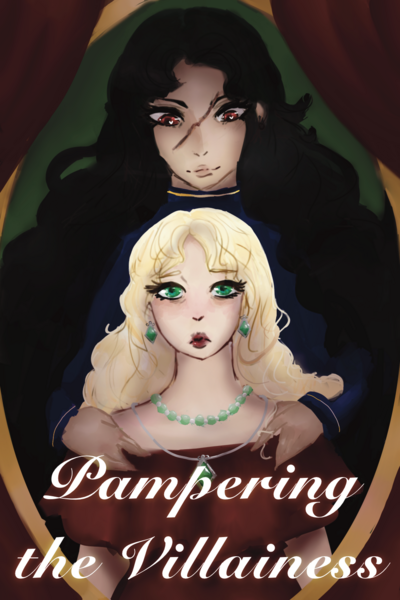
Duchess Amalia had black hair as thick and wild as a lion’s mane. She had red eyes as bright as blood. A deep scar wounded her pale face, which otherwise was as elegant and aristocratic as the finest of court ladies. Euphemie would be lying if she did not call her beautiful.
More than that, however, she was terrifying.
Euphemie knew how to read people. One needed to know what mood a noble lady might be in before she served her, so she could know whether or not to expect tea poured on her head. And with Leopold, Euphemie had lived by his whims. If he was amorous or enraged, she needed to be able to tell, to transform herself into whatever shape he needed, so he might keep her around, and gift her with pretty jewels and dresses.
Amalia’s piercing eyes were entirely unreadable. There was nothing behind her gaze that Euphemie understood, except a terrible calm, like a predator watching its prey.
Why had she saved her? Euphemie ought to be grateful, but instead found herself trembling beneath the heaviness of her eyes. Did Amalia wish to torture her further? What did she want?
Their ride continued in silence. After a moment, Amalia’s gaze slipped to the window, where the world moved by fast. Euphemie watched it too, until exhaustion overtook her body, and she fell into a deep sleep.
When she woke up, the carriage had stopped. Euphemie lay on the soft cushions, covered by a warm blanket. The door was open, allowing the cool breeze of a summer night to reach her. Over the wind she heard the chattering of soft voices, then the thunk of boots as Amalia entered the car.
Euphemie quickly shut her eyes.
“Still asleep, I see,” Amalia whispered.
The sound of her boots grew louder as she approached. A pair of muscular arms slid beneath Euphemie’s body, and she was lifted into the air as though she weighed less than a feather. Whereas before Amalia had hoisted her over a shoulder, now she carried her like a princess, one arm cradling her back, the other her legs.
They stepped outside. If only Euphemie could open her eyes, she could see her new prison. Instead she had to listen as Amalia spoke to whoever it was who greeted her.
“This is Euphemie, Jutte,” Duchess Amalia was saying. “From now on, she’ll be living in the manor. Please make sure everyone knows to treat her well.”
“Of course, my Lady.”
Euphemie was carried indoors, through what seemed to be a hallway, and draped in a soft bed. It was not difficult then, to fall back asleep.
When Euphemie awoke, it was to sunlight, streaming into the room through tall windows. Despite the filth that still caked her body she had been tucked in beneath the soft covers of a large, four-poster bed, in a room that was far too resplendent for someone like her.
The walls were covered in dark wood panels, the furniture ornate. This was a rich guest room, not the room someone put a slave in. Wondering at the choice, Euphemie sat up.
Just then, a knock resounded on her door.
“Miss Euphemie?”
Euphemie opened her mouth to respond, but whatever energy she’d had for words yesterday now escaped her.
“Miss Euphemie?” Again, a soft voice called. Then. “I’m going to come in. I’ve brought breakfast.”
The door opened, and a young maid walked in, wheeling a cart with a tray of covered dishes upon it. With her came the scent of cinnamon.
“You’re awake,” said the maid. She had soft brown eyes and hair the color of butter, and a face scattered with freckles. “My name is Elizabeth. I’ve brought breakfast.”
The tray was wheeled to where Euphemie lay, and then lifted off the cart and placed in Euphemie’s lap.
“There’s porridge,” said Elizabeth, “with cinnamon and a little sugar. Since you haven’t eaten much lately, Lady Amalia thinks you shouldn’t have coffee or tea or chocolate, but I’ve brought you a cup of water. When you’re ready, I’ll draw a hot bath for you.”
Euphemie blinked down at the tray. With a practiced motion, Elizabeth lifted the cover. Glistening, warm porridge released steam into the soft air. The cinnamon was sprinkled atop, the brown sugar half melted into an amber crystal.
Euphemie took the spoon from the dish, dipped it into the porridge, and brought it to her mouth.
“Careful,” Elizabeth warned. “It’s hot.”
Euphemie didn’t care. She swallowed the hot porridge down her throat, not minding how it scalded her flesh, then cooled its path with a gulp of water. Her empty stomach devoured the food; within minutes the bowl was barren, the cup empty.
Elizabeth took the dirty items back.
“Would you like assistance with your bath, Miss Euphemie?”
Euphemie stared. This Elizabeth had calloused hands like Euphemie’s, but they were steady, strong, and tanned. What would she think of Euphemie’s flawed body, all stretched thin? What would she think of her scars?
Shaking her head, Euphemie stared down at her trembling hands.
“Very well,” said Elizabeth. “I will leave a bell by the tub, should you require my assistance.”
Elizabeth drew a bath quickly, with the help of a few other maids. Euphemie was then left alone, a change of clothes sitting atop the bed. Stripping off her clothing, she slipped into the tub. Warm water met her, a balm after so long in the dark. A comfort, smelling of flower petals. She washed her hair and body with the soap, then submerged herself beneath the surface to rinse.
In that warm, dim cocoon, Euphemie began to drift. The soft water seemed to her an extension of her skin. She could not even hear her own heartbeat. For one precious moment, she did not exist.
Then she burst back into the air, eyes wet with tears.
“I’m not going to die,” she murmured, sniffling. She remained curled into herself for some time, stepping from the bath only when the water had turned cold.
The clothing she had been supplied was plain but comfortable. Combing out her hair and pulling it into a thick braid, she sat upon the bed, and wondered. What would happen to her next?
Why had Lady Amalia come for her? It could not simply be from the kindness of her heart. Euphemie wished she had paid more attention at her execution. Stupid girl, she thought. She had missed the useful information.
Yet there was one truth she always could count on. The empire’s elite were selfish creatures. The empire’s elite were monsters. Euphemie had become one of them, a rough and grasping creature with sharp teeth and sharper claws. A hungry thing that was never full. It was certain Amalia was one as well. She answered to Leopold, most fearsome of them all.
Would Leopold grow hungry and return to her, she wondered? Perhaps, but she could no longer rely on him.
So what did Amalia hunger for? What did she want? Euphemie would find it and give it to her. Then perhaps Amalia would keep her here, among her fine things.
Bolstered with new purpose, Euphemie went to the boudoir. No makeup awaited her there, so she pinched her cheeks to redden them, slid her feet into a provided pair of slippers, and opened the door.
Amalia’s manor was a dusty place, cavernous and empty. All was fashioned from dark wood, covered in tapestry or paintings. The blinds on the windows were pulled shut, letting in just enough light to see by.
Euphemie had just enough time to take in the hall before the maid waiting at the door called out.
It seemed it was Elizabeth. “Miss Euphemie!” she said, voice warm. “I see you are finished with your bath. Lady Amalia has instructed me to see to your needs this week, and help you settle in.”
“Settle in!” Euphemie mused. “Is this truly to be my room?”
“It is a guest room and you are a guest,” Elizabeth answered. “Miss Jutte told me you are to be treated well. Not that we would treat you terribly! We do good work here.”
Good work for the nobility, perhaps, but Euphemie was a war prize, a slave. A peasant from the Kingdom of Lavender. The mistress of Prince Leopold. A creature marked for death.
Euphemie looked at Elizabeth. “Do you know who I am?”
“I make it my business not to know,” Elizabeth chirped. “All I know is that you are a guest, and you’ve been starved. Whether you’re a noble or of common stock, whether you’re rich or poor, from the north or the south, please do not tell me. Pretend that discretion is my middle name, if it helps.”
What an absurd girl, Euphemie thought. “I… shall keep that in mind.”
“Wonderful,” said Elizabeth. “Now, would you like a tour of the manor?”
Euphemie shrugged her shoulders, preparing herself to be dragged along. If Lady Amalia (should she be calling her Lady Mondlicht?) wanted Euphemie to be shown around, that was simply what would happen.
Elizabeth stared at her. “Is that a yes, or a no?” She asked, frankly.
“I did not think you wanted to know.”
“Well,” Elizabeth said. “I did! Go on, give me a reason to take a break.”
Elizabeth had been waiting outside her door. It was clear she was meant to show her around. No matter if Elizabeth thought she had a choice: she was a free citizen. Euphemie knew her place.
“Lead on,” Euphemie said.







Comments (1)
See all