
That settled it. Lady Amalia clearly had malicious intent.
It should have been obvious, Euphemie thought, as Elizabeth showed her the gardens, the kitchen, the dark hallways brightened with fresh flowers. No person could ever really be that kind.
The plush room and warm clothes and clean bath and good breakfast only proved Amalia wanted something from her. Euphemie had to find out what, and dangle it just out of reach for as long as possible. Then Amalia would keep her around, at least until she grew tired of Euphemie. This would buy her time to make an escape.
But where would she go? Leopold was unreliable, and Lady Margaret would surely have her killed if she appeared in the city again.
A lump grew in Euphemie’s throat. She would have to leave the Holy Empire. But where could she go? Home was gone. She did not speak the languages of the nearby kingdoms, and given Leopold’s ambitions, it was unlikely they would ever be safe.
“Miss Euphemie?” Elizabeth was asking. With a start, Euphemie realized they had paused in a drawing room. It was most plain, with a piano shoved in one corner and a bookshelf in another. The furniture was out of style, their surfaces dusty. Euphemie supposed there was little point in cleaning an unused room. Lady Amalia barely seemed to leave her study.
“Yes?” Euphemie asked, remembering she still had company,
“You suddenly stopped,” Elizabeth informed her. “Is everything alright? Are you tired? I can fetch you something from the kitchens.”
“I'm alright,” said Euphemie. “Please, continue the tour.”
Mondlicht Manor was somehow overwhelmingly large and yet the smallest building Euphemie had visited in quite some time. It had parlors, yes, and multiple bedrooms, and its great garden was well kept and blooming, and certainly there were private hunting grounds. The walls were decorated in dark wood,and the occasional carved relief of foliage that was a few hundred years too old to look anything but plain. It was certainly beautiful in its once haunting way.
The imperial palace had been much, much bigger. There had been ballrooms and drawing rooms and parlors and bedrooms and bathrooms large enough for ten. The walls had been covered in mirrors or gold or white wood, carved in swirling tracery to resemble seashells, angel’s wings, and roses. Its hunting grounds had spread to what seemed like infinity. There had been a garden for each cardinal direction, trimmed to perfection, each rosebush cut of its every thorn. And there had been endless hallways behind every wall, where servants, and occasionally Euphemie, could pass unseen.
Here there did not seem to be any halls. They passed multiple maids going about their business where anyone could see. All stared at Euphemie with wide eyes. She could not help but wonder if they were unhappy to be serving a slave.
Elizabeth led her to a great hall next, with a great stone hearth and large windows and a long table. It was a pity that the grand hall at the Holy Palace had been larger.
If Euphemie wanted, there had been endless rooms to put between herself and Leopold or whoever else might have noticed here. Here, she felt, there seemed to be few places to hide.
Elizabeth looked at her. “You've gone quiet again.”
“I am a little hungry,” said Euphemie. “That is all.”
“Then sit here,” Elizabeth told her, “and I will bring you something to eat. Johanna already has so many meals planned."
Euphemie sat in the offered chair, frowning as Elizabeth took the time to push it in, the way a gentleman might. A raw sort of feeling caught between her ribs, and she blinked up at Elizabeth, this plain girl who was taking care of her. “Do you know who I am?”
Elizabeth frowned. “I am trying very hard not to.”
“I am a slave,” Euphemie informed her, watching Elizabeth sigh in frustration. “I am certain everyone but you already knows. I was to be executed yesterday.”
“It was in the papers,” Elizabeth said. “I found the whole subject extremely depressing, and so I did not read the article. Not that it stopped everyone from talking.”
“But you know what I am, and you know what I've done.”
“Well,” huffed Elizabeth, “now I do.”
“And still, you wish to serve me.”
“A job’s a job,” said Elizabeth. “And Lady Amalia pays well. Long as you don't try and poison me, I don't care who you are.”
Well, Euphemie thought, I doubt I would poison you.
“Why?”
Elizabeth shrugged. “Do you know much about Mondlicht?”
“I'm afraid I do not,” answered Euphemie, shaking her head.
“We’re located very far to the northeast,” said Elizabeth. “Once Mondlicht was a kingdom of its own. We aren't anymore and haven't been for a very long time. But the land remembers, and the people too. A time when we weren't a piece of the Holy Empire.”
This answered nothing. “But you are imperial now.”
“Sure,” said Elizabeth. “But when you go into town, ask anyone if they are Mondlichtan or imperial. You'll get an interesting answer no matter who.”
“And your Lady Amalia,” Euphemie asked. “Is she Mondlichtan, or imperial?”
“Ask her,” said Elizabeth, “not me.”
Well. There was no way Euphemie was doing that.
Elizabeth ignored her silence. “I'll get you that snack now.”
Euphemie sat in the quiet. Alone, she began to notice the ever-present tick of a grandfather clock in the hall. The sound of footsteps, quiet through the corridor. The chorale of birdsong outside. The smell of dust. The deep green of all the curtains. Curiously, aside from Lady Amalia’s eyes, Euphemie had spied barely a splash of the color red throughout the manor.
It occurred to Euphemie in that moment, that she was entirely alone and unsupervised. If there was anywhere in the manor she would learn she was not allowed to be, now was the time to look, before anyone could grow angry at her. Elizabeth would not be able to control what she saw.
Euphemie stood. When Elizabeth arrived in the dining room a few minutes later, she found it empty.
Euphemie had already made her way down the hall, through a closed door she had not been taken through. Here was some bedroom, well kept. Further down, beside a painting of a white-haired man, a library, its shelves empty of books. How odd!
She found herself, rather tragically, drawn back to the garden.
It was not as though Euphemie was unused to gardens! But when she had been small (a time that no longer mattered, a time that was not worth thinking about, a time that remained indelibly in her mind, ready to be recalled), her parents had kept an herb garden, and she had learned of the mazelike flower gardens that princesses danced through in storybooks. After her enslavement, she remembered glancing out the tall windows of Lady Rosa’s manor and looking down on the flower garden of her dreams.
Tall hedges had surrounded rosebushes and a pavillion of white stone. Lady Rosa had taken her tea there most spring mornings, and so Euphemie had spent her days watching the flowers bloom.
The garden before her was not fit for a princess. It had its hedges and flowers and trees like any garden ought to. It was just a little bit plain. There was not even a fountain in it.
Without a fountain’s edge to sit on, Euphemie found herself wandering the maze of hedges, until she found some small, forgotten corner, and planted herself there.
The sun wandered its way across the sky, turning it the color of honey, beginning to dip just beneath a misty mountain in the distance. She brought her knees to her chest, grateful she had been given a plain and comfortable garment instead of an awkward hoop skirt, leaned back against the foliage, and closed her eyes.
There was nobody who needed her now. If she lay here long enough, perhaps they would forget about her entirely. She could escape into those distant mountains and live in the woods.
“Miss Euphemie?”
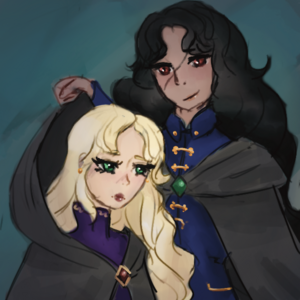
The warmth of summer faded into a frozen shock. Euphemie’s eyes snapped open. The air had gone dark, the moon peeking over the horizon. Lady Amalia stood above her, illuminated by the light of a lantern she held.
She needn’t panic. “Oh, how wonderful it is to see you!” Euphemie said, curving her lips into the most gentle smile. “You’ve saved me.”
“Elizabeth said you disappeared," Amalia said, dark brows furrowed.
“I found myself wishing to explore the garden,” Euphemie informed her. Slowly, she brought herself into a far more ladylike posture. “It is just that I got lost.”
“We searched for you,” Lady Amalia said. “There are not a lot of us here, so I’m afraid it took a while. You really worried everyone.”
“Did I now?” Euphemie murmured. “Well, I must apologize for causing a fuss.”
“There is no need,” said Lady Amalia. “You are a guest here.”
“So you say,” replied Euphemie, “and yet you also tell me there are matters we must speak on.”
She watched Amalia’s face fall. “There is,” Amalia said.
“You can tell me,” said Euphemie, schooling her voice into something sweet. “You can trust me.”
The real question, of course, was if Euphemie could trust Amalia.
“Fine,” said Amalia, with a nod. Holding out a hand in a gentlemanly fashion, she helped Euphemie get to her feet. “Tomorrow morning, we shall speak on it. For now, please come inside. Johanna has made you dinner.”







Comments (0)
See all