

1 January 2017
Winnipeg, Canada
The father walks the long way to the house that is not his own. He could’ve told the taxi to drop him at the door. Instead, he stops it at an intersection and it drives on without him.
In the 4am winter night, the father has no reason to fear anyone seeing him. The streets of this dingy neighbourhood are empty except for wet, brown snow that collects the deep footprints of strangers. The father has no reason to fear anyone robbing him. His pockets are light. They only hold an empty wallet, an expired driver’s licence, and a dead cell phone. And yet, the absence of life leaves room for imaginary danger. The father’s blue eyes stare down pockets of darkness, his tense legs ever ready to sprint.
He avoids the straight path that leads to his destination. Instead, he circles the housing block like a frantic bird, riding his own wings of instinct governed by survival, anxiety, and death. His metronome heart sets his quick pace, and when he makes the final turn that brings his destination into view, his heart drums to the swell of fear and excitement.
His eyes now squint in the dying light of sparse streetlamps, and he whispers to himself house numbers he passes in the language of a stranger. He stops at a small house. Its front has a door, a window with blinds, and a broken bulb with frozen cobwebs. Before the door is a wooden deck with stairs. Rusted nails barely hold the planks in place.
He walks up the stairs to the door and raises a fist to knock.
Fuck. No one’s going to be awake. God, I’m a fool. Got too excited—
Movement, through the crack beneath the door. It sparks the warm memory of the padded pit-pat of small, socked feet on hardwood floor. The father trembles. He doesn’t know if it’s from cold, excitement, or fear. He knocks before he decides.
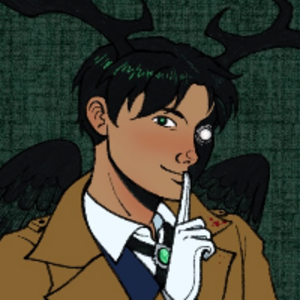
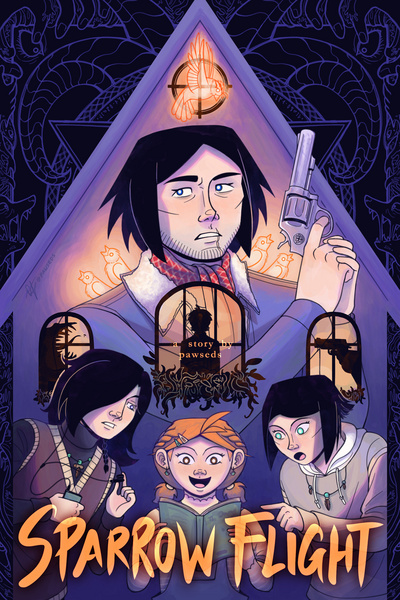
The pit-pats are real now. He can hear them: larger, heavier, but undoubtedly theirs. The window blinds fold to form a peephole. The lock clicks, the door swings open, and the father stares down at an almost mirror image of himself. The same messy black hair, the same weary eyes: his eldest child, better than him in every way.
They speak in the language of family. “Daa?”
The eldest child throws themselves at their father, nearly knocking him off the stairs. He can’t help but laugh as he picks them off the snow, warmth bubbling out of him into his tight embrace. His child is taller and stronger now — an adult by all definitions. But to him, as they bury their face into their father’s chest, they’re still so small, so light, so easy to tear away from him like before.
—
It has been a year since the siblings have lived in this house together. The eldest, Hrodwyn, left Auntie Elmira’s care at the orphanage when they turned eighteen. They had saved up enough from their two jobs, and the two jobs continued to be enough for rent. Their two siblings followed them: their sixteen-year-old brother Merethel who always kept his long, black hair swept over his right eye, and their twelve-year-old sister Hygd who always kept a smile on her face. Auntie Elmira let them leave. She knew they were inseparable, and their father was relieved that they were.
It has been ten years since their father was wrongly sent to prison. On the red-blue night of his arrest at their doorstep, Hygd was three and wailing, Merethel was seven and scared, and Hrodwyn was ten and bold. Hrodwyn heard the officers yell “Gavrill Vorobyev” over and over, watched them slam their pleading father against a car, and felt their siblings shatter in their arms. As the officers drove their father away, Hrodwyn knew it was now their responsibility to protect their family. They knew it was now their responsibility to fix all the broken pieces their father left behind, even if it meant pricking their own fingers.
In the mornings following their father Gavrill’s return, Hrodwyn made sure every piece of the siblings’ lives were meticulously organised like glass figurines on display. Nervously, they presented their father their handiwork within the cabinet of cutleries and Tupperwares, the closet of detergent and cleaning supplies, the fridge door of schedules and chores. All this order balanced on a rickety shelf Hrodwyn had built; all this order came crashing down in days to make room for Gavrill.
At first, Gavrill did not see this as a problem. He saw no problem at all — he was finally free, and his senses flared with life. He relished the touch of warm skin instead of thin paper, savoured the sound of rich voices instead of broken static. And with every chip and crack he felt between him and his children, an echo of his wife’s voice would comfort him:
—You’re here now, she would say, and that’s all that matters.
But it did not take long for reality to slip through the cracks of his ignorance. That was what he got for dancing around “How did you get out of prison?” — that was how he began stepping on his children’s broken pieces.






Comments (0)
See all