
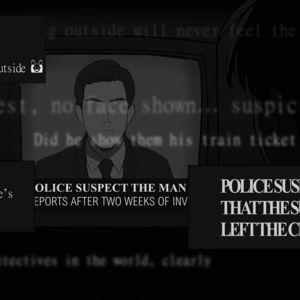
After the incident with Gobby and German, the media storm did not calm down for two weeks. Everyone was searching for the man in the Panama hat who attacked children. Social media filled with posts, arguments and endless comment threads, and some people even tried to organize volunteer patrols. Everyone was looking for the “Panama Hat Maniac” – the name given by the police and quickly picked up by journalists. For two weeks officers stayed near Gobby’s house, and other children were advised not to go outside unless necessary. In the eyes of the media, Drogo quickly transformed from the “Heart Reaver” into a pedophile and rapist. But after two weeks the topic slowly began to fade. That is how stories work in the digital age now – first there is intense attention and high engagement, but if nothing new happens, the public quickly loses interest.

Those two weeks passed quickly. German spent the first week in the hospital and the second recovering at home, while Gobby was taken home by his parents the very next day after that conversation. Every day he either visited German or spoke with him on the phone, and they constantly made plans. German had only one condition – Gobby was not allowed to visit during lunch time, because when food was involved he could not concentrate on anything except eating.
After two weeks the police allowed them to leave the house, but only under adult supervision. The reason was simple – the police assumed that the “Panama Hat Maniac” had left the city, since no new information about him had appeared.
From the detective, who visited their home three times, Gobby’s father learned three things: the police had already contacted the professor but gained no useful information, they provided the professor’s address, and the professor himself was already retired and no longer practicing.
Gobby insisted on meeting the professor. His parents did not object much – the professor had helped once before and might help again after such a traumatic event. That is what Gobby’s parents believed. But not Gobby. This time it was German who pushed for the meeting. He believed it could reveal certain mysteries, help him understand Gobby better, and simply satisfy his curiosity about the past of his close friend.
A gray Mercedes van pulled up near German’s house. Inside were Gobby and his parents. German’s grandmother – who had raised him since his parents died in childhood – rolled him outside in a wheelchair, because it was easier for him to move that way. German was helped into the van and they drove to the professor’s house.
When they arrived, everyone walked to the entrance. The doorbell rang and the door opened. The professor’s wife stood there, her face lighting up with a smile. Lisa, Alan, hello. Gobby, look at you – how you’ve grown. And this must be Gobby’s friend who was hurt. Poor thing. She was genuinely happy to see them and immediately began asking questions. Alan smiled politely. Hello. We’ll answer all your questions, but first we’d like to know – is the professor at home? She turned toward the second floor and called out: Sergey, you have visitors.

The professor appeared at the top of the stairs. When he saw who had come, he stopped and said sharply: Tell them to leave. Then he turned and started walking back upstairs. His wife gave a soft, apologetic smile. Please wait. I’ll speak with him and come back. She closed the door. About five minutes later the door opened again and the professor himself stood there. Come in. His wife invited everyone into the living room and began setting the table, bringing out treats, a teapot and a tea set.
The professor looked at the parents and asked directly: Why have you come? Lisa answered calmly. You probably know what happened to the boys. We hoped you might be able to help. The professor replied without hiding his irritation: I already helped you once. Now I only want to live out my old age in peace. Lisa insisted: Professor, please. Just talk to the boys and make sure everything is fine. You are a brilliant specialist. The professor grimaced at those words, muttered something under his breath, and then motioned for the boys to follow him upstairs. Alan lifted German in his arms and carried him after the professor.
When the men disappeared upstairs, the professor’s wife turned to Lisa and spoke quietly. Please don’t pay attention to him. After Gobby stopped visiting, he became deeply involved in studying parallel processes and worlds. He published many scientific articles while working with different patients. In those articles he proposed two ideas. First – that autism is not a psychiatric illness, but a form of giftedness that allows a person to see the world differently. Second – that schizophrenia is a unique condition that allows entry into specific states of consciousness where the world can be perceived as elements or particles. She paused briefly before continuing. Because of these ideas he almost lost his professorship and was even close to being declared mentally ill himself. In the end he had to publish another article apologizing and presenting those ideas as philosophical reflections. After that he withdrew into himself, spending most of his time in his study and no longer speaking about those ideas. Of course, in his pain and disappointment he partly blames me and you – me because I once approached you, and you because you brought Gobby.
Gobby and German were now in the professor’s study while Alan went back downstairs. German immediately began telling his story – about himself, about how he met Gobby, and what had surprised and disturbed him. He asked questions, wanting to understand how the professor had worked with Gobby. At that moment Gobby noticed the cookies on the table and immediately reached for one without hesitation. The professor listened to German silently, but when he saw what Gobby was doing his stern expression softened, almost like a grandfather watching his grandson.

Gobby, you may have grown, but you haven’t changed. You still love to eat. Alright, German, I will answer your questions. But one at a time. I see you brought a notebook – don’t forget to make notes. You remind me of myself when I was young. I also used to write down everything interesting.
German leaned forward.
Can I start with the main question?
Go ahead.
What illness did Gobby have? What were you treating him for?
The professor smiled slightly, but there was bitterness in his expression, as if he had explained this many times before without being heard.
Gobby was healthy.
Healthier than any of us.
German frowned.
How is that possible? His mother said he spoke with spirits and could not build normal relationships with people.
I spoke with his spirit as well. Or rather not a spirit, but an essence – the one he called “Deda”. And what do you mean by normal relationships? To submit to the structure of a society that teaches violence, murder, money, poverty and suffering children as if that were normal?
German thought for a moment and slowly nodded.
Exactly. Gobby built a perfect world around himself, but we could not accept it. We adults could not accept that a child could feel joy not because of the things we gave him, but simply because he existed. I realized how absurd this was during our very first meeting. I jokingly asked a four-year-old about the structure of the world, and he answered me. When I asked where those ideas came from, he told me they were not his – they belonged to “Deda”. I asked him to introduce me, to describe him, and that is exactly what happened. After that we simply spoke through Gobby.
The professor paused briefly before continuing.
Do you know why I accepted the possibility that this essence existed? Because I could not diagnose a four-year-old child with dissociative identity disorder. It does not work that way. A child with such a disorder cannot produce knowledge beyond his own development. A four-year-old cannot discuss Ancient Rome, gods, war, or the nature of human existence like an adult. With Gobby we spoke about the structure of objects and their multiple functions. A child cannot understand such things. So I tried accepting that there was another participant in our dialogue, and everything suddenly began to make sense. The essence simply did not understand why it needed to adapt to society’s expectations. That is what we worked on – conversations about Gobby’s fate and development, so that while he was still small and unable to protect himself he would not bring greater trouble upon himself.
He paused again.
Then the incident happened, and together with the essence we decided it would be better if “Deda” left Gobby’s life.
German asked immediately:
Why?
Because Deda was not only an essence you could speak with. He was also the source of Gobby’s abilities. From what we managed to understand, the main ability Gobby received from Deda was the ability to see other essences. But to restore the strength required for that ability one condition had to be met – the dominant need had to be satisfied. As you can probably guess, for Gobby that need was food. I did not manage to discover the rest of the abilities, because the moment Gobby saw the essence of that patient he was overwhelmed with extreme fear.
German was writing everything down rapidly while Gobby finished the last cookies. After a moment German stopped, leaned back in his chair and said slowly:
This is difficult to process. I still don’t understand what an essence really is. Does everyone have one?
The professor looked at him calmly.
I think that is enough for the first conversation. I dedicated my main monograph to Gobby and to our work together, and because of that my family and I nearly suffered serious consequences. I am not ready to speak about it yet.
He glanced at the empty plate.
And Gobby has already finished the cookies. Gobby, go downstairs and bring a few more. Meanwhile, German, tell me about the incident with the patient.
German nodded and began his story.








Comments (0)
See all