
Amalia was beginning to suspect she was a poor communicator.
Despite sitting across from Euphemie and explaining herself in detail, despite watching her nod in the affirmative and confirm her understanding, it seemed Amalia had in fact failed to adequately communicate. Or perhaps she had underestimated Euphemie’s ability to lie. All had seemed well.
And yet somehow, Amalia had made herself look dangerous.
She was fairly certain that such miscommunication was a bit of a trope in the other world, and a tired one. Hadn't the other Amalia once complained about this very plot, in which the male lead of a story was so gruff the fact that he was head over heels for the female lead flew right over her head?
She sighed and straightened her back. She was no male lead (and this storybook world was very, very real). She would simply have to do better. She needed to demonstrate to Euphemie that, despite her ‘selfish motivations’ (and they truly were selfish, rescue or not), she was on her side.
If words would not be enough, it was time to take action. If only she could present Euphemie with her own contract; her letter to Prince Leopold on the subject had not yet received a reply. In the meantime, she needed to present Euphemie with some sort of bargaining chip, some physical proof of her safety.
It was this goal that brought her into town.
Nestled in the crook of the mountains, the town of Feuerheim served as a small beacon, connecting Mondstadt’s imperial capital in its mountainous south to the plains of its north and the people who still lived there according to tradition. The Dukes of Mondstadt were the joinery that held these pieces together; Amalia hoped she was living up to the tradition.
As she strolled down Feuerheim’s wide streets, she took in the sight of its people going about their business. Craftsmen and shopkeepers and grocers and farmers selling their crop. Mothers and sons and fathers and daughters, walking together in the afternoon market. A smithy near the edge of town, in case the fire escaped the forge, where a woman hammered horseshoes and carved out kitchen knives and other tools.
It was at this smithy that Amalia stopped. First, because Marie’s parents were there picking up an order and she wished to greet them properly. Second, because the gruff woman hammering away could supply her with what was needed.
When the blacksmith had a free moment, Amalia approached the door.
“Miss Lucia?”
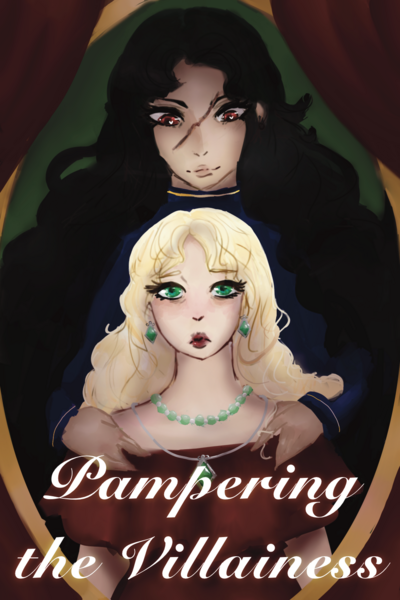
Lucia tucked the cloth she was wiping her hands on into her belt and came to greet her. Amalia was met with the sight of a muscular woman in a leather apron and tunic, the dark curls of her hair cropped short and shot with through grey. When she had been small, Amalia had found this woman fascinating. Where was her dress? Her jewelry? Her facepaint? She had not been pretty; Amalia had been unable to look away.
“Lady Mondlicht,” the woman said, crossing her arms. “What brings you here?”
“I need a dagger,” Amalia said. “One that is comfortable to hold and can easily be hidden in skirts.”
Lucia raised an eyebrow. “I swore off making weapons long ago,” she said.
“It is not for me,” Amalia said. “It is for a small woman who deserves a way to defend herself.”
A bit of understanding sparked in Lucia’s eyes; it occurred to Amalia then that by now the whole town must be aware of the new guest. She wondered what they might think of Euphemie.
“Fine,” said Lucia, “I will make a small dagger for a small lady. Come back for it tomorrow.”
That night, Amalia slept and dreamt of the webnovel’s comment section, of all things. Argument after argument: was Euphemie a bad person? Did she deserve her death? She had killed many in Margaret’s old timeline, and Lady Rosa at least in the new one! Other comments, too: cheers over Margaret’s victories, expressions of lust over Amalia’s brother Eberhard and all his scars from glory in war.
Amalia woke up in darkness, hands trembling.
When she returned to Feuerheim in the early hours of the morning, the town was quiet and the air cool. Dew trembled on tree-leaves. The sound of wind rustling branches was broken only by birdcall. Yet it would not be long before its people rose and filled the air with chatter. A different kind of peace.
Lucia’s dagger was simple and round, its blade coming to a needlepoint tip. A leather sheath had been made for it, which meant Lucia had sought out the leather worker. Amalia made sure to pay extra for the trouble.
“I hope she never needs it,” Lucia said, and went back to making horseshoes, pots, and pans.
“I hope so too,” said Amalia, and returned home.
When she reached her own front door, she found herself hesitating. Her feet remained planted on the front step, unable to push forward into the halls she knew well, the presence of Euphemie turning them strange. How would the other woman feel about her gift? Would she take offense?
One way to find out. Amalia had stormed castles. She could walk into her own home.
Euphemie she found in the library, pouring over a book. This in and of itself would not have been odd, had Amalia not known from her vision that Euphemie could not read. The text had no pictures, and appeared to be an antique book that had once belonged to Amalia’s mother.
Glancing up at Amalia’s entrance, Euphemie marked her place with a ribbon on the table and stood up from the armchair she had been curled up in.
“Lady Mondlicht,” Euphemie began, her voice a sweet cadence that Amalia was beginning to realize meant duplicity. “I wanted to apologize for my atrocious behavior yesterday, questioning your kindness the way I did. Of course you mean well-”
Amalia lifted a hand. “Please. Sit down.”
Euphemie did so immediately, and for a moment Amalia wondered if she had been too harsh in her voice. Or perhaps it was that Euphemie was performing obedience for her, to escape her wrath.
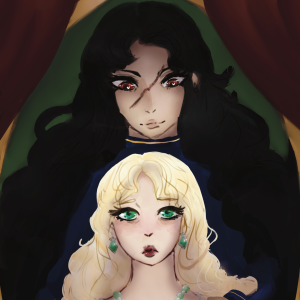
Euphemie sat in the armchair, its back framing her face like a throne. Amalia steeled herself, and knelt so that their gazes were closer.
“Will you give me your hand, please?”
Euphemie obliged, her face carefully blank. Amalia took the smaller hand in her own, then produced the dagger from her pocket. She pressed it into Euphemie’s soft hand, curling the delicate fingers around the dagger’s hilt. The weapon, which had seem a needle to Amalia, seemed much longer for Euphemie.
“This dagger is for you,” Amalia said, pulling away. “I want to make certain that you feel safe here. If ever you feel you are in danger, you may use it to defend yourself. Though I hope you would run and find me instead.”
Euphemie considered the dagger in her hand, testing its weight, her green eyes sharp and considering. She placed her free hand on its sheathe and slid the blade into the open air, where it glinted in the dim sunlight of morning wafting through the windows. The design was utilitarian, missing the inlaid jewels and silver tooling Amalia felt would look lovely in Euphemie’s hand. Yet, the sight of her holding such a dangerous tool did odd things to Amalia’s heart.
Euphemie turned the dagger this way and that. “You would give me such a gift? What if I were to turn it on one of your servants?”
Amalia blinked at her. “I don’t think you will.”
“And what if I turned it on myself?”
“You won’t,” Amalia said. This she knew for certain; Euphemie desired to live above all else.
Euphemie’s eyes darted to the blade and to Amalia, kneeling close. Her lips curled into a soft frown, she drew near, bringing the point of the dagger to Amalia’s throat.
“And if I turned it on you?”
The tip of the dagger was cool against Amalia’s skin, steady despite the tiny tremor visible in Euphemie’s free hand. The morning light caught her green eyes in such a way that they seemed to glow with a supernatural light. They were half lidded, focused and considered, framed by delicate curls.
“Then I must have done something to scare you, and deserve it,” Amalia said. Her voice came out strangely low. Was her heart racing? She felt strangely warm. Euphemie was too close; here, Amalia could make out the scent of lavender.
Seemingly satisfied, Euphemie pulled away. “Fine. Thank you, Lady Mondlicht, for your hospitality. Now please go. My book was fascinating and I would like to return to it.”
Amalia stood and obliged. There was always work to do in her office.
Hopefully now, Eupemie would be able to trust her.
When she returned to her study, a letter lay ominously on the desk, sealed with the imperial coat of arms. It was Leopold’s reply to her inquiries about Euphemie. Amalia cut it open with her letter opener and read the dreaded note.
My Dear Lioness, it began. I am afraid I cannot give you Euphemie’s contract, as I awarded it to the good Lady Margaret.







Comments (0)
See all