
An array of objects stood in the room, waiting to be of use. The only source of light was one from a circular glass window. A desk was placed right beneath it; the light illuminated sheets of paper that lay unkempt, scattered around.
The chair placement, however, was unusual; it had been pushed into the desk, balancing on its hind legs. A lone burnt-out candle stood right next to the bed.
The arrangement of the bed in the room was peculiar; it was placed to make the foot of the bed directly in front of the desk, with some space to withdraw the chair. Behind this positioning stood something that had been concealed.
I walked towards it and saw that it was a covered canvas.
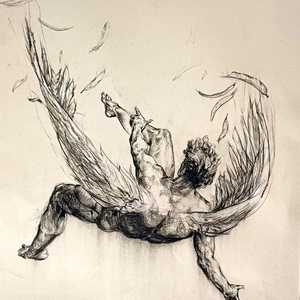
Beneath the cloth was a painting, incomplete and abstract. It resembled an animal with distinct wings and an unfinished body that was painted black; its forelimbs resembled a hand, and its hind limbs a bird's legs.
Then I reverted to the desk and observed that the under-drawer was stuffed with sheets of paper that had writing on them, but it was unintelligible. There lay a book within it, one with tattered edges. It was written as such.
"Thursday, Jan 1st, 1885.
Humans are monotonous. It was this thought that unfolded to me while I was watching the New Year's fireworks. Everyone else was laughing, enjoying the display. But to me, only one thing was on my mind. Humans are monotonous, dull, unexciting animals. They bear the same plastic smiles, the same forced laughter, and a lack of individuality. Shakespeare was right after all. This world is a stage.
Being an artist has its perks. One can reflect on and ridicule this canvas of a world and paint his ideas, his mind, onto his very own canvas. Everyone is given a blank canvas. It is the colours that we use, the shapes that we paint that dictate our way of life. Most spend their lives staring at it, indecisive. The rest spend it tracing others.
Oh! How fulfilling it feels to create something, even something as measly as an artwork.
Perhaps I do understand God after all.
Alas, God! Please throw something down for your creation to be entertained with, for what an uneventful life it is! If there is something called God in the first place.
An idea then came to my mind, and I worked on it; it was some sort of winged creature that my mind had made up. But it felt familiar.
I left it half-finished as my motivation had died. I felt empty looking at it. It didn't have any life to it. Another failed artwork.
Sunday, Jan 4th, 1885
It seems as if a faint light has shone into the darkness of my life. The night before yesterday had passed as usual. I endeavoured to sleep with the sound of rain pattering on my window, but it swept past me as an arrow to its mark. Something tugged me towards my empty canvas.
As I sat down before it and stared into it, its emptiness seemed to take form, and an array of colours splashed on it. But it was all in my psyche. Having nothing else better to do, I started painting.
But it didn't feel like I was painting. It felt as if… My instinct was being acted upon.
I then felt so exhausted after it to the point that I couldn't even bother to look at my creation.
This morning, I found myself asleep on my bed. I had slept through a whole day somehow.
I went on to check on my painting. It was not there. Had it been a dream? But then there was the paint on my fingers. Maybe it wasn't a dream after all.
Monday, Jan 5th, 1885
Something weird happened today as well. Old lady Margaret, from whom I rented the place, thanked me for helping her with her groceries the day before yesterday. But I thought I had been asleep that day?
Tuesday, Jan 6th, 1885
The bell rang today. I never did have anyone at the door.
It was the courier. "Harold, how are you, man?" He asked.
"Do I know you?" I replied back confused. I did not know that man at all, let alone for him to be on friendly terms with me.
He stood there puzzled for a second and said, "Uh… We met on Saturday when you had helped me get my wife to the doctor. I just wanted to tell you how grateful I am to you for that."
Again? I don't go out of my way to help people. Then who had helped them? And here I thought I was asleep that day. Something has happened to me. I no longer knew if I was writing my story. Or if the story were writing me.
He handed me a bouquet of roses and an envelope. "It was sent by the art museum," he said. The art museum? Why did they send me something? I thought they deplored me for not giving my painting the name 'Conscience'.
Closing the door on his face, I went back inside and opened it. It held a certificate of donation and a letter within. For what? And to me?
Nevertheless, I opened the envelope.
‘The Maplebrook Art Gallery.
Maplebrook, Hampshire.
Mr Harold Descartes
221B, Maplebrook, Hampshire.
Sire,
It is with the deepest gratitude that we acknowledge your most generous donation, "The Infernal Creation", which we housed at the gallery on January 3rd, 1885.
The gallery takes immense pride in housing such a distinguished piece, and in recognition of this donation, we have sent you a certificate of donation and, in gratitude, a bouquet of roses.
Once more, we extend our gratitude and ask you to call upon us as and when needed.
Sir Henry Cavendish,
Curator, The Maplebrook Art Gallery. ‘
I could not believe my eyes. I had donated my artwork to those damnable bastards at the Maplebrook Art Gallery. But wait… It couldn't be. That painting I made wasn't a dream after all. Then how did the painting get to the gallery?
What is happening to me? God, what have you done?"
That was all that had been written in the diary. Now there was a motive; Harold killed the curator because they had stolen his painting without his knowledge. At least that's what it seemed like.
Then I remembered the fact that I had found a book on his body.
When I opened it, I saw that the first few pages had been torn off.
The contents of it were as follows.
"He stood up from his work desk. For the first time in life, he had decided to take action.
He reached the gallery, but it had been closed. By now, he was burning with a great desire to obtain his art back.
But he knew another way in. How? It doesn't matter, does it?
Two voices argued in the hallway, one of which he knew so well, but he couldn't remember.
"You must sell the painting today, for we do not know when he will change his mind. You know how much his artworks are worth, right?" said the voice.
"But Sir Henry, the buyer said that he wouldn't be arriving until the day after." Sir Henry Cavendish was the curator, wasn't he?
"I don't care; sell it to someone else. We do not want him to know about this at all." The other person then walked away.
New feelings stirred up within Harold. An immense hatred was burning within him. His feet moved before he had a chance to understand why.
Instinctively, he jumped on Henry, and his fingers curled up around the curator's neck; all his effort was put into choking this man, but it didn't feel like him.
Then his hands pulled out a knife, and they stabbed Henry Cavendish, and it went on and on until the man's body went limp. Harold felt like his body had moved on its own, and his conscious mind was in a trance.
He couldn't believe what he had done; he had taken the life of another man. Now, how could he paint anymore?
Harold heard a gunshot, and he felt its impact.
Harold Descartes knew it was his death; he was shocked, but he had come to accept his fate. As he fell backwards, he saw shapes take form on the ceiling. The artistic mind, he thought, never fails to bring out the wildest imaginations in man.
The policeman had seen many terrible things in his life, but this, this was different. Who had expected such a renowned artist to have such an inhuman, bestial side?
The smell of gunpowder choked him. He then glanced at the worn-down statue of Sisyphus pushing the weight of the boulder. A carriage moved outside, and the hooves of its horses rattled against the road, and what only followed was silence.
It was the dreaded silence of an aftermath, but what had occurred slowly seeped into his imagination.
Life ended faster than it was made."





Comments (0)
See all