
The carriage was lined with black velvet, the kind that didn’t absorb light but swallowed thoughts whole.
The space carried a strange gravity, thick and deliberate, like the hush of a chapel where every step feels like trespass. But there were no saints here—only the elegant heirs of a blood-soaked empire, seated in their mourning like a crown they had not chosen, yet would wear until it crushed them.
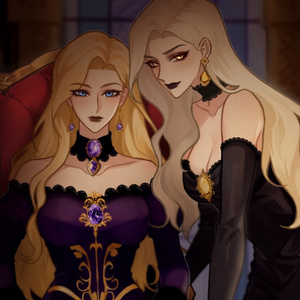
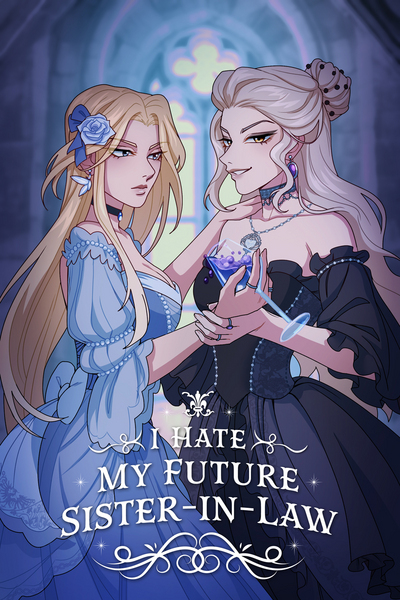
Princess Astreya Avenhart sat poised in her corner, spine perfectly straight, hands folded like silk over her lap. She was the picture of composed disdain, the kind of beauty that made silence feel like worship. Her skin was pale, almost luminous, kissed not by sun but by moonlight.
Her long platinum hair, smooth beyond reason, cascaded over her shoulders like a waterfall spilled from a glacier. Each strand shimmered faintly with an opalescent sheen, as if some forgotten deity had brushed starlight into it before abandoning her to this world.
Her features were knife-sharp and regal: high cheekbones, a sculpted jaw, full lips painted with the softest hint of red. And her eyes were pale like gold, but laced with frost, with a gaze so unreadable it could drive lesser souls mad. Her beauty held no warmth, only power—the kind that left you torn between falling to your knees or fleeing for your life.
Astreya didn’t enter a room, she eclipsed it, and wherever she stood, the world rearranged itself around her—shadows lengthened, breath caught—and even time seemed to pause, unsure whether to go on in her presence. Her beauty was not mortal, it was an affliction, a curse cast in elegance and power.
She had always known how to wield it to her advantage, just as she used it to shield herself from others by remaining unreadable. To look at her too long was to invite ruin, not because she tried to seduce, but because she didn’t. Her beauty didn’t ask to be loved, it demanded to be survived.
And across from her lounged her older brother, Caelis Avenhart, crown prince of the Eastern Flame. If Astreya was the moon—brilliant, shifting, impossible to hold—then Caelis was the eclipse that devoured everything.
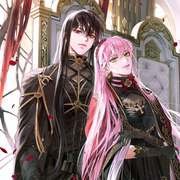
He was black-haired, red-eyed, and ruinously handsome. His hair was gleaming under the carriage lanterns, always falling perfectly without ever needing to be touched. It gave him the look of someone carved from midnight and blood, a figure both regal and dangerous.
His posture was relaxed, too relaxed, like a predator stretching its limbs before the kill. And those eyes, crimson and unnervingly quiet, burned with a calm that terrified. Caelis never raised his voice, he could flay someone alive with a whisper—peel back their dignity with a single, precise glance—and leave them shattered without ever laying a hand.
There was something wrong behind those eyes—something slow, methodical, and quietly thrilled by pain. She still remembered the day he’d dissected a bird before her, not out of cruelty he would admit to, but “to see how long it would still look alive.” That had been before he even turned twelve.
Beside her sat her younger brother, Malric Avenhart—fourteen, all sharp cheekbones and easy charm, with the same red eyes but a mouth perpetually tipped toward mischief. He adored his sister with a devotion that bordered on worship, trusting her as one might trust the sun to rise.
And in their family that had long since mastered the art of smiling through blood, he was the last shard of unbroken light—fragile, precious, and she feared, far too easy to shatter. Astreya always did everything in her power to shield him from the darkness that had claimed the rest of them.
Lastly, cloaked in shadow as though he had authored it sat their father, Emperor Darius Avenhart. No word truly fit him—tyrant, destroyer, monster—such labels slid from him like water off polished stone. He was not merely evil, he was the void where all traces of humanity had been stripped away.
Like his sons, he had black hair and red eyes, but the resemblance ended there. He didn’t speak often—because for him, a glance was enough to break a will, and a pause, to command armies. He could unmake a person without lifting a finger, and often did—not from fervor, but because cruelty was his craft.
And this man, this abyss draped in the ruins of a throne, was her creator. He hadn’t raised her as a daughter, but forged her into a weapon until she could bleed empires dry. And when he smiled—rarely, and never kindly—it was like gazing into a mirror he had carved from bone and consecrated in fire.
They spoke, as always, with that signature elegance laced in violence—of war, of bloodlines, of alliances carved in old grudges.
The silence had stretched too long, which meant Caelis was about to speak again.
“I wonder what she looks like,” he said almost casually. “The Virelys girl. The princess.”
His fingers tapped a slow, rhythmic pattern against his knee, as if measuring her pulse from afar. Astreya hated the way he said that, as if stripping people bare in his head was some private sport of his.
She had never gotten along with him, and enduring his presence was always an exercise in restraint, especially whenever she had to listen to him speak about women.
“She’s not a girl dear brother, she’s a political guarantee,” she answered flatly. “Try not to mistake the wrapping for the weapon.”
The last words left her mouth laced with undisguised poison, aimed to make him look ridiculous.
“You know how much I like weapons,” he muttered, smiling with cruelty. “Especially the elegant ones. They bleed with more grace.”
A thin smile traced Darius’s lips, as if the thought of conquering a woman were an accomplishment worthy of praise.
“She’s the second-born, kept hidden most of her life…” Caelis added, his voice like gravel rolled in wine. “Northern Court doctrine, they say: silence, stillness, and perfection.”
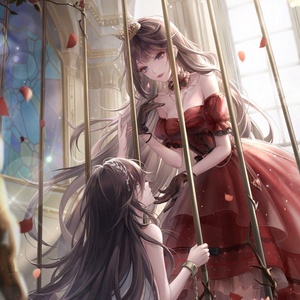
“Sounds like your dream wife,” Astreya answered sarcastically. “Mute, delicate, and bred in a cage.”
Caelis didn’t blink, if anything, the hunger behind his crimson gaze sharpened. He turned his head slowly, deliberately, until his eyes locked with hers.
“On the contrary. I hope she has teeth,” he replied. “It’s so much more satisfying when they resist.”
A silence descended, violent in its weight.
Malric blinked once, twice. He looked young, suddenly, too young to be sitting at a table where women were spoken of like prey.
“Careful, brother. You sound almost excited.” Astreya replied, fighting the urge to roll her eyes inside her skull.
She was, unfortunately, well accustomed to the violence in his words whenever he sought to assert his dominance in advance.
It was, in fact, the very reason they were always at each other’s throats—over a yes, a no, or no reason at all. And one of her favorite pastimes was contradicting him and making him look foolish, especially during gatherings.
“I am. I’ve waited long enough to claim something that matters.”
The word claim hung in the air like the echo of a door being locked from the outside.
Astreya’s fingers curled slightly on her lap. The movement was imperceptible to anyone but herself, but it came with a quiet ache just beneath the skin. She exhaled slowly through her nose, her mind already analyzing the silence between Caelis’s words.
Once again—as always—it would fall to her to see through it all. She would have to read the intention behind every sentence, weigh every possibility, and measure the hunger in her brother’s voice against the pride in her father’s.
She’d have to trace the outlines of a plan not yet spoken—then build a counter-plan in secret, layer upon layer. She would have to stay two moves ahead, or maybe three, and make herself indispensable enough that they’d never think to gut her first.
She tilted her head, her gaze drifting toward the trees beyond the window. The forest, thick and dark, bowed gently in the wind like it was keeping secrets. She let her mind wander there, past the ceremony, past the alliance, past the bloodied history of their kingdoms.
From what Astreya had heard, the tyranny of House Virelys came wrapped in ritual and ceremony. There were no open threats, no shouting tyrants, only power that smiled while it crushed you. It was a quieter kind of violence, one that rewarded grace, but never allowed softness.
A doctrine built on control so precise you no longer remembered what freedom truly tasted like. That was the Northern Court way—teach you how to dance in your chains, until you thanked them for the music.
Malric broke the tension with a sigh, long, theatrical, and entirely unnecessary. The kind of sigh that begged for attention.
“In my opinion dear sister, you’d make a beautiful tyrant.” he said, chin propped lazily in his hand, his eyes glittering with mischief.
Astreya turned to him with the deliberate grace of someone playfully considering fratricide.
“How sweet little brother. Remind me to poison your tea a little less next time.”
Malric lit up, as if she’d just said I love you little brother in a particularly violent dialect.
“That’s how I know you care. Slow death, mild nausea… like you’re saying ‘don’t die, but do suffer a little.’”
Astreya couldn’t suppress the upward twitch of her mouth, he was the only being on earth capable of stirring tenderness in her.
“Idiot.”
That single note of warmth was enough to make Caelis roll his eyes in exaggerated disdain, as though the mere sound of it offended his sense of decorum.
“It’s almost touching, the way you’re always so quick to spare him. I could nearly weep from the devotion.”
Malric ignored Caelis’s remark, unbothered, he was long accustomed to his brother’s endless attempts at sabotage. His temperament was far too incompatible with his—or their father’s, yet that never stopped him from opposing them whenever he had the chance.
“I’m happy you’re not the one sold to this stupid alliance.” Malric added, his grin dimming slightly at the edges.
There was something that cut beneath the performance, a real flicker of relief.
“Looks like the Empire couldn’t afford the damage I’d cause.” Astreya drawled, her smile sharp enough to cut.
For a moment, it was just the two of them—the only two left who remembered what it was to laugh without watching their backs. Malric wasn’t wrong, Astreya had been built for this. She was the flawless sister, the unburnable heir, the serpent wrapped in lace—taught to smile with fangs tucked neatly behind her teeth. She had worn that role so long, it fit like a second skin.
But something was shifting, very subtly, in the way Caelis watched the world now—not like a predator waiting, but like a sovereign choosing his stage. He was no longer content to whisper in shadows, to orchestrate chaos and ruin from behind veils of ritual and charm.
He wanted daylight now, obedience that knelt in public, and a crown. If he married Katarina Virelys—this girl offered in the name of peace, of union, of elegant surrender—and she turned out to be more than just a docile lamb, everything would shift.
Caelis didn’t want to sit beside their father, that was the lie they told at court—in front of priests, or at bloodless banquets. If he found a crown that glittered brighter than Darius’s, he would try to melt the Houses down and forge his own empire from its remains.
I can hardly wait to watch him draft yet another blueprint for his glorious domination.
And then, of course—I’ll have to redraw the whole thing, a brand-new plan just to unravel his attempts. Truly marvelous.
That’s the glory of being an Avenhart heir: eternal improvisation, just with prettier dresses and deadlier spells.
Because in every one of his scenarios, I will be the first to burn.
The last thought struck unbidden, cold and sharp between Astreya’s ribs. Caelis had always longed to tame or erase her, craving to be the only one who mattered, and she had forever been the thorn lodged in his side. The truth was he had never known what to do with strong women except try to own them, or break them—perhaps both.
He had spent their entire childhood trying to dominate her, reduce her, and make her feel smaller but he never succeeded. And the maddening impossibility of owning her wasn’t just a frustration—it was an obsession, a wound to his pride he could never cauterize.
Astreya’s gaze shifted back to Darius, he hadn’t spoken in minutes, but his silences were never idle. When he went quiet, it meant he was scheming futures only he could envision—futures built from bloodlines and legacies, and the perfectly positioned corpses that made them possible.
What is his game this time? Does he truly want Caelis to rise—to marry, to rule, to crush the Northern Court beneath his heel?
Or is it only another careful stroke in his endless design, another brick in the eternal empire of obedience and cruelty he craves to build? Or worse—perhaps he doesn’t care at all which of us survives, so long as the spectacle of his power continues.
If one of us falls—if I am destroyed by my brother’s schemes—I guess Father won’t mourn. He’ll try to replace me without hesitation, as easily as discarding a shattered porcelain vase: once admired, now useless.
No, never—not even in their wildest dreams. If this marriage is a move on their board, then I will become the piece they cannot contain.
Astreya hadn’t survived this long by obeying, she had survived by becoming indispensable, terrifying, impossible to cage. A force too powerful to silence, and too vital to discard.
She had sworn never to be erased, neither by them, nor by anyone.






Comments (31)
See all