
“O’ hazy eye of the blue moon above,” sang the young bard who sat on a rickety wooden stool by the tavern’s lone hearth fire, “bestow me the fortune of lovers and go~~old…”
Usually, bards wielded all manner of sorcerous illusions to accompany their songs. From conjured fog to colorful lights and even dancing spirits, the master bards of the Atlan Imperium turned every tune into a magical performance—but not him. Not this youthful, purple-haired bard who dared to entertain a gathering of the most dour-looking patrons he had ever encountered with only his voice and lute to woo them.
“And should your red twin fill the night with death and cold,” he sang, strumming his lute with a skill that belied his young years, “keep these troubles far from my weary so~~oul…”
As the bard finished his ballad—one that told the tale of the sisters who straddled Aarde’s night sky—he heard no applause. He didn’t feel disheartened, though, for the silence permeating the old tavern was telling enough that he’d captivated his audience.
Earlier, before he began his tune, many of the tavern’s patrons—these hardened-looking city folk who’d fallen on tough times—were up in arms against the appointment of their new governor, who, in the two weeks since he’d taken up office, had already caused friction between the northern and central regions of a kingdom that was already on the verge of civil unrest, thanks to a decade’s worth of decline and misfortune. No one cared how he’d managed that in so short a time, only that the new governor was, as they all claimed, unworthy.
“Incompetent!” they’d complained.
“Coward!” they’d railed.
“Magicless!” they’d condemned.
They’d huffed and puffed—spewing treasonous ideas into the ether—until the bard, quietly observing the crowd from a shadowy corner, stepped into the limelight to change the mood within the tavern. For personal reasons, he fancied himself a loyalist, but he didn’t want to scold the rabble rousers because he could see things from their point of view, too. So, instead, the bard serenaded them, trusting in the words of a wise man who once claimed ‘Tis music that soothes even the most savage beast.
Now, finished with his song, the bard rose from his seat. Before he could leave the spotlight, a copper coin flew toward him, carried through the air by a glowing magical hand. The hand deposited the coin into the bard’s mug on the dirty floor, then vanished in a puff of colorful smoke.
To use an advanced spell like the Sorcerer’s Hand in such a common way. The bard’s gaze snapped toward a plump, wiry-haired woman seated at a nearby table whose eyes glittered with the telltale signs of sorcery at work. Oh, how I envy your talent.
She sent him a flying kiss, which he promptly caught with his hand so that he might place it on his lips.
“Much obliged, love,” he said in his best commoner’s drawl.
Two more coins followed, a fourth, and a fifth—enough imperial griffins to buy him a pint of ale.
The bard smiled.
He possessed such a charming smile that the womenfolk in the crowded tavern couldn’t help but swoon, their cheeks flaring crimson as he trained his smile on them. Indeed, even some menfolk blushed at witnessing such a handsome bard glancing their way.
Yes, let me charm you some more.
He encouraged their admiration because it meant more coins fell into his mug, and he enjoyed seeing them prove his point.
I can’t wield sorcery like you all, but I don’t need it to make you love me for a little while.
He did his best not to look smug, though. Being on the other end of ridicule his whole life made him sensitive to smugness.
“Sing us another song,” one patron yelled.
“A lively one this time!” a second patron chimed in.
“Sing about our ill-fated prince!” a third patron added.
Many heads nodded at this last suggestion, though the bard wasn’t one of them. He’d sung for them so they might forget about the prince, yet here they were asking him to join them in their treason. His disappointment was swift to vanish, though, replaced by his charming smile.
“Once more for the people, yeah?”
His next tune was a lively one he’d learned recently from a fellow bard he’d met in the city’s midtown district, who claimed she created the song in honor of the Forest Kingdom of Lotharin’s new governor.
“I hear we’ve earned an ill-fated prince…that sounds horrible,” the bard began in jest, and his audience laughed in response. “Though I think Lotharin’ll endure, it’ll be no thanks to him…”
Their merriment grew as he continued to mock Lotharin’s new governor in verse, and though he encouraged them to sing along, in his heart, he grew weary…It wasn’t easy for him to make fun of someone he knew intimately.
“My friends,” he rose from his seat, “you’ve been a delightful audience!”
He began tapping his foot against the floor.
“I hope you continue to be generous with your tips!”
His strumming resumed, wilder, more manic than before.
“Now, come and sing this chorus with me!”
“Quit!” they cried together. “Quit, Ill-Fated Prince, quit!”
Yes, it was a new tune, yet strangely, everyone knew its words.
“Quit, quit, quit, quit, quit…” they chanted.
“Or we’ll throw you out,” the bard strummed the last key, his voice lowering to a whisper, “and leave you lying in filth, you magicless fool…”
This time, his audience cheered.
They stomped their feet on the ground, smashed their fists against wooden tables, and clinked their mugs together, oblivious to the fact that they were celebrating with words that could’ve gotten them hanged if the prince himself had overheard them. This was assuming, of course, that the prince was as villainous as they all seemed to think.
‘Ping!’
Something shimmered in the air, though only the bard could see it.
[CONGRATULATIONS! Your singing has won you the admiration of the entire tavern, earning you the title [Apprentice Bard]! This title gives you the [Charisma] attribute.]
This would be a useful boon if only you meant to give it to me…
[ALERT! Your body is unsuited to receiving the system’s boons. Canceling the activation of [Charisma].]
Hah…
[ALERT! You lack the magic to use the system to your benefit. Progressing in your job-exclusive quests may help to remove this penalty.]
Once again, you taunt me with promises of power but show me no path forward in seizing it.
These ghostly blue windows appeared every time the bard achieved something of note, although they were constantly negative and always denied him the boons he rightly deserved.
When he was much younger, he’d mistaken these otherworldly messages for a rare form of sorcery, and though he’d tried to show them to others, no one else could see them. That didn’t stop him from insisting the messages were real and everyone had bullied him about it. His teachers scolded him for his wild imaginings while his peers called him a liar, a fraud, and other hurtful insults children might hurl at each other. All because he was different—the only magicless boy in the empire who saw things no one else could.
For the bard, this strange power that was his alone only reminded him of his ill fate, but he wouldn’t allow it to ruin his mood. Not this time.
With a deep breath meant to expel his frustrations, the bard picked up his mug full of griffins. He raised it high and thanked his audience, and they cheered for him.
Here’s why I prefer coming to Lowtown instead of spending my day in that stuffy bastion. The people here might be shameless, but at least their smiles are genuine.
The sound of coins clinking inside his raggedy purse helped to shoo away some of his ill feelings.
“There’s enough here to get me drunk,” he murmured. “And one last day of playing the fool…”
The bard left his post by the hearth and made his way toward a corner of the tavern. However, before reaching his destination, he felt a hand groping the back of his trousers.
“Here we go again.”
Reforming his charming smile, he turned around but found no randy, middle-aged seamstress ogling him. This ‘Grabby Hands’ was a man, an unsavory-looking fellow with a greasy face. He wore a stained padded jacket that the bard recognized instantly because this teal-colored gambeson was the new uniform of the city guard who manned the city of Bastille’s parapets and gates.
“Where are you heading off to, pretty lad?” he asked in a slurring speech. “Want some company?”
The guard’s cheeks were red from drinking, his eyes dazed and wandering.
Seeing this evidence of intoxication, the bard’s smile faltered. “Sorry, bruv, but I’m not interested.”
Too drunk to listen, the guard came forward and flashed him a grin of yellowing teeth.
“Nights in Bastille can get cold without someone to snuggle with,” he said.
That’s when the bard’s smile vanished, replaced by an exasperated sigh.
It wasn’t the man’s lewdness that annoyed him because he was used to such propositions. Over the years, he’d enchanted many of the high nobles in the Sovereign’s court with his looks, which the Sovereign’s courtiers claimed were his only redeeming quality. In exchange for lewd favors, they offered him things that were enticing for a boy without genuine power or influence. He declined them all, the men and women both.
No, the bard’s hackles rose not because the guard was a vulgar bastard but because he was disloyal to his liege. Surely, he’d done nothing while the tavern patrons sang their rebellious tune. He’d probably sung with them, and loudly too.
You wear the prince’s colors, take your wages from the prince’s coffers, but show no loyalty to your liege…Not that I want people to get arrested, but still…
“Come on,” the guard’s hand reached for the bard, “let’s get better—”
He halted, his eyes widening in confusion…for the bard was gone. He’d vanished from sight, transformed into one who lacked the delicateness he’d shown earlier.
“What sort of sorcery—”
“There’s no sorcery here,” interrupted a man whose voice had lost its gentleness, “but one of simple misdirection.”
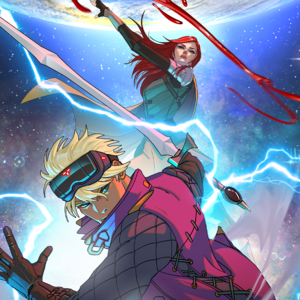
The purple-haired man who shrugged off his bard’s disguise stopped slouching like he’d been doing since stepping into the tavern. He stood to his full height, his shoulders widening, causing muscles hidden underneath loose-fitting clothes to expand. He revealed himself as a tall, muscular youth who towered over the guard.
“Meaning no offense, bruv, but I don’t swing that way, yeah.” The young man placed a hand on the guard’s shoulder and squeezed. “But if you’re so insistent on snuggling, I know one or two moves that’ll take your breath away.”
“G-Gah!”
Despite the thickness of his gambeson’s padding, the guard felt growing pressure from the young man’s fingers tightening around his shoulder. Such monstrous strength sobered him quickly.
“I-I’m a guardsman,” he complained, but, still feeling the pressure, he rallied, “and I’ve got the ear of the C-Captain of the Watch!”
One of the young man’s eyebrows hitched upward. “Captain of the Watch…?”
“Y-Yeah, that’s right…And the captain, well, he don’t like it when lowly commoners mess with his mates.” With each word, the guard’s confidence grew. It seemed he was used to name-dropping his captain’s name for situations like now. “S-So, you better stop—”
His voice faltered, along with his courage.
“You talk as if you aren’t one of us, bruv.”
Eyes the color of molten gold gazed imperiously back at the guard, and for a moment, it felt like he was in the presence of a noble.
“But you stink of Lowtown, same as me…”
This was a lie.
The young man enjoyed luxurious baths far too much to smell like the tavern’s patrons.
“Now, I value those who protect our fair city.” He slipped several of his hard-earned griffins into the guard’s pocket. “So, how about I pay for your meal, and we don’t cause a scene, yeah?”
Just in case the guard was too thick-headed to realize he’d been given an out, the young man pressed down on his shoulder, forcing the guard’s legs to buckle so that he fell back into his seat with a harsh thud.
Eyes around the table snapped toward the tall figure, and he, noticing they were all guards too, slapped several more griffins onto their table.
“Next round’s on me, gents.”
The young man placed enough coins on their table for them to send him off with cheers, and, while Grabby Hands looked on in confusion, he slipped away before anything else could happen. He hastened through the crowd, dodging more unwelcome advances, and finally claimed his seat beside a table in a corner of the tavern that was half-veiled in shadow. It was the perfect place for business he didn’t want anyone else to hear, the kind that meant trouble—the beginning of a grand adventure.



Comments (9)
See all